
Coming Out as Non Monogamous


So you are thinking about coming out as non monogamous. You are in good company. The term non monogamous covers a family of relationship styles that reject the old one partner model in favor of honest, consent based connections with more than one person. In this guide we will walk through what ENM stands for and how to approach coming out with clarity, compassion and a sense of humor. ENM stands for Ethical Non Monogamy. We will use ENM as a shorthand but we will also spell things out so everyone can follow along. This guide is practical and grounded in real life scenarios. It is designed to help you communicate your truth while protecting your relationships and your own wellbeing.
Quick Links to Useful Sections
- What ENM means and why it matters
- Am I ready to come out as non monogamous
- Preparing yourself before you come out
- Clarify your own truth
- Choose your audience and the order of disclosure
- Decide how you will describe ENM
- Prepare for different reactions
- Practical safety and privacy choices
- Conversation templates and realistic scripts
- Script for an in person talk with a primary partner after you have reflected
- Script for telling a close friend or family member who knows you well
- Script for a text or message when you feel unsure about a face to face conversation
- Script for later conversations with family members who are curious or worried
- Group or social circle disclosure
- How to handle different reactions
- When someone is supportive
- When someone is skeptical
- When someone is anxious or afraid
- When someone reacts with anger
- When someone reacts with judgment
- Boundaries and agreements in ENM
- Jealousy and emotional management
- Practical tips for disclosure in different life contexts
- Kids and ENM
- Myths about ENM and the reality
- Practical resources and ongoing learning
- Real life scenarios you might relate to
- Checklist for your upcoming disclosure
- Glossary of terms and acronyms
- Frequently asked questions
What ENM means and why it matters
ENM is an umbrella term that describes relationships built on honesty consent and ongoing negotiation. It is not a single recipe but a toolkit. People who practice ethical non monogamy might describe themselves as polyamorous open to multiple partners or in other cases as ethically non monogamous. The key idea is that all parties involved are informed and comfortable with the arrangement. ENM is not about random sexual adventures it is about intentional relationships with clear boundaries and mutual respect.
Let us break down some common terms you may encounter.
- Ethical Non Monogamy ENM a framework where consent communication and respect guide multiple relationship connections.
- Polyamory often means having more than one romantic relationship at the same time with the knowledge and consent of everyone involved.
- Open relationship a relationship in which partners agree that dating or sexual encounters with others are allowed outside the primary couple.
- Swinging typically refers to couples who swap partners for sexual experiences in social settings rather than forming ongoing emotional bonds.
- Monogamy the traditional relationship model with a commitment to one romantic and sexual partner at a time.
- Ethics in ENM refers to the set of boundaries respect consent and honesty that guide your decisions.
Why talk about ENM openly because honesty reduces harm. When people know what is going on they can decide how they feel and what they want to do next. It reduces surprise hurt miscommunication and it helps you stay aligned with your values. If you practice ENM ethically you will often find you have more room to explore grow and build trust with the people who matter most.
Am I ready to come out as non monogamous
Coming out is a personal decision. There is no universal timetable. Some people need to tell their partner before bringing opportunities for new connections into the relationship. Others want to come out to friends and family only after they have established a workable set of boundaries and agreements. Here are signs you might be ready to come out.
- You have clarity about your own boundaries and you can articulate them clearly.
- You can describe the kinds of relationships you want and the kinds you do not want.
- You have a trusted partner or partners who know your plan and are on board to support you.
- You feel safe enough to disclose without fearing immediate rejection or harm.
- You are prepared to listen and respond to others with empathy even if they disagree with your choices.
If you do not feel all these things yet that is okay. ENM is a journey not a one time announcement. You can take small steps test the waters and adjust as you go. The goal is to reduce harm and increase informed consent for everyone involved.
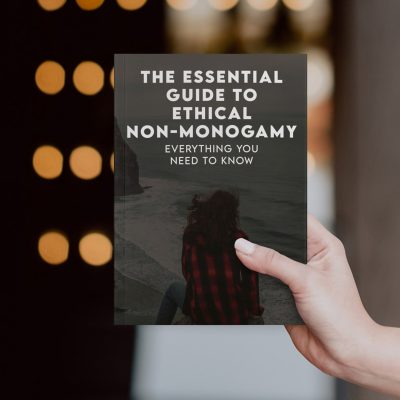
The freedom of an open relationship sounds incredible, but the logistics can feel like holding a grenade. That spinning "what if" anxiety isn't paranoia, it’s your survival instinct warning you that your bond is exposed. "Just seeing what happens" is the fastest way to turn a fantasy into a breakup.
The Essential Guide replaces chaos with discipline. We give you the blueprints, jealousy protocols, and repair scripts needed to explore the edge without falling off. Don't guess. Secure your foundation first.
The world of non-monogamy is a maze of confusing labels. Trying to be "Polyamorous" when your heart actually needs "Swinging" isn't just a vocabulary error; it’s a recipe for misery.
You can't build a stable home on a foundation that doesn't fit your psychology. This tool analyzes your emotional bandwidth and jealousy triggers to design the exact structure you need. Stop trying to squeeze into a box that doesn't fit. Build a relationship that actually feels like home.
Opening up feels exciting, but if you aren't reading from the same script, you're writing a tragedy. The disconnect between "I want freedom" and "I want safety" is where hearts break. This isn't just a quiz; it’s a synchronization engine.
We identify the silent gaps in your desires—from sleepover rules to emotional bandwidth, before they become unbridgeable chasms. Don't wait until the damage is done to find out you were never on the same page. Align your compasses now.
Theory is sexy. Reality is messy. You agreed you could date others, but how does your stomach drop when he takes her to your anniversary spot? Or when she comes home smelling like someone else?
This simulator drags your abstract rules into the harsh light of day. We force you to confront the visceral, gut-wrenching scenarios that actually destroy relationships, before they happen. Test your nervous system in the simulator so you don't crash the car in real life.
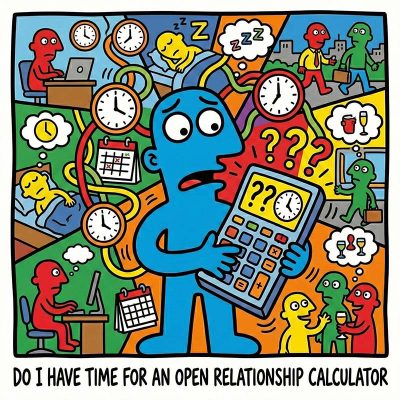
The fantasy is endless romance. The reality? It’s a logistical nightmare. Dating isn't just sex; it’s a second job of swiping, spending, and emotional processing that drains your sanity. Underestimating the "admin" of non-monogamy is the fastest way to turn your relationship into a burnout factory where resentment thrives.
This calculator forces you to confront the brutal math of your time, energy, and wallet. Can you actually afford this lifestyle, or are you just signing up for exhaustion?
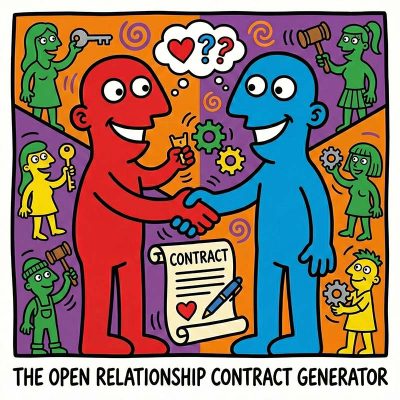
"I thought we agreed" is the sentence that destroys relationships & marriages. Relying on verbal promises when emotions run high is a gamble you cannot afford to lose. Your memory isn't just faulty; it's a liability. Ambiguity is the oxygen that jealousy breathes, turning "freedom" into a minefield of "did I mess up?"
This generator transforms vague permissions into a concrete, signed reality. Stop arguing about what you thought was said and lean on what is written. Secure your boundaries in ink, not hope.
Preparing yourself before you come out
Preparation makes the difference between a panic driven conversation and a calm constructive dialogue. Here are practical steps you can take.
Clarify your own truth
Take time to write down your own boundaries values and what you hope to achieve through ENM. This is your backbone. It will help you answer questions from others and keep you steady under pressure.
Choose your audience and the order of disclosure
Not everyone needs to know everything at once. Start with a person who you trust who you think will respond with curiosity and care. From there you can gradually tell others as you feel ready. It is common to begin with a primary partner before approaching friends or family members who might react with surprise.
Decide how you will describe ENM
You can describe ENM in a few different ways. Some people prefer simple direct language for example ENM means I am open to dating or being intimate with more than one person as long as everyone involved knows about it and consents. Others prefer a more formal or ethical explanation that emphasizes boundaries communication and consent. Practice a few concise lines that feel true to you.
Prepare for different reactions
People react in different ways and that is not a reflection on your worth. Some will be supportive some will be curious some will need time and some may react with fear or discomfort. Plan for these reactions and commit to staying patient. You do not have to defend yourself you simply share your truth listen to concerns and propose next steps.
Practical safety and privacy choices
Decide what you want to share publicly and what you want to keep private. For example you may choose to disclose ENM with coworkers only if it is relevant to your work life or if your workplace policies require disclosure. Protecting your personal safety and your mental health is important.
Conversation templates and realistic scripts
Below you will find several ready to use scripts. Adapt them to your voice and your actual situation. You can use these as a starting point for in person talks text messages or even voice or video chats.
Script for an in person talk with a primary partner after you have reflected
Hey I have been thinking a lot about us and about how our relationship works. I want to share something important with you. I want to be honest about how I feel and about what I am looking for. I realize this may come as a surprise and I want you to know I am committed to us. ENM means ethical non monogamy. That is a way of having multiple relationships with everyone knowing about it and consenting. I do not want to pressure you to agree with this. I want to know how you feel and I want us to decide together what works for us. What are your initial thoughts?
Script for telling a close friend or family member who knows you well
Hi I wanted to tell you something important about my relationship life. I am exploring non monogamy in an ethical way. This means I want to be honest with myself and with others about dating or having connections outside of my primary relationship. I am not asking you to judge me I am asking for your support and curiosity as I figure this out. I value our relationship a lot and I want to keep it strong as I navigate this. If you have questions I am happy to answer them we can figure this out together.
Script for a text or message when you feel unsure about a face to face conversation
Hey I am thinking about sharing something important with you. I want to be honest about my relationship life and how I see things. I practice ENM which means ethical non monogamy. I would love to talk more when you are ready and I can answer any questions you have. No pressure I just wanted to be upfront.
Script for later conversations with family members who are curious or worried
Thank you for listening. I know this is new for you and it may take time to adjust. The core of ENM for me is care respect and honesty. I am not seeking to hurt anyone I want to be transparent and to navigate this in a thoughtful way. If you have concerns I want to hear them and we can talk about what boundaries or protections would help you feel comfortable.
Group or social circle disclosure
In a group setting you can start with a short clear line and then invite questions. For example ENM means I am in relationships with more than one person with everyone’s consent. I am sharing this because I value the people in this circle and I want to be honest about my life. If you have questions I am happy to discuss them one on one later.
How to handle different reactions
Positive reactions can feel validating and give you confidence. Negative reactions can feel triggering. Here are ways to respond to various responses while staying true to your boundaries.
When someone is supportive
Thank them and invite them to learn more if they are curious. You can share resources for ENM such as articles or podcasts. Keep the conversation moving forward without pressuring them to agree with you.
When someone is skeptical
Ask questions and listen. You can share your reasons without making them wrong for their perspective. Explain that ENM is built on consent honesty and care not on risk taking or impersonal connections.
When someone is anxious or afraid
Validate their feelings. Reassure them that this is a personal journey and that your care for them remains the same. Offer to answer questions or revisit the topic later.
When someone reacts with anger
Stay calm. Use short clear statements and refuse to get drawn into a fight. You can acknowledge their feelings and set a boundary such as I am open to talking when we both feel calmer.
When someone reacts with judgment
Refocus on your values and boundaries. You can say I hear your concerns and I respect your view. If you need time to think about it I understand. I would invite you to meet again after you have considered it.
Boundaries and agreements in ENM
Boundaries are the core of ENM. They are not rules to control others but agreements to protect wellbeing and consent. Boundaries should be revisited as life changes.
- What kinds of connections are allowed with whom
- What information will be shared with which people
- What immunity or risk management measures exist such as practicing safe sex
- How time with each partner is balanced with family life work and self care
- What happens if a partner develops a new connection and how to navigate jealousy
Healthy ENM agreements are collaborative. They require ongoing check ins and a willingness to adjust as feelings and situations shift.
Jealousy and emotional management
Jealousy is a natural human emotion. It does not mean you are failing. The key is to recognize it acknowledge it and address it. Practical steps include talking about what triggers jealousy what needs are not being met and what changes could reduce discomfort. You can also practice jealousy management by pacing your connections and making space for your primary relationship preferences.
Practical tips for disclosure in different life contexts
Work life and professional contexts require careful thinking. You may not want to disclose ENM to colleagues or supervisors especially if it could affect your career or workplace dynamics. In many cases it is best to keep such information private unless it impacts your job performance or safety. When you do disclose consider how much detail is appropriate and what boundaries you want to maintain.
When you are dating someone new you might choose to disclose ENM early in the conversation. For some this is essential to avoid leading someone into a situation they do not want. For others it is better to develop trust first before discussing the topic.
In social circles you can control the pace by choosing how transparent you want to be. Some people will appreciate your honesty while others prefer to stay private about their own relationship life. You always have the right to set the boundary to not discuss certain aspects in certain contexts.
Kids and ENM
Talking with children about non monogamy should be age appropriate. Keep explanations simple and reassure children that you love them and that adult relationships will not change the basic stability they rely on. If a child overhears a conversation with questions you can answer honestly at their level and with kindness.
Myths about ENM and the reality
There are many myths that surround ethical non monogamy. Here we debunk a few common ones so you can approach the topic with clarity.
- Myth ENM means you cannot commit to one person. Reality ENM is about consent and honest communication which can support strong commitments to multiple people or to one person.
- Myth ENM is a way to avoid commitment. Reality ENM emphasizes transparency and intentional choices. It is about mature relationships not avoidance.
- Myth ENM is always about sex. Reality ENM can include romantic connections and emotional bonds in addition to or instead of sexual relationships.
- Myth ENM means you will inevitably hurt your partner. Reality ENM is designed to minimize harm through consent and careful negotiation though there can be bumps and learnings along the way.
- Myth ENM is only for young people. Reality ENM can work at any age as long as all parties are on board and boundaries are respected.
Practical resources and ongoing learning
Like any relationship practice ENM evolves with experience. There are books podcasts and communities that offer guidance. Look for resources that emphasize consent communication and self reflection. A few starting ideas include listening to personal essays from people who practice ENM reading about consent frameworks and joining discussion groups with supportive members. Remember that you do not have to figure this out alone. Reach out to trusted partners friends or support groups if you feel overwhelmed.
Real life scenarios you might relate to
Scenario one a long time couple discusses adding a new partner. The couple has clear agreements around dating and intimate boundaries. They commit to weekly check ins and live in a city with a busy social scene. They talk about jealousy patterns that can emerge and how they will handle them. They also talk about what information is shared with family or friends. Over time their communication improves and they learn to adjust boundaries to fit their evolving needs.
Scenario two a person who has recently discovered ENM wants to come out to a close friend. The friend is supportive but is curious about how this impacts the friendship. They set a plan for ongoing honest dialogue and the person explains the care at the heart of ENM. The friend appreciates the transparency and feels ready to continue supporting them while keeping their own life balanced.
Scenario three a builder of a polyamorous network navigates workplace dynamics. They are careful to separate personal life from professional life and do not disclose ENM at work unless necessary for safety or honesty. When conversations arise they are thoughtful and choose to set boundaries that protect both their job and their personal life.
Scenario four a family with multiple generations discusses coming out. They approach the conversation with patience and respect acknowledging that grandparents may need time to understand. They answer questions with care and reiterate that love and safety are the guiding values.
Checklist for your upcoming disclosure
- Clarify your boundaries and prepare a concise explanation of ENM.
- Choose the first person who should hear your disclosure.
- Practice a few versions of your talk so you can adapt.
- Decide what details you want to share and what you want to keep private.
- Plan for questions and how you will respond with empathy.
- Arrange a follow up conversation if needed and set a time to revisit the topic.
- Ensure you have a support system ready if things get tough.
Glossary of terms and acronyms
- ENM Ethical Non Monogamy a framework of relationship ethics where multiple intimate connections exist with consent awareness and respect.
- Polyamory or polyamorous describes having more than one romantic relationship at the same time with the knowledge and consent of everyone involved.
- Open relationship a relationship in which partners allow dating or connections with others outside the primary partnership.
- Swinging a form of non monogamy focused on sexual experiences with others often in social settings.
- Consent clear informed agreement to participate in a certain activity or relationship arrangement.
- Boundaries agreed limits that protect participants emotional and physical safety.
- NRE New Relationship Energy the excitement that comes with a new connection that can influence behavior.
- Jealousy a normal feeling that may arise when a partner connects with someone else. It can be managed with communication and boundaries.
- Ethics the standards of conduct that guide fair open and respectful behavior.
- Primary partner the person or people who hold the central place in a relationship or life.
- Secondary partner a partner who is not the primary focus but who has a meaningful relationship.
- Disclosure sharing information about one life or relationship with others in a direct and transparent way.
- Mutual consent every involved person agrees to the arrangement.
Frequently asked questions
What does ENM stand for?
ENM stands for Ethical Non Monogamy. It describes relationship models built on honesty consent and mutual respect where more than one intimate connection can exist with the agreement of everyone involved.
Is ENM the same as polyamory?
ENM is a broad umbrella term. Polyamory is a specific form of ENM where multiple romantic relationships are pursued and maintained with consent.
Do I have to sleep with people to practice ENM?
No sleeping with others is not a requirement. ENM can include romantic emotional connections and sexual connections but it is defined by consent and transparency rather than one specific activity.
How do I know if my partner is okay with ENM?
The only sure way is through an open conversation. You can share your needs and ask for their perspective. You look for ongoing consent and willingness to negotiate.
What should I share with family and friends?
You should only share what you feel comfortable sharing. Start with the basics and you can reveal more as your network grows more confident about ENM and as boundaries are established.
How can I handle jealousy in ENM?
Jealousy is a natural signal. Naming the feeling and talking about the underlying needs helps a lot. It is not a failure it is a sign to adjust boundaries or share more information.
Should I disclose ENM at work
It depends on your workplace culture and policies. If it does not affect your work there is no obligation to disclose. If it affects safety or your ability to do your job you may choose to share in a controlled way with a trusted manager or HR.
What if someone reacts badly
Give them space and time to process. Respond with empathy and set boundaries on what you will discuss. You can revisit the topic later when emotions have cooled.
What about kids
Talk with honesty at age appropriate levels. Reassure children that you love them and that their security and care remains a priority.
What if I change my mind later
It is common for people to adjust boundaries and even reconsider the arrangement. Keep communication open and prioritize everyone emotional safety and consent.
The freedom of an open relationship sounds incredible, but the logistics can feel like holding a grenade. That spinning "what if" anxiety isn't paranoia, it’s your survival instinct warning you that your bond is exposed. "Just seeing what happens" is the fastest way to turn a fantasy into a breakup.
The Essential Guide replaces chaos with discipline. We give you the blueprints, jealousy protocols, and repair scripts needed to explore the edge without falling off. Don't guess. Secure your foundation first.
The world of non-monogamy is a maze of confusing labels. Trying to be "Polyamorous" when your heart actually needs "Swinging" isn't just a vocabulary error; it’s a recipe for misery.
You can't build a stable home on a foundation that doesn't fit your psychology. This tool analyzes your emotional bandwidth and jealousy triggers to design the exact structure you need. Stop trying to squeeze into a box that doesn't fit. Build a relationship that actually feels like home.
Opening up feels exciting, but if you aren't reading from the same script, you're writing a tragedy. The disconnect between "I want freedom" and "I want safety" is where hearts break. This isn't just a quiz; it’s a synchronization engine.
We identify the silent gaps in your desires—from sleepover rules to emotional bandwidth, before they become unbridgeable chasms. Don't wait until the damage is done to find out you were never on the same page. Align your compasses now.
Theory is sexy. Reality is messy. You agreed you could date others, but how does your stomach drop when he takes her to your anniversary spot? Or when she comes home smelling like someone else?
This simulator drags your abstract rules into the harsh light of day. We force you to confront the visceral, gut-wrenching scenarios that actually destroy relationships, before they happen. Test your nervous system in the simulator so you don't crash the car in real life.
The fantasy is endless romance. The reality? It’s a logistical nightmare. Dating isn't just sex; it’s a second job of swiping, spending, and emotional processing that drains your sanity. Underestimating the "admin" of non-monogamy is the fastest way to turn your relationship into a burnout factory where resentment thrives.
This calculator forces you to confront the brutal math of your time, energy, and wallet. Can you actually afford this lifestyle, or are you just signing up for exhaustion?
"I thought we agreed" is the sentence that destroys relationships & marriages. Relying on verbal promises when emotions run high is a gamble you cannot afford to lose. Your memory isn't just faulty; it's a liability. Ambiguity is the oxygen that jealousy breathes, turning "freedom" into a minefield of "did I mess up?"
This generator transforms vague permissions into a concrete, signed reality. Stop arguing about what you thought was said and lean on what is written. Secure your boundaries in ink, not hope.
