
Avoiding Objectification and Ranking Language

Welcome to a practical guide designed for people living in a hierarchical polyamory arrangement. If you are in an ethically non monogamous dynamic where some partners have different levels of commitment and closeness you already know that language matters. The way we describe people in our lives can either build trust or create subtle harm. This guide breaks down why objectification and ranking language show up in hierarchical polyamory ENM dynamic and how to shift toward language that respects every person as a full human being with their own desires boundaries and dignity. We will explain terms so you never have to guess what someone means and we will offer concrete scripts you can use in real life.
Quick Links to Useful Sections
- What hierarchical polyamory is and why language matters
- Terms you might hear and what they mean
- The problem with ranking language and objectification
- Impact on relationships and trust
- Practical strategies to avoid objectification and ranking
- Ground rules for communication
- Language to use instead of ranking
- Templates you can adapt
- Realistic conversational scenarios
- Scenario one a new connection enters the orbit
- Scenario two a partner expresses concerns about hierarchy
- Scenario three a family member uses ranking language
- Jealousy and insecurity management
- Boundaries and consent across tiers
- Glossary of useful terms and acronyms
- Putting it all into practice
- Building a culture of respectful language in your ENM circle
- Real world tips to implement this week
- Final notes on respect and consent
- FAQ
Before we jump in let us cover some terms so you are speaking the same language. ENM stands for ethical non monogamy. It means that all people involved have given informed consent and clear agreement about the nature of the relationship. In a hierarchical polyamory setup there is a prioritization structure. Some partners are considered primary or nesting partners which means they have a central role in life logistics and long term plans. Secondary partners have a different level of closeness and time commitment. Tertiary partners may exist in some living arrangements but the key idea is not equality in status but a defined structure that all parties understand. The important part is consent and ongoing communication about how the structure works for everyone involved.
What hierarchical polyamory is and why language matters
Hierarchical polyamory is a relationship structure in which people order partners by levels of priority. This does not mean that one person is more valuable or less worthy. It means that when decisions are made or time is allocated there is an agreed order. For example a primary partner might have priority for housing finances or long term plans while a secondary partner might have a high level of emotional connection but fewer day to day commitments. A tertiary partner would be in the outer circle with even fewer responsibilities or expectations. The key is that the hierarchy is explicitly discussed and agreed upon so there are no hidden assumptions. Language matters because words shape how all involved feel seen respected and valued. If we describe people as if they are interchangeable objects or rank them in a way that equates love with scarcity we risk eroding trust and creating unspoken resentment. This guide focuses on avoiding objectification and ranking language while keeping the hierarchy clear and functional.
Terms you might hear and what they mean
- Ethical non monogamy ENM An approach to relationships in which all involved people consent to romantic or sexual openness beyond a single partner.
- Hierarchical polyamory A polyamory arrangement where partners are categorized by levels of priority such as primary or secondary partners.
- Primary partner The person or people who hold the highest level of life shared commitments. This can include housing decisions or major future planning.
- Secondary partner A partner who is deeply important but has fewer living arrangements or daily responsibilities than a primary partner.
- Nesting partner A term used in some hierarchies to describe a partner who shares a home and daily life with you and perhaps with other partners.
- Tertiary partner A partner who is part of your life but does not carry the same level of obligation as a primary or secondary partner.
- Consent Agreement reached by all involved parties about what is allowed and what is not in the relationship.
- Boundaries Clearly stated lines that describe what is acceptable and what is not in terms of time prioritization privacy and behavior.
- Objectification Treating a person as a tool or object rather than as a whole person with thoughts feelings and agency.
- Ranking language Phrases that imply one partner is more valuable or desirable than another based on hierarchy or status.
The problem with ranking language and objectification
When we use ranking language we imply that one person is better or more deserving of attention than another. Phrases like You are my primary partner therefore you come first This kind of language can place emotional weight on a person that they may not want to carry or deserve. It can also create pressure to perform or to live up to an imagined standard. In hierarchical polyamory it is easy for people to confuse love care and obligation with who is allowed to take up more time or more emotional space. That is a mistake. Each person in a family of hearts deserves respect fairness and autonomy. Objectification creeps in when we refer to partners as a type of possession for example My two girlfriends or My partners in this arrangement This frames people as categories rather than individuals with unique personalities histories and needs. The good news is you can catch these patterns early and switch to language that communicates clearly while honoring every person involved.
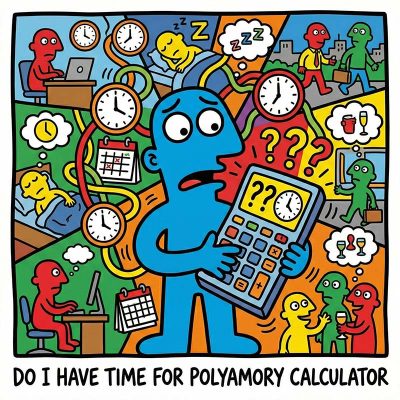
Love is infinite, but your calendar is brutally finite. The fantasy is deep connection; the reality is often just exhausted "calendar tetris." Promising time you don't actually have isn't romantic, it’s a recipe for burnout and broken trust. That sinking feeling when you have to cancel again? That’s the sound of overextension destroying your relationships.
This calculator forces you to confront the math of your life. Do you actually have space for another heart, or are you just setting everyone up for disappointment?

The fantasy is total autonomy and connection. The reality? It can feel like drowning in scheduling chaos and misunderstood expectations. That anxiety you feel isn’t just stress; it’s the wobble of living without a default "anchor." Without a solid architecture, Solo Polyamory stops being a life design and starts being a recipe for burnout and confusion.
The Essential Guide replaces the drift with a concrete anchor. We provide the "Solo Ethic," boundary scripts, and burnout protocols needed to protect your peace. Don't just date around—build a life that actually works for you.

Hierarchy sounds like a corporate org chart until someone gets their feelings hurt. That stomach-turning fear that you are just a "secondary" who can be fired at any time is real. If your relationship feels like a secret ranking system, you are doing it wrong.
Ambiguity is where resentment grows. The Essential Guide replaces the "who matters more" panic with a concrete charter. We provide the scripts and equity guardrails needed to protect every heart in the polycule. Stop guessing and start building.

The ideal is pure equality. The reality? It often slides into hidden rankings where someone gets hurt. That sinking feeling that you are secretly a "secondary" despite the label? That is your intuition detecting couple privilege. Ambiguity is where resentment thrives.
The Essential Guide replaces vague promises with concrete governance. We provide the charters, equity tools, and jealousy protocols needed to ensure "non-hierarchical" isn't just a fantasy. Stop guessing who matters most. Build a network that is actually fair.
The fantasy is total autonomy and connection. The reality? It can feel like drowning in scheduling chaos and misunderstood expectations. That anxiety you feel isn’t just stress; it’s the wobble of living without a default "anchor." Without a solid architecture, Solo Polyamory stops being a life design and starts being a recipe for burnout and confusion.
The Essential Guide replaces the drift with a concrete anchor. We provide the "Solo Ethic," boundary scripts, and burnout protocols needed to protect your peace. Don't just date around—build a life that actually works for you.
Hierarchy sounds like a corporate org chart until someone gets their feelings hurt. That stomach-turning fear that you are just a "secondary" who can be fired at any time is real. If your relationship feels like a secret ranking system, you are doing it wrong.
Ambiguity is where resentment grows. The Essential Guide replaces the "who matters more" panic with a concrete charter. We provide the scripts and equity guardrails needed to protect every heart in the polycule. Stop guessing and start building.
Impact on relationships and trust
Language shapes behavior and perception. When partners hear themselves described as disposable or ranked on a scale it can feel dehumanizing and can undermine trust. Over time that can show up as miscommunication less willingness to share concerns and a sense that someone is always being evaluated rather than appreciated. A healthy hierarchy exists in theory only when all people feel equally safe and respected within their respective roles. The moment a partner feels diminished or compared to another the trust in the arrangement weakens. That is a signal to pause reflect and adjust the language and the process by which decisions are made. Language is not just a momentary choice. It is a daily practice that either reinforces a respectful framework or reopens old wounds.
Practical strategies to avoid objectification and ranking
Ground rules for communication
- Commit to person first language. Always name the person before the role. For example say I adore my partner Maya who is also my nesting partner rather than I adore my nesting partner Maya with a primary status.
- Avoid language that assigns value. Do not say that one partner is more important because there is a hierarchy. Say that roles differ and that all partners have dignity and agency.
- Use consent driven phrases. Before any change in the structure or time allocation check in with everyone who is affected and obtain informed consent for the shift.
- Be precise about what is being prioritized. If housing finances or schedules are being discussed state the concrete area rather than using vague adjectives.
- Keep the language inclusive. Avoid making assumptions about the person s feelings or experiences. Ask open questions to invite their input.
Language to use instead of ranking
Here are examples of how to phrase things without implying rank while still acknowledging the structure of the dynamic.
- Instead of saying You are the primary partner and you always come first try We have a shared plan that gives us space for our living together while also making sure we attend to our other important connections.
- Instead of I love her more than my secondary partner say I care about each of my partners deeply and I want to nurture all of these connections with attention and honesty.
- Instead of My primary has veto power over all relationship decisions say We discuss major decisions openly as a group and we listen to what each partner needs as part of a fair process.
- Instead of You get more time with me because you are the primary describe how time is allocated based on shared commitments and explicit agreements that apply to all involved.
Templates you can adapt
Use these templates to keep conversations grounded in respect and consent.
- Opening a check in about a shift in structure
- Hey Maya and Alex I want to talk about how we are spending time this month. I value all three of you and I want to make sure we are fair about scheduling without making anyone feel less important.
- Clarifying roles without value judgment
- Our arrangement includes a nesting partner a secondary partner and a connection that is evolving. Let us talk about what each role means right now and how we can support each person.
- Discussing a conflict without blame
- I felt left out last week when plans changed. I want to find a pattern that works for everyone so we can avoid that in the future. How can we adjust the schedule together?
Realistic conversational scenarios
Scenario one a new connection enters the orbit
Context a person joins an already established hierarchical polyamory. The new connection should not become a measure of value for existing partners. The goal is to welcome the newcomer ensure consent among all partners and prevent feelings of jealousy from spiraling.
Dialogue example
New connection I am excited to be here and I want to be respectful of your existing commitments. How should we handle time together while you are still prioritizing your primary partner? Partner A I appreciate the question. Our plan is to schedule with everyone in the loop and to revisit if needs change. Primary partner I am glad you asked. I want to maintain balance and I expect honest check ins when any of us feels stretched. Let us all agree to communicate openly and to adjust if needed.
Scenario two a partner expresses concerns about hierarchy
Context one partner feels the language used in conversations makes them feel like they are less valued even if the plan is to keep fairness. The group revisits language and checks in on consent.
Dialogue example
Partner B I have felt a bit invisible lately when we talk about time. It would help if we avoid comparing who is more important and instead talk about who needs what right now. Primary partner I hear you and I want to ensure you feel seen. Let us set a weekly check in to share needs without placing value on anyone’s role.
Scenario three a family member uses ranking language
Context a family member uses language implying that one partner has more rights than another. The couple addresses it with a calm boundary.
Dialogue example
Partner C When you see them you two seem to be a package deal. Why is one person living with you? I want to understand the arrangement. You say we co create a life and that includes a primary and secondary. We can talk about our boundaries with family and we can also explain how we live with honesty and respect for all involved.
Jealousy and insecurity management
Jealousy is normal in any relationship including hierarchical polyamory. The key is to acknowledge it without letting it drive into a language that shames someone else. When jealousy appears use this approach. Name the feeling use a behavior based description and ask for a concrete change you would like while inviting the other person into a collaborative solution. For example I feel anxious when time with you seems to shift without notice because I fear losing our space together Could we plan a weekly date night that includes all of us or a check in to keep lines of communication open? It is not about ranking someone higher it is about keeping a sense of safety for everyone involved.
Boundaries and consent across tiers
Clear boundaries are the backbone of ethical ENM. In a hierarchical structure boundaries help prevent misinterpretation and guard against subtle power dynamics. Boundaries should be specific rather than general. They should also be revisited regularly as life changes for example relocation births moving in with a partner or changes in employment can all shift needs. Consent should be ongoing not a one time event. Check ins after major life events should be normal rather than a surprise or a negotiation that happens behind the scenes. Finally all parties should have a voice in boundary setting and any changes should be made with mutual agreement and clear communication.
Glossary of useful terms and acronyms
- ENM Ethical non monogamy a practice where all parties consent to romantic or sexual openness beyond a single committed relationship.
- Hierarchical polyamory A polyamory setup where partner roles are organized by levels of priority such as primary secondary or nesting secondary.
- Primary partner The partner who holds the most significant shared commitments within the structure.
- Secondary partner A partner with deep emotional connection but fewer daily life obligations than a primary partner.
- Nesting partner A partner who shares domestic life with you sometimes overlapping with other partners.
- Tertiary partner A partner with a more distant level of commitment and fewer practical obligations.
- Consent A mutual agreement about what is allowed in the relationship and how boundaries will be respected.
- Objectification Treating a person as an object or role rather than a full person with feelings and agency.
- Rank The idea that one partner has higher value or priority than another based on the structure rather than on consent and mutual respect.
- Boundaries Clear lines that define acceptable behavior thoughts and level of involvement of each partner.
Putting it all into practice
If you want to sound like a pro at keeping hierarchy while avoiding harm start by naming the person before their role in every sentence. Constantly check in with explicit consent when you consider changing how time or resources are distributed. Use language that emphasizes collaboration and respect rather than competition. Remember that the goal is a sustainable arrangement where every voice can be heard and every person can feel valued.
Building a culture of respectful language in your ENM circle
The best way to keep ranking language out of daily life is to embed respectful language into your rituals. Create a shared glossary of terms and a few simple phrases that you all agree are respectful. Have a monthly check in focused on language how people feel about the way they are referenced and whether anyone is feeling objectified or overlooked. Normalize asking for consent and revising agreements. Having explicit conversations about how you want to talk about partners will pay off in less drama more trust and a stronger relationship fabric for everyone involved.
Real world tips to implement this week
- Review recent conversations and highlight phrases that imply ranking or objectification. Rewrite them into person first neutral language.
- Practice a short opening statement about each partner that describes who they are and what they contribute rather than assigning value to their role.
- Set up a monthly language check in where everyone can share one example of language that felt respectful and one example that could be improved.
- Keep a live shared document with definitions terms and approved phrases that you can reference when you talk about the dynamic.
Final notes on respect and consent
Respect and consent do not vanish when a relationship moves into a hierarchical polyamory. They are the foundation that keeps all partners feeling seen heard and valued. If you notice a pattern of objectifying language or ranking language creeping back in do not shame anyone. Instead pause reset and revisit your agreements and your language. It is normal to slip occasionally. The real test is how you handle the moment and how you move forward with clearer more compassionate language.
FAQ
Frequently asked questions about language in hierarchical polyamory ENM
What is hierarchical polyamory and how does language affect it?
Hierarchical polyamory is a setup where partners are organized by levels of priority. Language affects it by either clarifying structure with respect or by implying value judgments that can damage trust. This guide focuses on using clear compassionate language that respects each person while keeping the structure transparent.
How can I tell if I am using ranking language?
Look for phrases that imply one partner is more important or worthy than another based purely on their position in the hierarchy. Examples include statements that place obligation or love primarily on the top partner. Replace them with language that describes needs and boundaries without measuring worth.
What should I do if a partner feels objectified?
Listen without defensiveness. Acknowledge their feelings and explore concrete language changes. Offer an immediate adjustment such as re labeling a role to the actual shared responsibilities and check in about how everyone feels.
Are there scripts for conversations about changes in arrangements?
Yes. Open conversations with a clear request for input and a shared goal. For example say I would like to revisit how we allocate time this month. I value all of you and I want to ensure we stay fair and respectful. What would help you feel respected and heard in this process?
How do I explain hierarchy to someone new to the group without sounding cold?
Lead with the person first and then describe the role. Give concrete examples of how decisions are made and how time is allocated while emphasizing consent and ongoing communication above all else.
What if someone uses ranking language in front of others?
Address it calmly in the moment and redirect to the agreed language. You can say we have a shared approach to refer to each partner as a person with a unique role and we want to keep language respectful in front of everyone.
Is it possible to maintain hierarchy while avoiding all objectifying language?
Yes. It requires ongoing effort and open dialogue. Make language choices with intention and revisit them regularly. Encourage feedback from all involved and model the behavior you want to see in the group.
Love is infinite, but your calendar is brutally finite. The fantasy is deep connection; the reality is often just exhausted "calendar tetris." Promising time you don't actually have isn't romantic, it’s a recipe for burnout and broken trust. That sinking feeling when you have to cancel again? That’s the sound of overextension destroying your relationships.
This calculator forces you to confront the math of your life. Do you actually have space for another heart, or are you just setting everyone up for disappointment?
The fantasy is total autonomy and connection. The reality? It can feel like drowning in scheduling chaos and misunderstood expectations. That anxiety you feel isn’t just stress; it’s the wobble of living without a default "anchor." Without a solid architecture, Solo Polyamory stops being a life design and starts being a recipe for burnout and confusion.
The Essential Guide replaces the drift with a concrete anchor. We provide the "Solo Ethic," boundary scripts, and burnout protocols needed to protect your peace. Don't just date around—build a life that actually works for you.
Hierarchy sounds like a corporate org chart until someone gets their feelings hurt. That stomach-turning fear that you are just a "secondary" who can be fired at any time is real. If your relationship feels like a secret ranking system, you are doing it wrong.
Ambiguity is where resentment grows. The Essential Guide replaces the "who matters more" panic with a concrete charter. We provide the scripts and equity guardrails needed to protect every heart in the polycule. Stop guessing and start building.
The ideal is pure equality. The reality? It often slides into hidden rankings where someone gets hurt. That sinking feeling that you are secretly a "secondary" despite the label? That is your intuition detecting couple privilege. Ambiguity is where resentment thrives.
The Essential Guide replaces vague promises with concrete governance. We provide the charters, equity tools, and jealousy protocols needed to ensure "non-hierarchical" isn't just a fantasy. Stop guessing who matters most. Build a network that is actually fair.
The fantasy is total autonomy and connection. The reality? It can feel like drowning in scheduling chaos and misunderstood expectations. That anxiety you feel isn’t just stress; it’s the wobble of living without a default "anchor." Without a solid architecture, Solo Polyamory stops being a life design and starts being a recipe for burnout and confusion.
The Essential Guide replaces the drift with a concrete anchor. We provide the "Solo Ethic," boundary scripts, and burnout protocols needed to protect your peace. Don't just date around—build a life that actually works for you.
Hierarchy sounds like a corporate org chart until someone gets their feelings hurt. That stomach-turning fear that you are just a "secondary" who can be fired at any time is real. If your relationship feels like a secret ranking system, you are doing it wrong.
Ambiguity is where resentment grows. The Essential Guide replaces the "who matters more" panic with a concrete charter. We provide the scripts and equity guardrails needed to protect every heart in the polycule. Stop guessing and start building.
