
How Hierarchical Polyamory Differs From Non Hierarchical Polyamory

Ethical non monogamy or ENM is a big umbrella term that covers many different relationship styles. Among those styles two big camps get talked about a lot. One is hierarchical polyamory and the other is non hierarchical polyamory. If you are curious about how these two styles differ in practice this guide will walk you through the core ideas. We will break down terms explain what they mean in plain language and give practical tips you can use in real life. Think of this as a friendly field guide to navigating multi partner dynamics without getting tangled in the jargon.
Quick Links to Useful Sections
- What is Hierarchical Polyamory
- What is Non Hierarchical Polyamory
- Core Differences at a Glance
- How Jealousy and Emotions are Handled in Each Dynamic
- Realistic Scenarios to See the Difference
- Scenario A: A primary anchor with a growing secondary
- Scenario B: A flat network with equal emphasis
- Scenario C: Life changes and a shift in structure
- Boundaries and Ethics in the Two Styles
- Practical Tools and Practices You Can Use
- Must Not Dos and Common Pitfalls
- Deciding Which Structure Fits You Best
- Glossary of Useful Terms and Acronyms
- Frequently asked questions
For readers new to ENM hierarchical polyamory is a structure where some relationships are treated as having a higher priority than others while non hierarchical polyamory is a more flat structure where partners are considered equal in importance. Both formats aim for honesty consent and healthy communication. The right choice for you depends on your life stage values boundaries and what you want from your connections. This guide is not about telling you one is better than the other. It is about understanding how each approach works in everyday life so you can decide what fits you best.
Before we dive in a quick note on terms. Polyamory means having intimate relationships with more than one person with the knowledge and consent of all involved. ENM stands for ethical non monogamy a broad term that includes polyamory swinging open relationships and other non traditional setups. A concept you will see a lot is the idea of hierarchy that means some relationships are treated as more central or more important than others. In non hierarchical setups there is a push to treat all partners as equally important with perhaps the freedom to shift emphasis as life changes. Now let us break down the two styles in more detail.
What is Hierarchical Polyamory
Hierarchical polyamory or HP is a common structure in which there is a defined order of priority among partners. The term hierarchy does not mean a person is more valuable as a human. It refers to how time energy finances or emotional attention may be distributed. The typical pattern you see in HP is a primary partner or partners who hold a central place in a person’s life. They may share finances make major life decisions together and form the core of the polycule. A secondary partner is someone who has an important relationship but is not in the same central position. Some people also describe nesting arrangements where a primary partner has priority access to living space or schedules while other relationships operate more flexibly around those anchor points.
Key ideas you will hear in HP include the concept of a primary partner or pair the idea of nesting or evergreen commitments and the practice of allocating time energy or resources in a way that protects the primary relationship. That does not mean secondaries or other partnerships are ignored. It means they function within a framework where the primary relationship is the core around which other connections revolve. HP can offer stability clarity and a sense of security for people who value long term plans or who share a home or finances with one partner.
Terms you might see in HP
- Primary partner The relationship that takes central priority in life planning and decision making.
- Secondary partner A relationship that exists alongside a primary one and does not have the same level of priority in all areas.
- Nesting Arrangements about living spaces and household responsibilities often anchored by the primary relationship.
- Metamour A partner of your partner who is not your direct partner.
- Gatekeeping The practice of controlling access to time or information sometimes exercised by a primary partner.
- Primary escalation When a new partner becomes a focus due to life changes such as moving in together or starting a family.
What is Non Hierarchical Polyamory
Non hierarchical polyamory or non HP is a flatter approach. There is no built in priority list that places one partner above others. In a non HP setup all partners are treated as equal in importance resilience and ability to shape the relationship. Time energy and emotional bandwidth are negotiated in context with all involved. In practice you might see schedules set up so that each partner gets fair access to time together rather than time being funneled through a single central relationship. Non HP can feel freer and more flexible for people who want every connection to stand on its own merits rather than leaning on a primary anchor.
In non HP the polycule is often described as a web. Each node can grow and shrink without forcing a re ordering of the entire structure. People who prefer non HP often value open communication as a core practice and they tend to invest more in individual relationships rather than a single central couple or triad. This approach can support a high degree of autonomy and experimentation as life changes or as feelings evolve.
Terms you might hear in non HP
- Truthful equality The idea that every partner has equal value and voice within the network.
- Polycule The network of all people who form connections within a polyamorous system.
- Open calendar Scheduling that emphasizes fair access to time with multiple partners rather than a fixed order of priority.
- Fluid boundaries Boundaries that shift as relationships grow or life circumstances change.
- Compersion The feeling of joy when a partner experiences happiness with someone else.
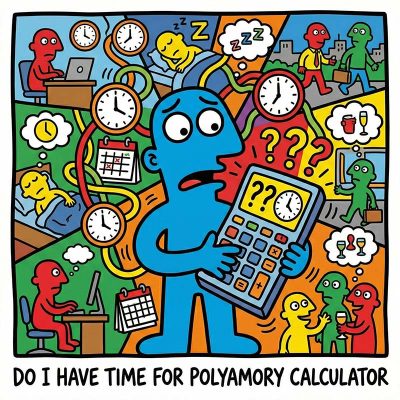
Love is infinite, but your calendar is brutally finite. The fantasy is deep connection; the reality is often just exhausted "calendar tetris." Promising time you don't actually have isn't romantic, it’s a recipe for burnout and broken trust. That sinking feeling when you have to cancel again? That’s the sound of overextension destroying your relationships.
This calculator forces you to confront the math of your life. Do you actually have space for another heart, or are you just setting everyone up for disappointment?

The fantasy is total autonomy and connection. The reality? It can feel like drowning in scheduling chaos and misunderstood expectations. That anxiety you feel isn’t just stress; it’s the wobble of living without a default "anchor." Without a solid architecture, Solo Polyamory stops being a life design and starts being a recipe for burnout and confusion.
The Essential Guide replaces the drift with a concrete anchor. We provide the "Solo Ethic," boundary scripts, and burnout protocols needed to protect your peace. Don't just date around—build a life that actually works for you.

Hierarchy sounds like a corporate org chart until someone gets their feelings hurt. That stomach-turning fear that you are just a "secondary" who can be fired at any time is real. If your relationship feels like a secret ranking system, you are doing it wrong.
Ambiguity is where resentment grows. The Essential Guide replaces the "who matters more" panic with a concrete charter. We provide the scripts and equity guardrails needed to protect every heart in the polycule. Stop guessing and start building.

The ideal is pure equality. The reality? It often slides into hidden rankings where someone gets hurt. That sinking feeling that you are secretly a "secondary" despite the label? That is your intuition detecting couple privilege. Ambiguity is where resentment thrives.
The Essential Guide replaces vague promises with concrete governance. We provide the charters, equity tools, and jealousy protocols needed to ensure "non-hierarchical" isn't just a fantasy. Stop guessing who matters most. Build a network that is actually fair.
The fantasy is total autonomy and connection. The reality? It can feel like drowning in scheduling chaos and misunderstood expectations. That anxiety you feel isn’t just stress; it’s the wobble of living without a default "anchor." Without a solid architecture, Solo Polyamory stops being a life design and starts being a recipe for burnout and confusion.
The Essential Guide replaces the drift with a concrete anchor. We provide the "Solo Ethic," boundary scripts, and burnout protocols needed to protect your peace. Don't just date around—build a life that actually works for you.
Hierarchy sounds like a corporate org chart until someone gets their feelings hurt. That stomach-turning fear that you are just a "secondary" who can be fired at any time is real. If your relationship feels like a secret ranking system, you are doing it wrong.
Ambiguity is where resentment grows. The Essential Guide replaces the "who matters more" panic with a concrete charter. We provide the scripts and equity guardrails needed to protect every heart in the polycule. Stop guessing and start building.
Core Differences at a Glance
Here is a quick contrast to help you see the big ideas at a glance. Use this as a mental checklist when you are sorting through your own desires and boundaries.
- Priority structure HP has a clear order of priority with a primary anchor. Non HP treats all partners more evenly with shared decision making.
- Time management In HP time is often allocated through the primary relationship first. In non HP time is distributed more flexibly among all partners.
- Resource distribution HP may allocate finances housing or planning according to hierarchy. Non HP aims for more balanced distribution that can adapt over time.
- Decision making HP often centers major life choices around the primary partner. Non HP seeks consensus across the network or uses rotating decision models depending on the issue.
- Emotional ecology HP relies on a stable core while non HP prizes adaptability and ongoing recalibration of feelings and needs.
How Jealousy and Emotions are Handled in Each Dynamic
Jealousy is a normal human feeling in any relationship. The question is how a structure responds when it shows up. In hierarchical polyamory the intensity of jealousy can be influenced by the centrality of the primary relationship. If the primary is thriving the secondary or other partnerships can feel supported or neglected depending on how time and energy are allocated. Honest clear communication and transparent boundaries are essential to prevent resentment from building.
In non hierarchical polyamory jealousy tends to be more diffuse because there is no single anchor that can feel stretched thin. The focus shifts to establishing transparent agreements and flexible boundaries that adapt to changing dynamics. People who choose non HP often build ceremonial checks in the form of regular check in conversations or written agreements that keep all partners connected without creating a sense of ranking.
Here are some practical strategies that work in both styles but are especially helpful when a lot of moving parts are involved.
- Regular communication rituals Create safe spaces for talking about needs fears and desires on a predictable cadence. This could be weekly or monthly depending on how dynamic your network is.
- Clear expectations Document what everyone expects from each other in a shared space or document. Review it when life changes justify an update.
- Boundaries that are revisited Boundaries are not set and forgotten. They are living guidelines that evolve with relationships and life events.
- Compersion practices Practice celebrating your partner s happiness and exploring how their joy can enrich your own life as a community.
Realistic Scenarios to See the Difference
Scenario one shows hierarchical polyamory in action. Scenario two shows non hierarchical polyamory in action. Scenario three explores a life change that prompts a shift in structure. These are realistic and grounded in common life events so you can picture how the dynamics feel in real time.
Scenario A: A primary anchor with a growing secondary
Alex has a primary partner named Casey with whom they share a home and most major life decisions. They also date Jordan who is important but not in the same central position as Casey. Alex designs a weekly date night with Casey first and then tries to fit in time with Jordan as the schedule allows. Communication includes weekly updates about plans and potential conflicts or overlaps. If Casey has a strong week at work the energy available for dating may shift toward Casey while still leaving room for Jordan on alternate days. This is a classic HP pattern where the primary anchor guides a lot of the flow but secondary partners still play a meaningful role.
Scenario B: A flat network with equal emphasis
Bea Carlos and Dana all date each other in a semi fluid cycle without one person standing as the central anchor. Everyone negotiates time and energy with the whole network in mind. There is a shared calendar and an agreed upon approach to decision making. When someone wants a new relationship a full network discussion happens rather than a single partner leading the process. Jealousy is walked through with group conversations and the emphasis is on distributing attention fairly while honoring personal boundaries. This is a non hierarchical pattern that values equal standing among all partners.
Scenario C: Life changes and a shift in structure
Three years into their polycule Jamie who once had a strong primary relationship with Riley begins dating a new partner Sam who becomes central in Jamie s life due to shared life goals. The couple chooses to reevaluate structure at a scheduled planning session. They discuss how finances living arrangements and time will be realigned. This shift could feel like a natural evolution in HP or it could trigger a transition toward a more non hierarchical approach depending on how everyone in the network responds. The key is to keep the door open for honest conversation and consent based negotiation rather than letting friction build up.
Boundaries and Ethics in the Two Styles
Boundaries are the guardrails that keep relationships healthy. In HP boundaries often protect the primary relationship first. They can specify how much emotional energy is directed toward the primary partner or how new partners fit into existing plans. Boundaries can create clarity but they can also feel restrictive if imposed without ongoing consent and conversation.
In non HP boundaries are negotiated with all partners in mind. The aim is fairness and transparency across connections. Boundaries tend to be flexible and are adjusted as relationships grow. The risk with non HP is boundary drift where people assume shared norms but do not actively discuss changes. That is why regular check ins are particularly important in non HP networks.
Practical Tools and Practices You Can Use
Whether you are into HP or non HP there are practical tools that can help you manage complexity without losing warmth. Here are some suggestions that work well in both styles with minor adaptations.
- Shared agreements document Create a living document that outlines how time is allocated what counts as a date what is sharing finances and how decisions are made about major life events.
- Joint calendar system Use a digital calendar that shows all partners events with color coding. Make sure everyone can view and update as needed.
- Regular check in rituals Schedule a weekly or bi weekly talk to discuss feelings needs boundaries and any upcoming changes in life circumstances.
- Metamour conversations Facilitate open conversations among partners who are not in a relationship with each other to reduce tension and increase understanding.
- Conflict resolution protocol Agree on steps to resolve conflicts including time outs agreed cooling off periods and a plan to revisit difficult topics with a mediator if needed.
Must Not Dos and Common Pitfalls
Here are some careful cautions that people often hit in HP and non HP. Recognizing these can save a lot of friction later on.
- Don t assume hierarchy equals control A primary partner should not exert coercive power over others or override consent. All adults deserve autonomous choices.
- Don t let fear drive boundaries Boundaries should come from thoughtful reflection not fear based scarcity or jealousy.
- Don t rush into a new dynamic If life is busy or emotions are high take time to reflect before adding new partners or changing the structure.
- Don t ghost when conflicts arise Communication matters. Step into conversations even if they feel uncomfortable and use a calm steady voice.
- Don t compare partners Each relationship has its own rhythm and needs. Value uniqueness rather than trying to fit everyone into one mold.
Deciding Which Structure Fits You Best
Choosing between hierarchical and non hierarchical polyamory is not a one size fits all decision. It is about your values your life situation and how you want to experience love and connection. Here are some reflective questions to guide your thinking.
- What role does stability play in your life right now If you have big commitments such as a demanding career a family you might lean toward HP for predictability. If you want creative freedom and experimentation non HP might feel more natural.
- How comfortable are you with sharing time and energy Do you prefer a system where the main relationship gets priority or do you want to distribute attention more evenly across partners
- How do you handle change If life is likely to shift dramatically a flexible non HP approach can be a good safety net. If you value continuity HP can offer steady anchors.
- What are your financial living situation and family considerations Shared living arrangements or children can make HP easier to navigate or more complex depending on how boundaries are set. It is essential to talk these realities through with all involved.
- What is your communication style Are you comfortable with frequent transparent conversations or do you prefer more time to process feelings before discussing them
Glossary of Useful Terms and Acronyms
- ENM Ethical non monogamy a broad umbrella term for relationship styles that involve more than two people with consent and honesty as core values.
- HP Hierarchical polyamory a structure where some relationships are prioritized over others.
- Non HP Non hierarchical polyamory a flat structure where all partners are treated with equal importance.
- Primary partner The relationship that holds central priority in most life planning.
- Secondary partner A partner who is important but not the central anchor.
- Nesting Living arrangements and household logistics often centered around a primary partner.
- Metamour The partner of your partner who is not your own partner.
- Polycule The network of relationships in a polyamorous system.
- Gatekeeping Controlling access to time or information often a concern in HP dynamics.
- Compersion The joy from seeing your partner happy with someone else.
Frequently asked questions
Love is infinite, but your calendar is brutally finite. The fantasy is deep connection; the reality is often just exhausted "calendar tetris." Promising time you don't actually have isn't romantic, it’s a recipe for burnout and broken trust. That sinking feeling when you have to cancel again? That’s the sound of overextension destroying your relationships.
This calculator forces you to confront the math of your life. Do you actually have space for another heart, or are you just setting everyone up for disappointment?
The fantasy is total autonomy and connection. The reality? It can feel like drowning in scheduling chaos and misunderstood expectations. That anxiety you feel isn’t just stress; it’s the wobble of living without a default "anchor." Without a solid architecture, Solo Polyamory stops being a life design and starts being a recipe for burnout and confusion.
The Essential Guide replaces the drift with a concrete anchor. We provide the "Solo Ethic," boundary scripts, and burnout protocols needed to protect your peace. Don't just date around—build a life that actually works for you.
Hierarchy sounds like a corporate org chart until someone gets their feelings hurt. That stomach-turning fear that you are just a "secondary" who can be fired at any time is real. If your relationship feels like a secret ranking system, you are doing it wrong.
Ambiguity is where resentment grows. The Essential Guide replaces the "who matters more" panic with a concrete charter. We provide the scripts and equity guardrails needed to protect every heart in the polycule. Stop guessing and start building.
The ideal is pure equality. The reality? It often slides into hidden rankings where someone gets hurt. That sinking feeling that you are secretly a "secondary" despite the label? That is your intuition detecting couple privilege. Ambiguity is where resentment thrives.
The Essential Guide replaces vague promises with concrete governance. We provide the charters, equity tools, and jealousy protocols needed to ensure "non-hierarchical" isn't just a fantasy. Stop guessing who matters most. Build a network that is actually fair.
The fantasy is total autonomy and connection. The reality? It can feel like drowning in scheduling chaos and misunderstood expectations. That anxiety you feel isn’t just stress; it’s the wobble of living without a default "anchor." Without a solid architecture, Solo Polyamory stops being a life design and starts being a recipe for burnout and confusion.
The Essential Guide replaces the drift with a concrete anchor. We provide the "Solo Ethic," boundary scripts, and burnout protocols needed to protect your peace. Don't just date around—build a life that actually works for you.
Hierarchy sounds like a corporate org chart until someone gets their feelings hurt. That stomach-turning fear that you are just a "secondary" who can be fired at any time is real. If your relationship feels like a secret ranking system, you are doing it wrong.
Ambiguity is where resentment grows. The Essential Guide replaces the "who matters more" panic with a concrete charter. We provide the scripts and equity guardrails needed to protect every heart in the polycule. Stop guessing and start building.
