
Rules That Protect Versus Rules That Control


Welcome to a practical breakthrough guide for anyone navigating a hierarchical polyamory setup in ethically non monogamous dynamics. If you are new to the term ENM or you already live inside a primary versus secondary relationship structure this guide will help you tell the difference between rules that keep people safe and rules that squeeze freedom. We are going to keep things real and straightforward and you can read this aloud with a laugh and a plan in hand.
Quick Links to Useful Sections
- What hierarchical polyamory is and why rules matter
- Key terms you should know
- Why rules exist in a hierarchical polyamory dynamic
- Rules that protect your dynamics in hierarchical polyamory
- Consent driven boundaries
- Time management and resource sharing rules
- Privacy and disclosure rules
- Safety and health rules
- Transparency and documentation rules
- Emotional wellbeing and support rules
- Rules that can slide into control or harm
- Prohibitions without consent or coercive pressure
- Punitive rules and fear based compliance
- Overly prescriptive or punitive time restrictions
- Public shaming or social punishment
- How to tell protective rules from controlling rules in practice
- Practical steps to craft protective rules that work
- 1. Start with consent and safety as the core
- 2. Make rules specific and revisitable
- 3. Build in a healthy renegotiation mechanism
- 4. Separate protection from punishment
- 5. Use reversible and flexible language
- 6. Document agreements clearly
- 7. Create space for emotional safety and support
- 8. Encourage transparency and privacy balance
- Negotiation and renegotiation strategies
- What to do when a rule feels protective but is challenged
- Common realistic scenarios and conversations
- Scenario one you are the primary partner needing space for serious life events
- Scenario two a secondary partner wants more visibility in the relationship
- Scenario three jealousy arises around a new partner
- Scenario four a life event disrupts a schedule
- Templates for protective rule thinking you can adapt
- Checklist before you step into a rules discussion
- Glossary of useful terms and acronyms
- Frequently asked questions
What hierarchical polyamory is and why rules matter
Hierarchical polyamory is a dynamic where partners place one relationship at the top of the structure as the primary connection and other relationships sit in a lower tier as secondary or sometimes casual connections. The hierarchy is not about who is more loved it is about how time boundaries emotional resources and life responsibilities are managed. In this setup rules can act as guard rails to protect safety and consent. They can also become a cage if they are used to police or punish. The key distinction is intent and impact. Protective rules are built to protect consent safety privacy and emotional wellbeing. Controlling rules try to curb autonomy restrict consent without good reason or penalize someone for normal relationship needs.
Key terms you should know
- ENM Ethically non monogamous a relationship style that emphasizes consent honesty and fair treatment for multiple intimate connections.
- Hierarchical polyamory A polyamorous structure in which one relationship is prioritized as primary while other relationships are considered secondary or tertiary.
- Primary partner The person in the hierarchy who holds the main or central role in the relationship structure often associated with key decisions logistics and long term plans.
- Secondary partner A partner who is important but not the central focus of the life planning and time allocation in the hierarchy.
- Rules Prescribed behaviors or limits agreed by all parties to guide interactions and boundaries.
- Boundaries Personal limits that are non negotiable for safety or wellbeing.
- Consent A voluntary agreement to participate based on awareness and freedom of choice.
- Veto A power to stop a relationship or a decision often controversial and emotionally charged in ENM discussions.
- Negotiation The process of discussing needs and adjusting rules to accommodate all involved.
- Compersion The feeling of happiness from watching a partner experience joy with someone else.
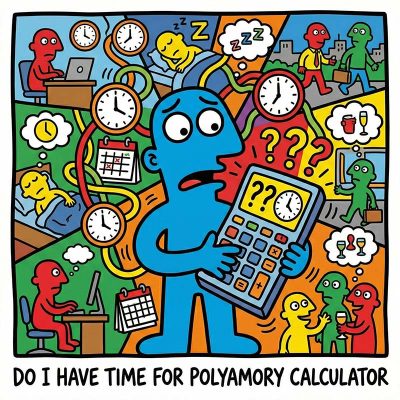
Love is infinite, but your calendar is brutally finite. The fantasy is deep connection; the reality is often just exhausted "calendar tetris." Promising time you don't actually have isn't romantic, it’s a recipe for burnout and broken trust. That sinking feeling when you have to cancel again? That’s the sound of overextension destroying your relationships.
This calculator forces you to confront the math of your life. Do you actually have space for another heart, or are you just setting everyone up for disappointment?

The fantasy is total autonomy and connection. The reality? It can feel like drowning in scheduling chaos and misunderstood expectations. That anxiety you feel isn’t just stress; it’s the wobble of living without a default "anchor." Without a solid architecture, Solo Polyamory stops being a life design and starts being a recipe for burnout and confusion.
The Essential Guide replaces the drift with a concrete anchor. We provide the "Solo Ethic," boundary scripts, and burnout protocols needed to protect your peace. Don't just date around—build a life that actually works for you.

Hierarchy sounds like a corporate org chart until someone gets their feelings hurt. That stomach-turning fear that you are just a "secondary" who can be fired at any time is real. If your relationship feels like a secret ranking system, you are doing it wrong.
Ambiguity is where resentment grows. The Essential Guide replaces the "who matters more" panic with a concrete charter. We provide the scripts and equity guardrails needed to protect every heart in the polycule. Stop guessing and start building.
The ideal is pure equality. The reality? It often slides into hidden rankings where someone gets hurt. That sinking feeling that you are secretly a "secondary" despite the label? That is your intuition detecting couple privilege. Ambiguity is where resentment thrives.
The Essential Guide replaces vague promises with concrete governance. We provide the charters, equity tools, and jealousy protocols needed to ensure "non-hierarchical" isn't just a fantasy. Stop guessing who matters most. Build a network that is actually fair.
The fantasy is total autonomy and connection. The reality? It can feel like drowning in scheduling chaos and misunderstood expectations. That anxiety you feel isn’t just stress; it’s the wobble of living without a default "anchor." Without a solid architecture, Solo Polyamory stops being a life design and starts being a recipe for burnout and confusion.
The Essential Guide replaces the drift with a concrete anchor. We provide the "Solo Ethic," boundary scripts, and burnout protocols needed to protect your peace. Don't just date around—build a life that actually works for you.
Hierarchy sounds like a corporate org chart until someone gets their feelings hurt. That stomach-turning fear that you are just a "secondary" who can be fired at any time is real. If your relationship feels like a secret ranking system, you are doing it wrong.
Ambiguity is where resentment grows. The Essential Guide replaces the "who matters more" panic with a concrete charter. We provide the scripts and equity guardrails needed to protect every heart in the polycule. Stop guessing and start building.
Why rules exist in a hierarchical polyamory dynamic
Rules come from trying to balance many moving parts in a shared life. People in a primary relationship often face responsibilities such as parenting time cohabitation financial planning and career goals. Those demands create a need to plan and protect time energy and emotional safety. When everyone contributes to the same goal rules can help reduce friction clarity cause and effect and misunderstandings. The right rules are not about controlling love they are about protecting it. They give people space to feel secure and respected while still allowing room for growth and new connections.
Rules that protect your dynamics in hierarchical polyamory
Consent driven boundaries
Protective rules start with consent. That means every partner agrees to the rule with full knowledge of what it means and what it requires. A consent driven boundary is specific concrete and revisitable. It is not a vague expectation that can be ignored without consequence. Examples include clearly defined safe sex practices consent for engaging with others new relationship disclosures and communication obligations about changes in feelings or needs.
- All new partners should be disclosed to the primary partner and to any other involved partners as agreed.
- Sexual health standards including regular testing and clear discussion of protection methods for all partners.
- Open and honest communication about changes in attraction or interest in other people to allow renegotiation if needed.
Time management and resource sharing rules
Time is a resource in hierarchical setups. Rules that manage where and when partners spend time together protect the primary relationship from neglect and burnout. They are also about fairness and predictability. Examples include fixed date nights with the primary partner added to the calendar and agreed blocks of time for secondary relationships that do not interfere with essential life duties.
- Weekly schedule reviews to ensure primary and secondary needs are balanced.
- Advance notice for scheduling overnights or extended stays with secondary partners during busy periods.
- Clear expectations about communication during workdays or family time to avoid cross wires.
Privacy and disclosure rules
Rules about what gets shared and when ensure everyone feels safe. Privacy protection reduces fear of gossip or misrepresentation and helps keep trust intact. A protective rule might set clear boundaries around what is shared with friends or family or what is shared publicly on social media. It can also govern what is disclosed in professional spaces to protect reputations and safety.
- Disclosures about sexual activity or relationship details are limited to what all parties agree in writing.
- Images or personal information about a partner outside the immediate circle are not shared without consent.
- Information about a partner should be safe to discuss within the agreed boundaries set by the group.
Safety and health rules
Health and safety come first in any relationship. Protective rules ensure everyone is protected physically and emotionally. These include regular STI testing hydration and safe sex practices. Safety rules also cover emotional safety like safe language to pause or stop a conversation or interaction when someone feels overwhelmed.
- Regular sexual health checks for all active partners with shared results as permitted by privacy preferences.
- Clear guidelines for safe sex including condom use or PrEP where applicable.
- A plan for stepping back from a relationship if health concerns arise and a process for resuming when safe.
Transparency and documentation rules
Protective rules prefer clear documentation of agreements. This reduces memory drift and helps with renegotiation when life changes. Agreements can be written contracts or simple checklists. The point is to be explicit and to revisit these documents on a regular basis.
- Written agreements outlining the primary and secondary expectations and the rules that apply to each relationship.
- Regular review sessions every eight to twelve weeks to assess what is working and what needs adjustment.
- Record of decisions and the date of renegotiation to create a history you can learn from.
Emotional wellbeing and support rules
Emotional safety matters. Protective rules encourage ongoing support for all partners. They set expectations for checking in on feelings after new experiences and require space for conversations about jealousy or discomfort without punishment.
- Scheduled check ins with each partner to discuss how they feel about the current arrangement.
- Strategies for managing jealousy such as time outs for cooling off and techniques for self validation.
- Access to outside support such as counseling or coaching if emotions become overwhelming.
Rules that can slide into control or harm
Prohibitions without consent or coercive pressure
Rules that ban topics or exclude partners from conversations without a voice in the process are typically controlling. When rules are used to punish or to force a certain outcome they stop being protective and start eroding trust.
- Absolute bans on seeing someone without a legitimate safety reason and consent from all involved parties cannot be a blanket rule for a dynamic as it cuts across autonomy.
- Threats like you will be cut off if you do this or that create fear rather than informed choice.
Punitive rules and fear based compliance
Rules that threaten losing access to a primary relationship for failures or mistakes are a red flag. Pressure tactics harm emotional safety and create a culture of fear instead of respect.
- Rules that say you cannot talk to a new partner without permission every day or that you will be expelled from the primary relationship for minor missteps.
- Shaming tactics after mistakes rather than a calm renegotiation to repair trust.
Overly prescriptive or punitive time restrictions
Any rule that micromanages someone else time with zero room for flexibility can feel controlling. Flexibility is essential in long term polyamorous life because life changes and needs evolve.
- Rules that lock a person into a fixed schedule with no room for emergencies or personal needs.
- Penalties for schedule changes that do not account for real world realities such as work shifts or caregiving duties.
Public shaming or social punishment
Carrying out a private rule in a public way to make someone feel small is a control tactic. That kind of dynamic damages trust and creates resentment.
- Posting about a partner s mistakes on social media or sharing private conflicts broadly without consent.
- Using friends or family as instruments to police behavior rather than addressing the issue with the people involved.
How to tell protective rules from controlling rules in practice
We want rules that keep people safe and allow growth. Here is a practical way to evaluate a rule you are considering or living with. Ask yourself these questions and be honest about the answers:
- Is the rule about consent safety or personal convenience of one person only
- Would the rule still apply if the relationship structure changes
- Does the rule respect the autonomy of all partners
- Is there a clear plan for renegotiation if feelings or life circumstances shift
- Would breaking the rule endanger someone or cause undue emotional harm
- Is there a clear and fair enforcement method that is not punitive
If the answer to any of these questions leans toward fear control punishment or a lack of transparency you likely have a controlling rule. If the rule centers on consent safety fairness and a plan for ongoing communication then it is likely protective.
Practical steps to craft protective rules that work
1. Start with consent and safety as the core
Begin every rule with a clear statement about consent and safety. This sets a positive frame and helps everyone feel respected. For example you can say This rule exists to protect our health and to preserve the trust we share rather than You must do this or you will be punished.
2. Make rules specific and revisitable
Specify what is allowed what is not and how to confirm changes. Build in a scheduled renegotiation period so everyone can express new needs or concerns. Specificity prevents misinterpretation and reduces drama when life shifts.
3. Build in a healthy renegotiation mechanism
Agree to revisit agreements at regular intervals or whenever major life events occur. The process should be collaborative and not dominated by one person. This creates a sense of shared control rather than rule tyranny.
4. Separate protection from punishment
Protective rules focus on safety and wellbeing not on punishment for mistakes. If rules feel punitive it is a signal to pause and rethink. The goal is repair and growth not fear and blame.
5. Use reversible and flexible language
Frame rules with language that can be adjusted as needed. For example instead of You cannot see others say We will discuss new relationships before making commitments and adjust the plan as needed.
6. Document agreements clearly
Put agreements in writing even a simple shared document. This reduces memory drift and helps during renegotiation. Include topics such as who is involved what counts as a breach what are the consequences and how to report concerns.
7. Create space for emotional safety and support
Include check ins after major events and provide access to support tools such as counseling or coaching. Emotional wellbeing needs to be nurtured as part of the rules not treated as a side topic.
8. Encourage transparency and privacy balance
Be transparent about essential information with consent and protect private details that could harm someone if shared. Balance is key and it protects trust.
Negotiation and renegotiation strategies
Negotiation is a continuous practice in a dynamic relationship landscape. Here are practical strategies to keep negotiations constructive and productive:
- Set a calm agenda for discussions. Do not bring up heavy topics in the heat of an argument.
- Enter negotiations with a clear list of needs and a willingness to listen. Use reflective listening to show understanding.
- Propose multiple options rather than a single fix. This gives everyone a sense of agency.
- Agree on a trial period for new rules and a plan to review results after the trial ends.
- When emotions run high consider a short break to cool down and reflect before resuming the conversation.
What to do when a rule feels protective but is challenged
Conflict can signal that a rule is not working or that life has shifted. When this happens consider these steps:
- Pause and name the feeling you are experiencing. Acknowledging feelings without blame helps people stay connected.
- Revisit the underlying purpose of the rule. Is it still protecting something essential or is it outdated?
- Invite all involved to share their perspective and experiences. Aim for understanding rather than persuading.
- Decide on a concrete path forward such as a tweak to the rule or a temporary pause to test a different approach.
Common realistic scenarios and conversations
Scenario one you are the primary partner needing space for serious life events
You can say I am navigating a major life event and I need extra space and time for myself. I want to keep you updated but I do not want to overwhelm you with constant check ins. Can we agree on a plan that ensures you feel seen while I get the space I need
Scenario two a secondary partner wants more visibility in the relationship
You might respond I value our connection and I want you to feel secure. Let us define what visibility means does it include communication frequency public updates or social media sharing and what are the boundaries for privacy
Scenario three jealousy arises around a new partner
Try this approach I notice a wave of jealousy and I want to understand what is triggering it. Can we discuss specific actions that would help us feel safer and what would count as a successful renegotiation
Scenario four a life event disrupts a schedule
Say I am dealing with a scheduling conflict that affects time with you. I want to adjust the plan temporarily and we will revisit it in a set period. How does next week look for a quick check in
Templates for protective rule thinking you can adapt
Use these templates to shape your own rules with a focus on protection not punishment. Replace the brackets with your details and customize for your situation.
Template A concise protective rule
We will [action] with [person or factor] only after [condition] and with consent from all involved. We will revisit this rule on [timeline] to ensure it still protects everyone involved.
Template B collaborative renegotiation
If [situation] arises we will pause and renegotiate within [time frame] to ensure the plan still protects all partners and aligns with our values.
Template C privacy and disclosure rule
Information about our relationships will be shared only with consent and only to the extent agreed in writing. We will protect each other s privacy as a baseline and adjust as needed through dialogue.
Checklist before you step into a rules discussion
- Outline your core needs in clear statements
- Choose a calm time and place for the discussion
- Agree on a trial period for any new rule
- Prepare to listen and to be flexible
- Document decisions and share a copy with all involved
- Plan a follow up meeting to review progress
Glossary of useful terms and acronyms
- ENM Ethical non monogamy a framework that emphasizes consent honesty and fairness when multiple relationships exist.
- Hierarchical polyamory A structure where one relationship is prioritized as primary while others remain secondary or tertiary.
- Primary partner The partner who holds the central role in daily life decisions time and resources.
- Secondary partner A partner who is important but not the central focus of life planning.
- Rule A guideline that governs behavior within the relationship network.
- Boundary A personal limit that protects safety or wellbeing and may be non negotiable.
- Consent A voluntary agreement given with full knowledge of what is involved.
- Renegotiation The process of revisiting and adjusting agreements as life or feelings change.
- Veto A power to stop a relationship or action though many communities prefer not to rely on vetoes due to safety concerns.
- Compersion A positive feeling when a partner experiences joy with someone else rather than jealousy.
Frequently asked questions
What is hierarchical polyamory and why do people use it
Hierarchical polyamory is a form of ethically non monogamous relationship where a primary relationship is placed at the top and other connections sit in lower tiers. People use this structure to balance long term commitments with the desire for additional connections and experiences. The hierarchy is a tool not a weapon and it can work well when everyone agrees on the rules and renegotiates as life shifts.
How can I tell if a rule is protective or controlling
Ask whether the rule centers consent safety and wellbeing or if it limits autonomy punitive measures or shames a partner. Protective rules are explicit specific and revisited with input from all parties. Controlling rules feel rigid punitive or used to punish anyone who does not comply with one person s preferences.
What role does consent play in these rules
Consent is the foundation. Rules should only govern actions that all parties have agreed to and can revoke consent for. If a rule is proposed without space for withdrawal or real time discussion it is a red flag for coercion rather than consent driven policy.
Can veto rights be part of a protective rule set
Veto rights are controversial in ENM communities. Some protective families use veto as a last resort with safeguards and accountability. Others avoid veto entirely due to its potential for power imbalance. The focus should be on open communication and renegotiation rather than power plays.
How often should we renegotiate rules
Many couples find a cadence of every eight to twelve weeks works well. Others renegotiate after major life events such as moving in together changes in employment or the arrival of a new partner. The key is to keep the process frequent enough to adapt to life without letting disagreements fester.
What if someone feels we have too many rules
Rules should support safety and fairness not overwhelm. If the group feels burdened consider consolidating rules into broader principles or deleting those that do not actively protect wellbeing. You can also shift from prescriptive rules to agreements on processes for renegotiation.
How do we talk about jealousy in this structure
Jealousy is a normal signal that something important to you is at risk. The best responses are empathy curiosity and practical adjustments. Schedule a calm talk to identify triggers and agree on steps that reduce discomfort such as more communication or adjusting certain boundaries for a period of time.
How can we document rules without turning it into a legal contract
A simple living document or shared checklist can work. You do not need heavy legal language. The aim is clarity and reference so that all people know what to expect and how to handle changes.
What should a renegotiation plan look like
A renegotiation plan includes the reason for renegotiation the proposed changes the rationale for those changes who should be involved and the date by which a decision will be made. It can also include a temporary trial period in which the new terms apply and a follow up date when the changes are evaluated.
Is it ever okay to remove a partner from a rule discussion
Yes but only if all parties agree that the partner is not affected by the decision or if there is a process to re invite or include them later. In a healthy dynamic the inclusion of all involved is preferred unless safety or privacy concerns require otherwise.
Love is infinite, but your calendar is brutally finite. The fantasy is deep connection; the reality is often just exhausted "calendar tetris." Promising time you don't actually have isn't romantic, it’s a recipe for burnout and broken trust. That sinking feeling when you have to cancel again? That’s the sound of overextension destroying your relationships.
This calculator forces you to confront the math of your life. Do you actually have space for another heart, or are you just setting everyone up for disappointment?
The fantasy is total autonomy and connection. The reality? It can feel like drowning in scheduling chaos and misunderstood expectations. That anxiety you feel isn’t just stress; it’s the wobble of living without a default "anchor." Without a solid architecture, Solo Polyamory stops being a life design and starts being a recipe for burnout and confusion.
The Essential Guide replaces the drift with a concrete anchor. We provide the "Solo Ethic," boundary scripts, and burnout protocols needed to protect your peace. Don't just date around—build a life that actually works for you.
Hierarchy sounds like a corporate org chart until someone gets their feelings hurt. That stomach-turning fear that you are just a "secondary" who can be fired at any time is real. If your relationship feels like a secret ranking system, you are doing it wrong.
Ambiguity is where resentment grows. The Essential Guide replaces the "who matters more" panic with a concrete charter. We provide the scripts and equity guardrails needed to protect every heart in the polycule. Stop guessing and start building.
The ideal is pure equality. The reality? It often slides into hidden rankings where someone gets hurt. That sinking feeling that you are secretly a "secondary" despite the label? That is your intuition detecting couple privilege. Ambiguity is where resentment thrives.
The Essential Guide replaces vague promises with concrete governance. We provide the charters, equity tools, and jealousy protocols needed to ensure "non-hierarchical" isn't just a fantasy. Stop guessing who matters most. Build a network that is actually fair.
The fantasy is total autonomy and connection. The reality? It can feel like drowning in scheduling chaos and misunderstood expectations. That anxiety you feel isn’t just stress; it’s the wobble of living without a default "anchor." Without a solid architecture, Solo Polyamory stops being a life design and starts being a recipe for burnout and confusion.
The Essential Guide replaces the drift with a concrete anchor. We provide the "Solo Ethic," boundary scripts, and burnout protocols needed to protect your peace. Don't just date around—build a life that actually works for you.
Hierarchy sounds like a corporate org chart until someone gets their feelings hurt. That stomach-turning fear that you are just a "secondary" who can be fired at any time is real. If your relationship feels like a secret ranking system, you are doing it wrong.
Ambiguity is where resentment grows. The Essential Guide replaces the "who matters more" panic with a concrete charter. We provide the scripts and equity guardrails needed to protect every heart in the polycule. Stop guessing and start building.
