
Attachment Styles and Non Hierarchy


Welcome to a practical, down to earth exploration of how attachment styles play out in the non hierarchical polyamory world. If you are new to ENM and you hear phrases like attachment styles and non hierarchy and wonder what they even mean in real life you are about to get a clear map. This guide breaks down core ideas with relatable examples and straightforward tips you can actually use. No fluff just usable strategies for building healthy equal valued relationships in a flexible love landscape.
Quick Links to Useful Sections
- What this guide covers and why it matters
- Attachment styles explained in plain terms
- Secure attachment
- Anxious preoccupied attachment
- Avoidant dismissive attachment
- Disorganized fearful attachment
- How attachment styles influence non hierarchical polyamory
- Secure with secure partners
- Secure with anxious or avoidant partners
- Anxious with avoidant partners
- Disorganized patterns across the board
- Practical strategies for making non hierarchical dynamics work with different attachment styles
- Build a clear shared language
- Create reliable communication rituals
- Design flexible agreements rather than rigid rules
- Practice jealousy management and compersion
- Onboard new partners with care
- Address time management and energy balance openly
- Encourage self awareness and self care
- Real life scenarios we can learn from
- Scenario A: A secure partner supporting a partner who feels insecure
- Scenario B: An anxious partner learning to regulate without becoming overly dependent
- Scenario C: An avoidant partner practicing deeper connection without losing autonomy
- Glossary of useful terms and acronyms
- Frequently asked questions
What this guide covers and why it matters
First up we are talking about two big ideas in one sentence. Attachment styles are patterns we learn in childhood that shape how we relate to love and closeness as adults. Non hierarchy or non hierarchical polyamory means there is no formal ranking of partners. All relationships are treated as valuable and legitimate even if you spend more or less time with one person than another. When you put these two ideas together you get a powerful lens for understanding jealousy communication and trust. You can get a lot more clarity about what you need and how to give what you want while keeping all your relationships respectful and thriving.
Attachment styles explained in plain terms
Attachment style is a label for how you tend to connect with other people emotionally. Think of it as your default operating system for closeness. Most people fall into one of four broad categories though real life is more nuanced. We will explain them in a way that fits everyday life in non hierarchical polyamory.
Secure attachment
What it looks like in the real world. You feel comfortable with closeness and you can balance independence with connection. You trust your partners and you assume they want the best for you. When things go off track you can talk about it calmly and work toward a shared solution. In a non hierarchical setup a securely attached person tends to be egalitarian about time and emotional energy. They do not see love as a limited resource they see it as a growing garden with room for multiple plants.
Common behaviors you might notice
- You can ask for what you need without fearing rejection
- You can celebrate a partner who is with someone else without feeling left out
- You keep communication clear and direct and you solve conflicts constructively
- You are comfortable with the idea that different partners may meet different needs in your life
Anxious preoccupied attachment
People with this style often long for closeness but worry about being left or not being important enough. In a non hierarchical polyamory world this can show up as fear of replacement or a constant urge to seek reassurance from partners. The good news is with structure conversation and reliable routines you can channel this energy into healthy connection rather than spiraling insecurity.
Typical patterns you might see
- You frequently seek reassurance about your place in a partner s life
- You may respond to perceived slights with heightened emotion or overthinking
- You value frequent communication and updates about what is happening with each partner
- You may worry about future closeness with new partners even when current relationships are doing well
Avoidant dismissive attachment
People with this style often protect themselves by keeping emotional distance and valuing independence above all else. In a non hierarchical setup this can manifest as keeping boundaries at arm s length or needing more personal space than others are ready to offer. The challenge here is balancing autonomy with the natural human need for connection in a network of relationships.
Common signs you might spot
- You prefer to handle emotions on your own rather than seek support
- You may delay or minimize conversations about needs and boundaries
- You value time apart and avoid getting too emotionally entangled with multiple partners
- You can be very reliable and steady even if you seem emotionally distant at times
Disorganized fearful attachment
This is the blend of fear and confusion often born from inconsistent caregiving experiences. In adult life it can look like push and pull behavior where closeness feels both desirable and scary at the same time. In a non hierarchical setting the key is creating consistent predictable structures that reduce fear while honoring everyone s autonomy.
Signals to watch for
- Mood shifts that swing between seeking closeness and fleeing
- Conflicting signals about what you want from a partner
- Difficulty trusting and a tendency to overreact to small perceived slights
- A need for reassurance that can feel persistent or exhausting to others
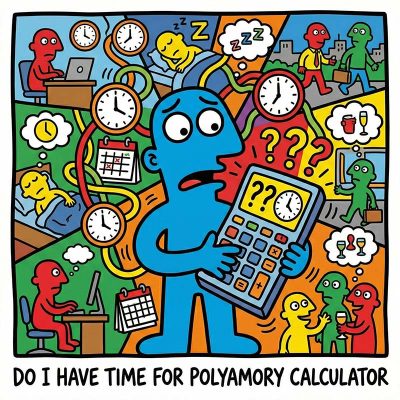
Love is infinite, but your calendar is brutally finite. The fantasy is deep connection; the reality is often just exhausted "calendar tetris." Promising time you don't actually have isn't romantic, it’s a recipe for burnout and broken trust. That sinking feeling when you have to cancel again? That’s the sound of overextension destroying your relationships.
This calculator forces you to confront the math of your life. Do you actually have space for another heart, or are you just setting everyone up for disappointment?

The fantasy is total autonomy and connection. The reality? It can feel like drowning in scheduling chaos and misunderstood expectations. That anxiety you feel isn’t just stress; it’s the wobble of living without a default "anchor." Without a solid architecture, Solo Polyamory stops being a life design and starts being a recipe for burnout and confusion.
The Essential Guide replaces the drift with a concrete anchor. We provide the "Solo Ethic," boundary scripts, and burnout protocols needed to protect your peace. Don't just date around—build a life that actually works for you.
Hierarchy sounds like a corporate org chart until someone gets their feelings hurt. That stomach-turning fear that you are just a "secondary" who can be fired at any time is real. If your relationship feels like a secret ranking system, you are doing it wrong.
Ambiguity is where resentment grows. The Essential Guide replaces the "who matters more" panic with a concrete charter. We provide the scripts and equity guardrails needed to protect every heart in the polycule. Stop guessing and start building.

The ideal is pure equality. The reality? It often slides into hidden rankings where someone gets hurt. That sinking feeling that you are secretly a "secondary" despite the label? That is your intuition detecting couple privilege. Ambiguity is where resentment thrives.
The Essential Guide replaces vague promises with concrete governance. We provide the charters, equity tools, and jealousy protocols needed to ensure "non-hierarchical" isn't just a fantasy. Stop guessing who matters most. Build a network that is actually fair.
The fantasy is total autonomy and connection. The reality? It can feel like drowning in scheduling chaos and misunderstood expectations. That anxiety you feel isn’t just stress; it’s the wobble of living without a default "anchor." Without a solid architecture, Solo Polyamory stops being a life design and starts being a recipe for burnout and confusion.
The Essential Guide replaces the drift with a concrete anchor. We provide the "Solo Ethic," boundary scripts, and burnout protocols needed to protect your peace. Don't just date around—build a life that actually works for you.
Hierarchy sounds like a corporate org chart until someone gets their feelings hurt. That stomach-turning fear that you are just a "secondary" who can be fired at any time is real. If your relationship feels like a secret ranking system, you are doing it wrong.
Ambiguity is where resentment grows. The Essential Guide replaces the "who matters more" panic with a concrete charter. We provide the scripts and equity guardrails needed to protect every heart in the polycule. Stop guessing and start building.
How attachment styles influence non hierarchical polyamory
Non hierarchical polyamory means there is no cold earned hierarchy of partners where one relationship automatically eclipses another. Instead every bond is evaluated on its own terms while you manage time energy and emotion in a network. Attachment styles shape how you experience jealousy communicate safety and build trust within this framework. Here is how the four styles typically interact in a non hierarchical dynamic.
Secure with secure partners
When everyone shows up secure in a non hierarchical setting you often see straightforward communication reliable scheduling and a general sense of calm. People can talk about needs openly and you can negotiate time and energy in a way that makes sense for everyone. The community vibe tends to feel equitable and respectful because assumptions about who gets more attention are minimized by clear agreements and consistent behavior.
Secure with anxious or avoidant partners
Here the secure partner can act as a stabilizing force offering steady communication and clear boundaries while the other partner may struggle with reassurance or distance. The key is balancing empathy with healthy boundaries so no one feels overwhelmed or neglected. Regular check ins and predictable routines can help both sides feel seen while keeping the non hierarchical structure intact.
Anxious with avoidant partners
This pairing can be rocky in any setup. The anxious partner seeks closeness and reassurance while the avoidant partner pulls back to protect themselves. In a non hierarchical world you can address this with explicit agreements about communication frequency what counts as sufficient reassurance and what time alone looks like. The goal is to create a rhythm that respects both the insiders need for contact and the outsiders need for space.
Disorganized patterns across the board
When attachment feels inconsistent inside a network the risk is mixed signals and confusion. The antidote is a commitment to predictable rituals transparent communication and emotion regulation practices. After all non hierarchical relationship structures work best when people know where they stand and feel safe to express what they truly feel.
Practical strategies for making non hierarchical dynamics work with different attachment styles
These practical tactics are designed to help you translate theory into daily life. They focus on communication boundaries emotional safety and sustainable time management. Adapt these suggestions to fit your personal context and the specifics of your relationships.
Build a clear shared language
Start with a simple glossary of terms you all understand. Words like needs boundaries time together frequency and emotional energy should have a shared meaning for your group. When everyone uses the same language you reduce misunderstandings and you create a foundation of trust that helps all attachment styles feel seen.
Create reliable communication rituals
Rituals beat drama on the long run. Decide how you want to check in with each other and how often. Some groups do weekly check ins that cover what is working what needs adjustment and what celebrations are in order. Others prefer shorter daily texts with a longer weekly debrief. The point is consistency not intensity.
Design flexible agreements rather than rigid rules
Non hierarchical means relationships have value but not necessarily the same level of commitment or time. Agreements should be flexible enough to adapt as life changes while still protecting everyone s emotional safety. For example you might agree that each partner has space for two important dates per month with an optional third as a special event. You can adjust the numbers as needed as long as all parties consent openly.
Practice jealousy management and compersion
Jealousy is a natural human signal that something important might be at risk. Rather than suppressing it use it as a cue to explore needs. Compersion is the feeling of joy when your partner is happy with someone else. Cultivate both by learning to reframe thoughts and celebrate the positives without pushing for control. A practical approach is to write down what triggers jealousy and then outline concrete actions you will take when that trigger arises.
Onboard new partners with care
Non hierarchical groups often grow by adding new partners. Treat onboarding like an expansion project rather than a new interview process. Share your agreements early make time for questions and ensure the new person understands your group norms. Ask your current partners to weigh in and emphasize that everyone in the network brings unique value. The goal is a smooth transition that preserves emotional safety for existing relationships while welcoming the newcomer.
Address time management and energy balance openly
Time is a finite resource even in a large network. Create a simple model to plan how you allocate energy and attention. Some groups use a weekly plan that maps out who you see when and how often. Others rely on a triage approach where urgent needs are prioritized and less urgent needs wait a little while. The point is to avoid assuming that more is always better. Equal value does not mean identical time budgets for every relationship.
Encourage self awareness and self care
Attachment style work is as much about you as it is about your partners. Invest in personal growth such as therapy journaling mindfulness or other practices that help you regulate emotions. When you tend to your own nervous system you show up more reliably for others and you reduce the risk of unhealthy push pull dynamics.
Real life scenarios we can learn from
Scenario A: A secure partner supporting a partner who feels insecure
In this scenario the secure partner notices a partner feels anxious about a new relationship. They set a recurring check in time but also invite their partner to co create a reassurance plan that feels comfortable for both. They acknowledge the other person s fears without becoming defensive and they maintain the non hierarchical stance by treating the relationship as a separate but equally valued connection. Outcome you want is more open dialogue less guessing and a clearer path to shared agreements that respect both people s needs.
Scenario B: An anxious partner learning to regulate without becoming overly dependent
The anxious partner arranges a structured language for requests and a predictable rhythm in communication. They practice self soothing techniques and ask for space when needed instead of shouting into the void. The other partners respond with empathy and clear boundaries while still keeping the door open for reassurance as a natural part of the network. The result is more stability and less drama because the anxious energy has a productive outlet rather than turning into a crisis.
Scenario C: An avoidant partner practicing deeper connection without losing autonomy
The avoidant partner identifies a minimal but meaningful level of emotional sharing they are comfortable with. The group agrees on a cadence for checking in that respects both autonomy and closeness. The avoidant partner learns to name needs directly and the others learn to respond without pressuring for more intimacy than is comfortable. Over time trust grows and the relationship load feels more manageable for everyone involved.
Glossary of useful terms and acronyms
- ENM Ethically non monogamous or ethically non monogamy. A relationship philosophy that values honesty communication and consent across multiple romantic or sexual relationships.
- Non hierarchical polyamory A style of polyamory where no partner is ranked above others and all relationships are valued without a fixed hierarchy.
- Attachment style Patterns in how a person relates to closeness and trust often rooted in early experiences that influence adult relationships.
- Secure attachment A comfortable approach to closeness with healthy boundaries and good emotional regulation.
- Anxious attachment A tendency to seek closeness and reassurance sometimes accompanied by fear of abandonment.
- Avoidant attachment A preference for independence and a tendency to distance emotionally to feel safe.
- Disorganized attachment A mix of fear and desire for closeness often resulting in inconsistent responses to relationship situations.
- Compersion A joyful feeling when a partner experiences happiness with someone else rather than jealousy.
- Boundaries Clear rules about what is acceptable and what is not in a relationship to protect emotional safety.
- Onboarding The process of introducing a new partner into an existing relationship network with care and clarity.
Frequently asked questions
Love is infinite, but your calendar is brutally finite. The fantasy is deep connection; the reality is often just exhausted "calendar tetris." Promising time you don't actually have isn't romantic, it’s a recipe for burnout and broken trust. That sinking feeling when you have to cancel again? That’s the sound of overextension destroying your relationships.
This calculator forces you to confront the math of your life. Do you actually have space for another heart, or are you just setting everyone up for disappointment?
The fantasy is total autonomy and connection. The reality? It can feel like drowning in scheduling chaos and misunderstood expectations. That anxiety you feel isn’t just stress; it’s the wobble of living without a default "anchor." Without a solid architecture, Solo Polyamory stops being a life design and starts being a recipe for burnout and confusion.
The Essential Guide replaces the drift with a concrete anchor. We provide the "Solo Ethic," boundary scripts, and burnout protocols needed to protect your peace. Don't just date around—build a life that actually works for you.
Hierarchy sounds like a corporate org chart until someone gets their feelings hurt. That stomach-turning fear that you are just a "secondary" who can be fired at any time is real. If your relationship feels like a secret ranking system, you are doing it wrong.
Ambiguity is where resentment grows. The Essential Guide replaces the "who matters more" panic with a concrete charter. We provide the scripts and equity guardrails needed to protect every heart in the polycule. Stop guessing and start building.
The ideal is pure equality. The reality? It often slides into hidden rankings where someone gets hurt. That sinking feeling that you are secretly a "secondary" despite the label? That is your intuition detecting couple privilege. Ambiguity is where resentment thrives.
The Essential Guide replaces vague promises with concrete governance. We provide the charters, equity tools, and jealousy protocols needed to ensure "non-hierarchical" isn't just a fantasy. Stop guessing who matters most. Build a network that is actually fair.
The fantasy is total autonomy and connection. The reality? It can feel like drowning in scheduling chaos and misunderstood expectations. That anxiety you feel isn’t just stress; it’s the wobble of living without a default "anchor." Without a solid architecture, Solo Polyamory stops being a life design and starts being a recipe for burnout and confusion.
The Essential Guide replaces the drift with a concrete anchor. We provide the "Solo Ethic," boundary scripts, and burnout protocols needed to protect your peace. Don't just date around—build a life that actually works for you.
Hierarchy sounds like a corporate org chart until someone gets their feelings hurt. That stomach-turning fear that you are just a "secondary" who can be fired at any time is real. If your relationship feels like a secret ranking system, you are doing it wrong.
Ambiguity is where resentment grows. The Essential Guide replaces the "who matters more" panic with a concrete charter. We provide the scripts and equity guardrails needed to protect every heart in the polycule. Stop guessing and start building.
