
Building a Personal Values Framework for Non Hierarchy

Non hierarchical polyamory can feel like a wild ride and a clear map at the same time. You want freedom to love openly and you also want a sense of direction that keeps your relationships healthy and sane. A personal values framework is that map. It helps you decide who you are becoming in each connection and how you want to show up in every interaction. This guide will walk you through what a values framework is in plain language, why it matters in a non hierarchical setup, and how to build one that actually sticks. We will keep it practical, real and a little bit playful because love deserves both clarity and a good laugh.
Quick Links to Useful Sections
- What non hierarchical polyamory means in everyday life
- Key terms you may hear as you build your framework
- Why a personal values framework matters in a non hierarchical setup
- Core values you might consider in a non hierarchical polyamory world
- How to build a personal values framework step by step
- Step 1. Clarify your non negotiables and negotiables
- Step 2. Define what each value looks like in action
- Step 3. Create relationship level guidelines rather than universal rules
- Step 4. Build a living document you can edit
- Step 5. Practice and test your framework with small experiments
- Step 6. Schedule regular reviews and updates
- Practical exercises you can use to shape your framework
- Values inventory
- Decision journal
- Boundary versus agreement map
- What if scenarios
- Common scenarios and value conflicts and how to navigate them
- Scenario one jealousy and time management
- Scenario two disclosure versus privacy
- Scenario three evolving life circumstances
- Scenario four safety and health concerns
- Communication strategies that support a values driven non hierarchical dynamic
- Self care and ecosystem thinking inside a non hierarchical polyamory world
- Tools and resources to support your framework journey
- Glossary of useful terms and acronyms
- Frequently asked questions
What non hierarchical polyamory means in everyday life
Let us break down the terms so we are all on the same page. Non hierarchical polyamory is a form of ethical non monogamy where there is no ranking of partners based on a priority or a hierarchy. In this setup every relationship is valuable and none is assumed to be more important than another by default. The emphasis is on consent, communication and intentional decision making. People in non hierarchical polyamory often create agreements that reflect their own values rather than following a universal ladder of significance. A personal values framework supports that approach by giving you a reliable reference point for what you will tolerate what you will celebrate and how you will show up when things get complicated.
In practice this means you might be courting time management decisions with multiple partners you might be navigating emotional energy across relationships and you will often negotiate boundaries in a way that respects the dignity and autonomy of everyone involved. A well designed values framework helps you to avoid drift it helps you to avoid letting fear or habit push you into outcomes that do not fit your deepest beliefs. It also makes it easier to communicate your stance in a way that is clear but not punitive. And yes it is totally possible to be playful and warm while still holding a strong value driven stance on what matters to you and the people you love.
Key terms you may hear as you build your framework
Below is a quick glossary of terms and acronyms you might encounter as you work on a personal values framework in a non hierarchical polyamory setting. If anything is new to you take a moment to jot it down and refer back here. We explain things in plain language so you do not have to guess what people mean.
- ENM Ethical non monogamy. A broad term for relationships that involve more than one intimate connection with the knowledge and consent of everyone involved.
- Non hierarchical In this context relationships are not ranked or prioritized by default. Each connection is evaluated on its own terms rather than through a universal ladder.
- Polyamory The practice of having multiple loving relationships with the knowledge and consent of everyone involved.
- Compersion The opposite of jealousy. Feeling happy when others experience joy or romance with someone you care about.
- Boundary A line you set that helps you protect your well being and values within a relationship. Boundaries are about keeping you safe and comfortable.
- Agreement A practical understanding among partners about how you will behave in a given situation, such as how you handle scheduling or sexual health precautions.
- Values framework A living document or mental model that describes the core principles that guide your decisions and actions in relationships.
- Living document A framework that you update over time as people grow and circumstances change rather than a fixed rule book.
- Jealousy navigation The process of understanding where jealousy comes from and how to respond in a way that aligns with your values rather than reacting impulsively.
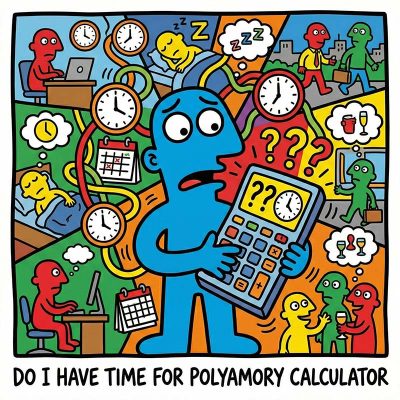
Love is infinite, but your calendar is brutally finite. The fantasy is deep connection; the reality is often just exhausted "calendar tetris." Promising time you don't actually have isn't romantic, it’s a recipe for burnout and broken trust. That sinking feeling when you have to cancel again? That’s the sound of overextension destroying your relationships.
This calculator forces you to confront the math of your life. Do you actually have space for another heart, or are you just setting everyone up for disappointment?

The fantasy is total autonomy and connection. The reality? It can feel like drowning in scheduling chaos and misunderstood expectations. That anxiety you feel isn’t just stress; it’s the wobble of living without a default "anchor." Without a solid architecture, Solo Polyamory stops being a life design and starts being a recipe for burnout and confusion.
The Essential Guide replaces the drift with a concrete anchor. We provide the "Solo Ethic," boundary scripts, and burnout protocols needed to protect your peace. Don't just date around—build a life that actually works for you.
Hierarchy sounds like a corporate org chart until someone gets their feelings hurt. That stomach-turning fear that you are just a "secondary" who can be fired at any time is real. If your relationship feels like a secret ranking system, you are doing it wrong.
Ambiguity is where resentment grows. The Essential Guide replaces the "who matters more" panic with a concrete charter. We provide the scripts and equity guardrails needed to protect every heart in the polycule. Stop guessing and start building.
The ideal is pure equality. The reality? It often slides into hidden rankings where someone gets hurt. That sinking feeling that you are secretly a "secondary" despite the label? That is your intuition detecting couple privilege. Ambiguity is where resentment thrives.
The Essential Guide replaces vague promises with concrete governance. We provide the charters, equity tools, and jealousy protocols needed to ensure "non-hierarchical" isn't just a fantasy. Stop guessing who matters most. Build a network that is actually fair.
The fantasy is total autonomy and connection. The reality? It can feel like drowning in scheduling chaos and misunderstood expectations. That anxiety you feel isn’t just stress; it’s the wobble of living without a default "anchor." Without a solid architecture, Solo Polyamory stops being a life design and starts being a recipe for burnout and confusion.
The Essential Guide replaces the drift with a concrete anchor. We provide the "Solo Ethic," boundary scripts, and burnout protocols needed to protect your peace. Don't just date around—build a life that actually works for you.
Hierarchy sounds like a corporate org chart until someone gets their feelings hurt. That stomach-turning fear that you are just a "secondary" who can be fired at any time is real. If your relationship feels like a secret ranking system, you are doing it wrong.
Ambiguity is where resentment grows. The Essential Guide replaces the "who matters more" panic with a concrete charter. We provide the scripts and equity guardrails needed to protect every heart in the polycule. Stop guessing and start building.
Why a personal values framework matters in a non hierarchical setup
Without a default hierarchy to guide decisions you depend more on your own internal compass. A values framework gives you that compass and a reference point when situations get tricky. It helps you to:
- Make consistent choices that reflect what you truly believe in rather than what your fears push you toward
- Communicate clearly with current and potential partners about what you want and do not want
- Repair or renegotiate agreements when life changes or when your feelings shift
- Reduce friction by aligning expectations before problems arise
- Respect the autonomy and dignity of everyone involved by being transparent and fair
Important note about values and ethics. A values framework is not a set of commands that rules other people. It is a personal guide to how you choose to show up. You can share it with partners as a living invitation to understand you better. The more you articulate your values and the more you listen to others values the healthier the web of connections becomes.
Core values you might consider in a non hierarchical polyamory world
Everyone has a unique blend of values. Here are common ones you may want to test for yourself. You can embrace all of them or pick the ones that feel most true to you. The key is to choose intentionally and to revisit your choice regularly.
- Autonomy Valuing personal freedom time and the ability to make choices about your own life without coercion.
- Honesty Telling the truth even when it is uncomfortable and being clear about what you want and what you feel.
- Empathy Striving to understand other peoples experiences and to respond with care and consideration.
- Respect Recognizing the dignity of every person including yourself and honoring boundaries and agreements they commit to.
- Transparency Sharing essential information that affects others in the relationship space so that decisions can be made collectively.
- Fairness Treating people with equal regard and ensuring that resources time energy are shared in a just way.
- Growth Committing to ongoing learning about yourself your partners and the dynamics you are part of.
- Kindness Keeping interactions respectful even when there is conflict and choosing language that preserves trust.
- Safety Prioritizing physical and emotional safety for you and for your partners.
- Playfulness Keeping room for humor spontaneity and joy within responsible boundaries.
If you are unsure where to begin you can start with a small set of values and expand as you gain confidence. The most important thing is to act in a way that matches your stated beliefs and to be willing to adjust when new information or experiences challenge you.
How to build a personal values framework step by step
Here is a practical 6 step process you can use to craft a robust framework that supports non hierarchical polyamory. It is designed to be doable in a weekend or a bit longer if you want to take your time. The goal is a living document you can actually refer to when making decisions.
Step 1. Clarify your non negotiables and negotiables
Non negotiables are the things you will not compromise on regardless of the situation. Negotiables are the areas where you can bend or adapt in service of growth or relationship harmony. Start by listing a dozen values that feel essential to you. Then mark which are non negotiable in dating or in ongoing relationships. If a value is non negotiable for you that means you will make a decision that aligns with that value even if it creates friction with a current partner. Be clear about what is at stake and why it matters to you. Writing that down makes it easier to share with others when needed.
Step 2. Define what each value looks like in action
Abstract values help no one. You want concrete behaviors you can recognize in a conversation or a moment of decision. For each value write a short description of what it would look like in daily life. For example autonomy might look like asking for time to think before making a commitment and respecting another person s choice even if it does not match your own plan.
Step 3. Create relationship level guidelines rather than universal rules
In non hierarchical polyamory you often manage multiple connections at once. Instead of universal rules that apply to every person you can create guidelines that apply to each relationship case by case. For example a guideline could be a rule about open communication during scheduling conversations or about sharing important information that could affect a partner s feelings. You may decide that in a new relationship the guideline is to disclose foundational health information early. You may decide that in a more established connection you will negotiate more flexible timing. These guidelines are meant to protect your values and support the health of each connection.
Step 4. Build a living document you can edit
Make a short personal charter that outlines your core values and the practical ways you plan to honor them. Save this document in a place you can easily access. Revisit it every few months or whenever a major life change happens. The charter should not feel rigid. It should feel like a clear invitation to grow with integrity.
Step 5. Practice and test your framework with small experiments
Use light experiments to learn how your framework behaves in real life. For example you might test scheduling with a new partner using a transparent plan that also respects a current partner s need for space. Observe how you feel and what the other person experienced. Use that feedback to refine your descriptions and guidelines.
Step 6. Schedule regular reviews and updates
Put a quarterly reminder on your calendar to review your framework. Ask yourself questions like what values are most relevant right now what has changed and what needs to be adjusted. If your life or relationships evolve you will find your framework changes with you. That is exactly how it should work.
Practical exercises you can use to shape your framework
Try these exercises alone or with a trusted partner or partner group. They are designed to be approachable and non intimidating while still delivering real clarity.
Values inventory
Grab a notebook and write down 20 values that matter to you. If you get stuck try a quick brainstorm. Then rate each value on a scale from 1 to 5 based on how central it feels in your daily life. Choose the top five values you want to center your framework around. If you find you are leaning toward two or three conflicting values you can write a short paragraph that explains how you will balance them in practice. This is your compass keep it handy.
Decision journal
Keep a simple journal that records decisions you make in your relationships and the values that drove those choices. For each decision write what happened why you chose it what values were in play and how you feel about the outcome. Over time patterns emerge and you can adjust your framework to support better decisions.
Boundary versus agreement map
Sometimes we feel a line in the sand and sometimes we reach an agreement that is different. Create a two column map with boundaries on one side and agreements on the other. For each item list the values that support the boundary or the agreement. This helps you see where your personal ethics are guiding you and where you are negotiating with others in practical terms.
What if scenarios
Take a few common tension points and play them out in a low risk way. For example you might imagine you meet a potential partner who has strong feelings about disclosure where do you stand with that value and what would you do. Or you might explore how you would respond if a partner needs more time than you expected to make a decision. These exercises reduce fear and help you articulate your framework with clarity.
Common scenarios and value conflicts and how to navigate them
In a world with many loves you will encounter situations that test your framework. Here are a few typical tensions and respectful ways to approach them. The point is not to avoid conflict but to ride it with your values as your steering wheel.
Scenario one jealousy and time management
You notice a partner sharing exciting new experiences with someone else and you feel a sting in your chest. Your framework would guide you to first acknowledge your feelings without punishment. Then you would reflect on which value is most at stake is it autonomy fairness or growth. You could open a conversation focused on your needs for time and space while also validating the other person s right to pursue connections. If you find you want more time with a certain partner you could propose a temporary schedule adjustment that respects both this need and the needs of others involved.
Scenario two disclosure versus privacy
You value transparency but you also want to protect personal privacy for everyone involved. Your framework could suggest a baseline rule you share essential information that could affect emotional safety or health while keeping private details to be shared by mutual agreement. You might decide that certain boundaries apply to sensitive information and that other topics warrant full openness with consent. The key is to keep conversations ongoing and to revisit what needs to be disclosed as relationships evolve.
Scenario three evolving life circumstances
You experience a major life change such as a new job moving to a different city or a shift in mental health. Your values framework should help you decide how to adapt rather than defaulting to old patterns. You may choose to pause new commitments reflect on your core values then renegotiate with partners to fit the new reality. The process is about honoring your values while respecting others needs and boundaries.
Scenario four safety and health concerns
Safety always comes first. If a health concern emerges you will want to communicate openly about risks and precautions and be prepared to adjust agreements for a time. Your framework helps you to decide what level of openness is necessary and how to involve others in decisions in a respectful and non punitive way.
Communication strategies that support a values driven non hierarchical dynamic
Clear thoughtful communication is the engine that keeps non hierarchical polyamory moving forward. Here are practical practices you can adopt to make conversations easier calmer and more productive.
- Check in regularly Make time for brief conversations about how each person is feeling and what is working or not working in the current arrangement.
- Lead with values When discussing a conflict or a new arrangement start by naming the values that matter to you and invite the other person to share theirs.
- Use specific language Describe behaviors and impacts rather than labeling people or intentions. For example say I felt overlooked when dinner got canceled rather than you never consider me.
- Practice reflective listening Paraphrase what the other person said and ask if you understood correctly before adding your own point.
- Document agreements Keep a running document of agreements and decisions so everyone has a reference point and no one forgets what was decided.
- Plan for renegotiation Accept that agreements are living instruments. Build in regular check ins to renegotiate when life shifts occur.
Self care and ecosystem thinking inside a non hierarchical polyamory world
Your value centered framework works best when you protect your own well being as a baseline. Self care means making space for rest down time and reflection. It also means recognizing when you need support from trusted friends or professionals. Building a healthy relationship ecology is about creating capacity for honest communication and compassionate engagement with multiple partners without burning out.
As you practice your framework you will learn to spot when your energy is being drained by a dynamic and you will know when to recalibrate. Remember that your framework is not a rigid prison it is a flexible compass. It helps you stay aligned with what matters most while you remain open to growth and change.
Tools and resources to support your framework journey
Here are some practical resources you can lean on as you build and refine your personal values framework. Use what resonates and adapt what does not fit your life or your style.
- Templates for value inventories and decision journals
- Simple guides to non hierarchical relationship agreements
- Reading lists on ethical non monogamy and consent culture
- Worksheets that help you articulate boundary and consent expectations
- Conversation starters designed to open up value based discussions with partners
Glossary of useful terms and acronyms
- ENM Ethical non monogamy a broad umbrella term for relationships that involve more than one intimate connection with consent among all involved.
- Non hierarchical A relational structure where no partner is universally ranked above others by default and decisions are made based on context and values.
- Polyamory The practice of engaging in multiple intimate relationships with the knowledge and consent of everyone involved.
- Compersion A feeling of joy for a partner when they experience happiness with someone else.
- Boundary A personal limit that protects your emotional or physical safety and aligns with your values.
- Agreement A concrete understanding with partners about how you will behave in a given situation.
- Values framework A living guide to the core beliefs that shape decisions and actions within relationships.
- Living document A flexible policy you update as you grow and as circumstances change.
Frequently asked questions
Here are some common questions people ask when they start building a personal values framework for non hierarchical polyamory. If your question is not listed feel free to reach out and we will help you tailor a plan that fits your life.
What exactly is a values framework in non hierarchical polyamory
It is a personal guide that describes the core beliefs and standards you want to be reflected in your relationships. It explains how you will handle decisions about time energy communication and consent while you maintain autonomy and mutual respect with your partners.
Why is non hierarchical important
Non hierarchical means there is no automatic ranking of partners. Relationships are valued for what they bring to your life rather than where they stand on a ladder. A strong framework helps you honor that intention and avoid drifting into unspoken expectations that can cause friction.
How can I start if I feel overwhelmed
Begin with a short list of three to five core values. Write a simple description of what each value looks like in action. Create a small set of guidelines that apply to your current relationships. Remember that the framework is a living document and you can revise it as you learn more about yourself and your partners.
How often should I revisit the framework
Plan a formal review every three to six months. You may also revisit it after major life events such as a change in relationship status a move a job shift or the arrival of a new partner. Regular reflection keeps the framework relevant and useful.
What if my partner disagrees with my values
That is a normal part of any evolving relationship. Approach it with curiosity ask questions about where your values diverge and look for common ground. You may adjust certain guidelines or create new agreements that honor both sets of values. If a fundamental mismatch is too large you may need to renegotiate the relationship or end it respectfully.
How do I communicate my framework to new partners
Share a concise summary of your core values and the rationale behind them. Be open to questions and invite them to share theirs. Use the conversation to negotiate a few initial agreements that honor both parties needs. Remember that you cannot control how someone else feels but you can control how you show up and how clearly you communicate.
Can a personal values framework prevent conflict completely
No it cannot. What it can do is drastically improve your ability to navigate conflicts when they arise. It gives you shared ground to negotiate from and it gives you a framework to refer back to in order to keep conversations respectful and productive.
Is this only for romantic relationships
Not at all. A values framework can guide friendships dating and any kind of partnership where more than one person is involved. The key is that it reflects your ethics and protects your well being while supporting healthy interactions with others.
Building a personal values framework for non hierarchical polyamory is a commitment to yourself and to the people you care about. It is not a cage it is a cooperative tool for living with intention. As you practice you will discover more about who you are what you value and how you want to show up in love. Think of it as a living map that grows as you do a map you will keep up to date and you will use every day to guide your choices.
Love is infinite, but your calendar is brutally finite. The fantasy is deep connection; the reality is often just exhausted "calendar tetris." Promising time you don't actually have isn't romantic, it’s a recipe for burnout and broken trust. That sinking feeling when you have to cancel again? That’s the sound of overextension destroying your relationships.
This calculator forces you to confront the math of your life. Do you actually have space for another heart, or are you just setting everyone up for disappointment?
The fantasy is total autonomy and connection. The reality? It can feel like drowning in scheduling chaos and misunderstood expectations. That anxiety you feel isn’t just stress; it’s the wobble of living without a default "anchor." Without a solid architecture, Solo Polyamory stops being a life design and starts being a recipe for burnout and confusion.
The Essential Guide replaces the drift with a concrete anchor. We provide the "Solo Ethic," boundary scripts, and burnout protocols needed to protect your peace. Don't just date around—build a life that actually works for you.
Hierarchy sounds like a corporate org chart until someone gets their feelings hurt. That stomach-turning fear that you are just a "secondary" who can be fired at any time is real. If your relationship feels like a secret ranking system, you are doing it wrong.
Ambiguity is where resentment grows. The Essential Guide replaces the "who matters more" panic with a concrete charter. We provide the scripts and equity guardrails needed to protect every heart in the polycule. Stop guessing and start building.
The ideal is pure equality. The reality? It often slides into hidden rankings where someone gets hurt. That sinking feeling that you are secretly a "secondary" despite the label? That is your intuition detecting couple privilege. Ambiguity is where resentment thrives.
The Essential Guide replaces vague promises with concrete governance. We provide the charters, equity tools, and jealousy protocols needed to ensure "non-hierarchical" isn't just a fantasy. Stop guessing who matters most. Build a network that is actually fair.
The fantasy is total autonomy and connection. The reality? It can feel like drowning in scheduling chaos and misunderstood expectations. That anxiety you feel isn’t just stress; it’s the wobble of living without a default "anchor." Without a solid architecture, Solo Polyamory stops being a life design and starts being a recipe for burnout and confusion.
The Essential Guide replaces the drift with a concrete anchor. We provide the "Solo Ethic," boundary scripts, and burnout protocols needed to protect your peace. Don't just date around—build a life that actually works for you.
Hierarchy sounds like a corporate org chart until someone gets their feelings hurt. That stomach-turning fear that you are just a "secondary" who can be fired at any time is real. If your relationship feels like a secret ranking system, you are doing it wrong.
Ambiguity is where resentment grows. The Essential Guide replaces the "who matters more" panic with a concrete charter. We provide the scripts and equity guardrails needed to protect every heart in the polycule. Stop guessing and start building.
