
Dating While Practicing Non Hierarchy

Non hierarchy in polyamory means relationships are not ranked by priority or status. There is no designated primary partner who gets first claim on time or resources. Instead partners are treated as equals in terms of emotional investment and freedom. If you have ever wondered how dating works when you reject the idea of a single central relationship you are not alone. This guide is designed for people who live the non hierarchical polyamory life or who are curious about trying it out. We break down terms we explain acronyms and we offer practical steps for dating ethically and with kindness. We will keep things clear and humorous because relationships deserve practical humor as well as honesty.
Quick Links to Useful Sections
- What non hierarchical polyamory means for dating
- Key terms and acronyms you will meet
- How to approach dating in a non hierarchical way
- Start with a clear personal map
- Develop a culture of consent and open communication
- Practice transparent time management
- Manage expectations with thoughtful conversations
- Learn to talk about jealousy and compersion
- Boundaries and agreements that support non hierarchy
- Realistic dating scenarios in non hierarchical polyamory
- Scenario one A busy week with two dates
- Scenario two A metamour conversation that helps everyone feel safe
- Scenario three Handling a breakup within a non hierarchical setup
- Scenario four A new partner and a new energy moment
- Safe sex consent and health in non hierarchy
- Navigating jealousy and building trust
- The metamour relationship dynamic
- Tools and practices for thriving in non hierarchical dating
- Common myths and honest truths about non hierarchical dating
- Practical takeaways for dating non hierarchical
- Glossary of useful terms and acronyms
- Frequently asked questions
What non hierarchical polyamory means for dating
Non hierarchical polyamory is a structure where every relationship is valued on its own merits rather than on a ranking system that places one person above others. In this setup you might have multiple partners who are all equally important. That does not mean there is no commitment or boundaries. It simply means that commitment does not revolve around a single anchor or primary connection. You get to define what each connection means to you and you negotiate what you can give to each person without creating an implicit ladder of love.
In practice dating within a non hierarchical dynamic involves a few core ideas. First there is open honest communication about expectations. Everyone involved has a voice and that voice gets heard. Second there is transparency about time. People work together to make sure needs are met without forcing anyone into a fixed schedule. Third there is respect for metamours. A metamour is someone who is dating or partnered with your partner. You can learn to co exist peacefully and even celebrate the connections in your circle of love. These ideas form the backbone of how you date when you practice non hierarchy.
Key terms and acronyms you will meet
- Ethical non monogamy A relationship stance that rejects the idea of exclusive monogamy and emphasizes consent honesty and transparency among all involved.
- Non hierarchical polyamory A form of polyamory in which no relationship holds a superior or default status over another. All relationships are treated as equally valid.
- Polyamory A relationship style in which a person has romantic or sexual relationships with more than one person at the same time with consent from everyone involved.
- Metamour The person who is dating or involved with one of your partners but is not connected to you by a romantic bond.
- New relationship energy A surge of excitement and optimism that often comes when a new relationship begins to form. It can affect how you feel and how you behave with others.
- NRE New relationship energy is the same idea as new relationship energy but abbreviated. It helps to know that feelings can change as relationships mature.
- DTR Define the relationship is a conversation about where a relationship is heading and what the future might hold. It helps to set expectations with new partners.
- Consent A ongoing and clear agreement to participate in a specific activity or relationship. Consent can be withdrawn at any time.
- Boundaries Guidelines you and others set to protect your emotional safety and well being. Boundaries can be about time honesty privacy and physical intimacy.
- Jealousy An emotion that can show up when a person perceives a threat to something they value. Jealousy can be managed with self awareness and communication.
- Compersion A feeling of joy when a partner experiences happiness with someone else. It is the opposite of jealousy and a goal for many non hierarchical setups.
- Transparency The practice of sharing information openly with all parties involved to prevent misunderstandings.
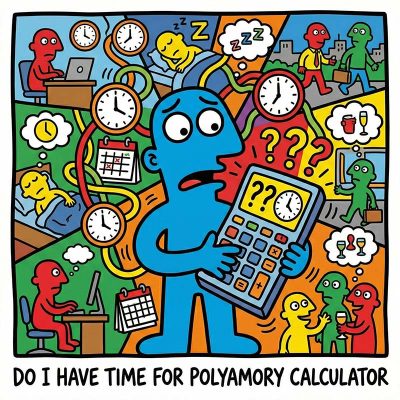
Love is infinite, but your calendar is brutally finite. The fantasy is deep connection; the reality is often just exhausted "calendar tetris." Promising time you don't actually have isn't romantic, it’s a recipe for burnout and broken trust. That sinking feeling when you have to cancel again? That’s the sound of overextension destroying your relationships.
This calculator forces you to confront the math of your life. Do you actually have space for another heart, or are you just setting everyone up for disappointment?

The fantasy is total autonomy and connection. The reality? It can feel like drowning in scheduling chaos and misunderstood expectations. That anxiety you feel isn’t just stress; it’s the wobble of living without a default "anchor." Without a solid architecture, Solo Polyamory stops being a life design and starts being a recipe for burnout and confusion.
The Essential Guide replaces the drift with a concrete anchor. We provide the "Solo Ethic," boundary scripts, and burnout protocols needed to protect your peace. Don't just date around—build a life that actually works for you.

Hierarchy sounds like a corporate org chart until someone gets their feelings hurt. That stomach-turning fear that you are just a "secondary" who can be fired at any time is real. If your relationship feels like a secret ranking system, you are doing it wrong.
Ambiguity is where resentment grows. The Essential Guide replaces the "who matters more" panic with a concrete charter. We provide the scripts and equity guardrails needed to protect every heart in the polycule. Stop guessing and start building.

The ideal is pure equality. The reality? It often slides into hidden rankings where someone gets hurt. That sinking feeling that you are secretly a "secondary" despite the label? That is your intuition detecting couple privilege. Ambiguity is where resentment thrives.
The Essential Guide replaces vague promises with concrete governance. We provide the charters, equity tools, and jealousy protocols needed to ensure "non-hierarchical" isn't just a fantasy. Stop guessing who matters most. Build a network that is actually fair.
The fantasy is total autonomy and connection. The reality? It can feel like drowning in scheduling chaos and misunderstood expectations. That anxiety you feel isn’t just stress; it’s the wobble of living without a default "anchor." Without a solid architecture, Solo Polyamory stops being a life design and starts being a recipe for burnout and confusion.
The Essential Guide replaces the drift with a concrete anchor. We provide the "Solo Ethic," boundary scripts, and burnout protocols needed to protect your peace. Don't just date around—build a life that actually works for you.
Hierarchy sounds like a corporate org chart until someone gets their feelings hurt. That stomach-turning fear that you are just a "secondary" who can be fired at any time is real. If your relationship feels like a secret ranking system, you are doing it wrong.
Ambiguity is where resentment grows. The Essential Guide replaces the "who matters more" panic with a concrete charter. We provide the scripts and equity guardrails needed to protect every heart in the polycule. Stop guessing and start building.
How to approach dating in a non hierarchical way
Dating without hierarchy comes with unique advantages and challenges. You can pursue connections that feel right without chasing a single ultimate commitment. You can also face situations that require careful communication and thoughtful boundaries. The core practice is to stay honest about your needs and to invite others to do the same. Here are practical steps to start and sustain healthy dating in a non hierarchical context.
Start with a clear personal map
Before you meet new people take a moment to map your own needs and values. Decide what you want from dating in the near term and in the longer term. Think about how much time you can realistically invest in multiple people and what kinds of emotional energy you want to share. You may know that you want to explore friendship intimacy or romance with different people. Write down a few bullet points about what would feel healthy for you. This map will guide conversations with potential partners and metamours.
Develop a culture of consent and open communication
Consent is ongoing not one conversation you have once. You should check in about comfort levels with new topics or changes in the relationship. Regular check ins reduce miscommunication and prevent boundary violations. Your conversations can begin with simple questions like how are you feeling about our connection today or is there anything you wish we could adjust. Always invite feedback and accept it even if it is hard to hear.
Practice transparent time management
In non hierarchical dating time is a resource that everyone shares. Work with partners to create a flexible schedule that honors each person s needs. Some people use shared calendars or group notes to plan dates while protecting privacy. The goal is to avoid unpredictable last minute conflicts and to allow space for rest and personal time. You may find that shorter more regular connection points work better than long sporadic bursts of time. Remember that the quality of time matters more than the quantity of time.
Manage expectations with thoughtful conversations
Expectations differ from one relationship to another. You may expect more frequent updates from one partner while a second partner may value deep one to one time. Have open discussions about what each relationship needs and how those needs fit with your life. It is okay to discover that some connections are evolving and others remain steady. What matters is honesty and ongoing consent from everyone involved.
Learn to talk about jealousy and compersion
Jealousy is not a failure it is a signal. Use it as a prompt to discuss boundaries and reassure yourself and others. Speak up about what makes you uncomfortable and ask what would help you feel safer and more connected. When you can cultivate compersion you may feel joy in your partner s happiness even if you are not sharing that exact experience. Compersion grows with time and trust.
Boundaries and agreements that support non hierarchy
Boundaries are personal and they can change. The trick is to treat boundaries as living guidelines that can be updated as relationships change. In non hierarchical polyamory there is a practical emphasis on consent transparency and respect for each person s autonomy. Here are some boundaries and agreements that many people find helpful.
- Time boundaries Decide how much time you want to devote to dating multiple people. Agree on a minimum amount of personal time you want for yourself each week.
- Sexual health boundaries Share up to date information about sexual health and testing. Agree on the use of protection and what forms of testing are required or preferred.
- Communication boundaries Establish how often you will check in with each partner and what kinds of topics belong in group conversations versus private chats.
- Privacy boundaries Determine what information you prefer to keep private and what you are comfortable sharing with metamours and partners.
- Public vs private life Decide how you will present your relationships to friends family and colleagues. Agree on what details are shared in social settings.
Realistic dating scenarios in non hierarchical polyamory
Seeing real life examples helps make sense of these ideas. Here are a few scenarios that illustrate the dynamics you might encounter. These are not rules just possibilities. Use them as a starting point to shape your own agreements with partners.
Scenario one A busy week with two dates
You have a date with partner A on Tuesday and partner B on Friday. You commit to using a shared calendar to avoid double booking and you tell both partners that you will be unavailable during a small window on Wednesday and Thursday to rest and catch up on personal tasks. You also promise to share you thoughtful reflections after each date and invite feedback about how the time felt. Both partners know they are not the sole focus of your attention but they feel respected because you honor commitments and communicate clearly.
Scenario two A metamour conversation that helps everyone feel safe
You have met your partner s new partner during a group event. You notice a twinge of discomfort inside you. You invite a calm conversation with your partner and the new metamour separately. You share your boundaries and ask what the new relationship means for all of you. The others share their expectations and we end with a group check in to see how everyone feels. The result is a better sense of safety for each person and an understanding that the dynamic can evolve in a positive way.
Scenario three Handling a breakup within a non hierarchical setup
One of your relationships reaches a natural end. You acknowledge the loss and you acknowledge the positive growth you gained from that connection. You have a plan for privacy and emotional safety in shared spaces and you communicate what the new boundaries will be with the other partner. You offer mutual respect and a path to maintain friendship if that feels possible. It is normal for feelings to shift as the dynamic changes and that is part of honest dating within non hierarchy.
Scenario four A new partner and a new energy moment
You meet someone with strong NRE energy. You take time to be transparent about how that energy can influence your decisions and your interactions. You check in with your existing partners about comfort levels and you pace the early days so the bond can grow without pressure. The approach helps you to manage expectations and to avoid forcing a sudden shift in any existing relationship.
Safe sex consent and health in non hierarchy
Health and safety are fundamental no matter what the relationship structure. In non hierarchical polyamory you want to keep everyone safe and informed. This includes talking about testing frequency sharing results when appropriate and using protection as needed. Be willing to adjust safety practices as you rotate through partners and as circumstances change. Clear consent remains the bedrock of every intimate encounter and it is normal for practices to evolve over time.
Navigating jealousy and building trust
Jealousy can appear suddenly or grow slowly. The non hierarchical approach gives you the tools to address it without shaming yourself or others. Start with your feelings name what you are actually feeling and articulate what you need to feel safe. This kind of mapping reduces the chance of a volatile reaction. It also helps you to explain your perspective to your partners in a kind straightforward way. Trust grows when communication is reliable and when boundaries are honored.
The metamour relationship dynamic
Metamours can be a source of strength or stress depending on how you handle it. The goal is to foster a respectful atmosphere where you do not feel compelled to compete for attention. Some people discover they become friends or friendly co conspirators who cheer each other on. Others keep professional boundaries and focus on their own connections. The key is to approach metamours with curiosity and kindness and to avoid assuming negative intent about their actions with your partner.
Tools and practices for thriving in non hierarchical dating
- Honest check ins Schedule consistent conversations to review what is working and what needs adjustment in each relationship.
- Shared but private calendars Use a calendar to coordinate dates without sharing every detail of your life with everyone at once.
- Energy accounting Reflect on how much emotional energy you have available and allocate it across different relationships in a balanced way.
- Templates for conversations Create small scripts you can customize for different situations. This reduces anxiety and ensures you cover essentials.
- Boundaries review ritual Set aside time every few weeks to review boundaries with each partner and adjust as needed.
Common myths and honest truths about non hierarchical dating
- Myth You cannot have serious relationships without hierarchy. Truth People build deep connections through consistent communication and shared values. Hierarchy is a choice not a requirement.
- Myth Jealousy means you cannot do this. Truth Jealousy is a signal to explore boundaries and needs. With practice you can process it in a healthy way.
- Myth It means you are less committed. Truth Commitment is not about the number of partners it is about the honesty and reliability you show across relationships.
- Myth Everyone will want to date you if you are non hierarchical. Truth You will attract people who share the same values and you will also meet people who prefer different structures. Compatibility matters more than a specific label.
Practical takeaways for dating non hierarchical
- Be explicit about the absence of a primary relationship when starting a romance with someone new.
- Invite questions and welcome a conversation about what is important to each person you are dating.
- Use time management tools that protect your well being and allow you to meet the needs of multiple partners.
- Seek community support whether that means friends who understand ENM or a therapist who is comfortable with non conventional relationship dynamics.
- Practice compassionate communication even when a conversation feels difficult. Kindness creates safety for all involved.
Glossary of useful terms and acronyms
- ENM Ethical non monogamy a term for relationship styles that involve openness about multiple partnerships with consent from everyone involved.
- Non hierarchical polyamory A polyamory model in which no partner holds a dominant status over others. All relationships are treated as equally valid.
- Polyamory The practice of engaging in multiple romantic or sexual relationships with the consent of everyone involved.
- Metamour The partner of your partner or the partner someone else is dating who is not directly your partner.
- NRE New relationship energy a burst of excitement when a new relationship begins which can affect feelings and actions.
- DTR Define the relationship a conversation about where a relationship is heading and what it will look like moving forward.
- Consent Ongoing clear agreement to participate in a given activity or relationship. It can be revised or withdrawn at any time.
- Boundary Personal limits about what you are comfortable with in terms of time privacy honesty and physical intimacy.
- Jealousy An emotional response to perceived threats to a valued relationship. It can be managed with self awareness and communication.
- Compersion Feeling happiness from your partner's joy with someone else a sign of healthy interdependence.
- Transparency Open sharing of information and feelings among all involved parties to prevent misunderstandings.
Frequently asked questions
Answers to common questions that people often have when exploring non hierarchical polyamory. If you want more detail you can reach out to a trusted adviser in your community or a therapist who understands ENM dynamics.
- What does non hierarchical polyamory feel like in daily life? It feels like a flexible web of connections where each relationship has its own shape. You balance time energy and affection across several people without placing one relationship above the others. It requires ongoing consent open conversation and mutual respect.
- How do I begin dating someone new without implying a hierarchy? Be upfront about your structure early in the conversation. Explain that you value all your relationships equally and you will manage your time to maintain fairness. Invite questions and share your expectations clearly.
- How can I handle jealousy when I am dating multiple people? Name your feelings acknowledge their legitimacy and articulate what would make you feel safer and more supported. Seek solutions together such as adjusting schedules or clarifying boundaries.
- Is it possible to create a long term stable life with non hierarchical relationships? Yes. Stability comes from continuous communication trust and agreed boundaries. It evolves as needs change and it can be deeply fulfilling when everyone feels valued and respected.
- How do I talk to metamours about boundaries? Approach the conversation with curiosity and kindness. Share your own boundaries and invite them to share theirs. Focus on the shared goal of making the dynamic comfortable for everyone involved.
- What if someone wants exclusivity or a hierarchy for a relationship with me? Acknowledge their feelings and explain your current structure and boundaries. You can offer a trial period or agree to revisit the topic later if both sides are open to conversation.
- Are there tools that help manage multiple relationships? Yes there are calendar apps note sharing and group chats that help coordinate scheduling while preserving privacy. Regular check ins are essential for keeping everyone aligned.
- How often should I check in with each partner? There is no one size fits all answer. A good approach is to check in at least every two weeks with each partner and sooner if there is a major change in feelings or circumstances.
- What if I want to slow down dating because I feel overwhelmed? It is perfectly fine to pause dating while you recharge. You can let partners know you will slow the pace or take a break and revisit the topic later when you feel ready.
- Where can I learn more about non hierarchical polyamory? Look for books articles and online communities that focus on ethical non monogamy with emphasis on mutual respect and ongoing consent. It helps to learn from multiple voices and experiences.
Love is infinite, but your calendar is brutally finite. The fantasy is deep connection; the reality is often just exhausted "calendar tetris." Promising time you don't actually have isn't romantic, it’s a recipe for burnout and broken trust. That sinking feeling when you have to cancel again? That’s the sound of overextension destroying your relationships.
This calculator forces you to confront the math of your life. Do you actually have space for another heart, or are you just setting everyone up for disappointment?
The fantasy is total autonomy and connection. The reality? It can feel like drowning in scheduling chaos and misunderstood expectations. That anxiety you feel isn’t just stress; it’s the wobble of living without a default "anchor." Without a solid architecture, Solo Polyamory stops being a life design and starts being a recipe for burnout and confusion.
The Essential Guide replaces the drift with a concrete anchor. We provide the "Solo Ethic," boundary scripts, and burnout protocols needed to protect your peace. Don't just date around—build a life that actually works for you.
Hierarchy sounds like a corporate org chart until someone gets their feelings hurt. That stomach-turning fear that you are just a "secondary" who can be fired at any time is real. If your relationship feels like a secret ranking system, you are doing it wrong.
Ambiguity is where resentment grows. The Essential Guide replaces the "who matters more" panic with a concrete charter. We provide the scripts and equity guardrails needed to protect every heart in the polycule. Stop guessing and start building.
The ideal is pure equality. The reality? It often slides into hidden rankings where someone gets hurt. That sinking feeling that you are secretly a "secondary" despite the label? That is your intuition detecting couple privilege. Ambiguity is where resentment thrives.
The Essential Guide replaces vague promises with concrete governance. We provide the charters, equity tools, and jealousy protocols needed to ensure "non-hierarchical" isn't just a fantasy. Stop guessing who matters most. Build a network that is actually fair.
The fantasy is total autonomy and connection. The reality? It can feel like drowning in scheduling chaos and misunderstood expectations. That anxiety you feel isn’t just stress; it’s the wobble of living without a default "anchor." Without a solid architecture, Solo Polyamory stops being a life design and starts being a recipe for burnout and confusion.
The Essential Guide replaces the drift with a concrete anchor. We provide the "Solo Ethic," boundary scripts, and burnout protocols needed to protect your peace. Don't just date around—build a life that actually works for you.
Hierarchy sounds like a corporate org chart until someone gets their feelings hurt. That stomach-turning fear that you are just a "secondary" who can be fired at any time is real. If your relationship feels like a secret ranking system, you are doing it wrong.
Ambiguity is where resentment grows. The Essential Guide replaces the "who matters more" panic with a concrete charter. We provide the scripts and equity guardrails needed to protect every heart in the polycule. Stop guessing and start building.
