
Grief and Change in a Multi Partner System

Welcome to a frank, practical guide from The Monogamy Experiment. We are here to talk about the moments when love and connection shift in a group that does not rank relationships. This guide dives into grief and change within a multi partner system built on non hierarchical polyamory, a dynamic often described with the acronym ENM which stands for ethical non monogamy. If you are navigating a breakup, a new arrival, or a shift in energy within a non hierarchical setup, you are not alone. We will walk you through what changes look like, how grief can show up for different people in the system, and concrete strategies to move through transitions with care, humor, and real talk. And yes we will keep the explanations clear so everyone understands what is going on even if you are new to this world.
Quick Links to Useful Sections
- Who this guide is for
- Quick primer on terms and acronyms
- What non hierarchical polyamory looks like in real life
- Why grief shows up in multi partner ENM systems
- How grief can show up differently for different people in a non hierarchical system
- For partners who were deeply involved with the person drawing away
- For people who welcomed a new partner into the circle
- For metamours who feel left out or overlooked
- For individuals dealing with personal boundaries and desires shifting
- How to talk about change in a non hierarchical polyamory ENM system
- Practical tools to help your system grieve and re negotiate
- 1. Boundary mapping
- 2. Regular check in rituals
- 3. Grief journaling templates
- 4. The three questions framework
- 5. Mini rituals for closure and renewal
- Realistic scenarios you might encounter
- Scenario 1: A partner steps back and energy shifts
- Scenario 2: A new partner arrives and changes the balance
- Scenario 3: Scheduling and life events create friction
- Scenario 4: A shift in desires or relationship structures
- Scenario 5: A crisis triggers collective grief
- Healing through care in a non hierarchical ENM system
- Supportive conversations you can have with your circle
- When to seek outside help
- Glossary of useful terms and acronyms
Grief in any relationship system is messy. In a non hierarchical polyamory ENM setup the grief can feel amplified because connections are not neatly tiered and there is often more than one emotional center at play. The goal of this guide is to help you recognize grief as a signal, understand where it is coming from, and respond in ways that honor everyone involved. We will cover language you can use, scripts you can adapt, and practical tips that work in real life. If you are reading this because you want to support a friend or partner or because you want to navigate your own changes with more grace, you will find tools here that apply to many different configurations. And because we believe in making complex topics accessible, we will spell out terms and acronyms so nothing is left mysterious.
Who this guide is for
This guide is for people who live in or are curious about non hierarchical polyamory ENM dynamics where there is no single primary partner or ranking ladder. It is for partners who want to understand how grief can appear in a group and for individuals who find themselves grieving a change in a relationship without a clear hierarchy. It is also for friends, allies, and professionals who want to support groups with many connections at once. If you want to approach change with empathy, practical rituals, and honest conversation, you are in the right place. We will use concrete scenarios and simple language so you can translate theory into everyday steps that actually help.
Quick primer on terms and acronyms
To make sure everyone is on the same page we will start with a quick glossary of terms and acronyms you will frequently see in non hierarchical polyamory ENM conversations. If a term feels unfamiliar, skim this section and keep it handy as you read the rest of the guide.
- ENM Ethical Non Monogamy. A relationship style that prioritizes consent, honesty, and open communication among all people involved. ENM does not imply chaos it implies intentional openness.
- Non Hierarchical Polyamory A polyamory approach in which there is no ranking of relationships. All connections are treated as equally valuable and important, even if they differ in time intensity or closeness.
- System In polyamorous contexts a group of people who share connections and potentially life events. A system can include partners, metamors and close friends who are part of the network.
- Jealousy An emotional response that can arise when someone feels threatened by a rival or by perceived loss of attention. In ENM jealousy is explored openly rather than suppressed.
- Grief The emotional process that follows a significant change in a relationship. Grief can include sadness anger longing and a sense of loss even when the change is chosen or desired by some members.
- Boundaries Agreed limits that help keep relationships safe and respectful. Boundaries are flexible in ENM and can shift as a system evolves.
- Boundary map A practical tool to visualize where lines are drawn in a system and how those lines affect feelings and actions.
- Metamours People who are in a relationship with another partner in your circle but not with you directly. In a non hierarchical setup metamours can form close connections or maintain traditional boundaries depending on the group.
- Rituals Small practices that help a group process change together such as a check in, a shared meal or a grounding exercise.
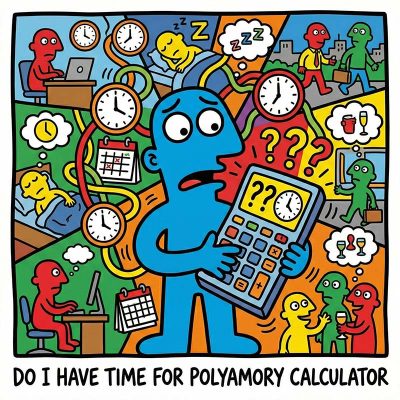
Love is infinite, but your calendar is brutally finite. The fantasy is deep connection; the reality is often just exhausted "calendar tetris." Promising time you don't actually have isn't romantic, it’s a recipe for burnout and broken trust. That sinking feeling when you have to cancel again? That’s the sound of overextension destroying your relationships.
This calculator forces you to confront the math of your life. Do you actually have space for another heart, or are you just setting everyone up for disappointment?

The fantasy is total autonomy and connection. The reality? It can feel like drowning in scheduling chaos and misunderstood expectations. That anxiety you feel isn’t just stress; it’s the wobble of living without a default "anchor." Without a solid architecture, Solo Polyamory stops being a life design and starts being a recipe for burnout and confusion.
The Essential Guide replaces the drift with a concrete anchor. We provide the "Solo Ethic," boundary scripts, and burnout protocols needed to protect your peace. Don't just date around—build a life that actually works for you.

Hierarchy sounds like a corporate org chart until someone gets their feelings hurt. That stomach-turning fear that you are just a "secondary" who can be fired at any time is real. If your relationship feels like a secret ranking system, you are doing it wrong.
Ambiguity is where resentment grows. The Essential Guide replaces the "who matters more" panic with a concrete charter. We provide the scripts and equity guardrails needed to protect every heart in the polycule. Stop guessing and start building.

The ideal is pure equality. The reality? It often slides into hidden rankings where someone gets hurt. That sinking feeling that you are secretly a "secondary" despite the label? That is your intuition detecting couple privilege. Ambiguity is where resentment thrives.
The Essential Guide replaces vague promises with concrete governance. We provide the charters, equity tools, and jealousy protocols needed to ensure "non-hierarchical" isn't just a fantasy. Stop guessing who matters most. Build a network that is actually fair.
The fantasy is total autonomy and connection. The reality? It can feel like drowning in scheduling chaos and misunderstood expectations. That anxiety you feel isn’t just stress; it’s the wobble of living without a default "anchor." Without a solid architecture, Solo Polyamory stops being a life design and starts being a recipe for burnout and confusion.
The Essential Guide replaces the drift with a concrete anchor. We provide the "Solo Ethic," boundary scripts, and burnout protocols needed to protect your peace. Don't just date around—build a life that actually works for you.
Hierarchy sounds like a corporate org chart until someone gets their feelings hurt. That stomach-turning fear that you are just a "secondary" who can be fired at any time is real. If your relationship feels like a secret ranking system, you are doing it wrong.
Ambiguity is where resentment grows. The Essential Guide replaces the "who matters more" panic with a concrete charter. We provide the scripts and equity guardrails needed to protect every heart in the polycule. Stop guessing and start building.
What non hierarchical polyamory looks like in real life
In a non hierarchical polyamory setting every relationship is valued, and there is no official ladder that places one bond above another. People often create a web of connections that can be fluid. Some days one connection might be more active while another becomes central in a given month. The lack of hierarchy requires strong communication and a shared understanding that all people involved deserve respect, space, and honest information. Grief and change can feel big because the system is not just about two people it is about multiple relationships that influence each other in complex ways. The good news is that the same tools that help a system stay connected can also help it grieve and heal together when needed. You can create rituals to hold space for loss and create new connections as energy shifts. In a healthy non hierarchical setup you will often see these patterns: inclusive planning transparent communication scheduled check ins mutual support and a willingness to renegotiate when circumstances change.
Why grief shows up in multi partner ENM systems
Grief is not just about ending a relationship it is also about losing a version of a connection that you counted on. In a non hierarchical system grief can arise from:
- Partner transitions such as someone stepping back or stepping away from a primary connection or from the system entirely.
- New partners entering the circle and shifting the emotional or logistical balance of time and attention.
- Shifts in sexual or romantic energy that cause uncertainty about where you fit in or how your needs will be met.
- Life events such as job changes health issues or relocation that reduce or redistribute time and energy across several relationships.
- Perceived or real changes in commitment or closeness that can feel like a loss of belonging in the group.
- Changes in communication patterns such as less check in depth or transparency which can trigger fear and grief in the system.
Grief in this context often travels in waves and may appear differently for different people in the system. Some people may feel sadness at a quiet level while others may experience bursts of anger or fear. The important thing is to acknowledge the grief as a legitimate emotional response and to respond to it with care rather than trying to push it away or pretend it does not exist.
How grief can show up differently for different people in a non hierarchical system
In a non hierarchical polyamory ENM setup there are often multiple near equal centers of gravity rather than a single dominant bond. Because of this you may see grief showing up in varied forms. Here are some common patterns and what they might look like in daily life.
For partners who were deeply involved with the person drawing away
They may experience a sense of loss that feels personal even though the choice was made by the partner. They might question their own value within the system or worry about being replaced. Practical responses include inviting them to share feelings in a structured way and ensuring they have dedicated space and time to process the change.
For people who welcomed a new partner into the circle
New energy can feel exciting and unsettling at the same time. The grief here often centers on fear of being displaced or losing previously intimate routines. The antidote is to establish rituals that include the new partner gradually while maintaining existing routines with the rest of the group. Communication is key and so is patience.
For metamours who feel left out or overlooked
When someone in the circle shifts focus or energy, metamours may feel pushed aside. They may grieve the kinds of interactions they used to have with someone else. Openly acknowledging those feelings and creating small, recurring check ins can help metamours express what they need without blaming others.
For individuals dealing with personal boundaries and desires shifting
Sometimes personal change arrives like a small earthquake. A person might realize they want something different from the relationship or worry about how their evolving needs will be met. The grief here is not only about loss but also about hoping to find a new balance that still feels safe and fair to everyone involved.
How to talk about change in a non hierarchical polyamory ENM system
Clear compassionate communication is the backbone of any ENM setup. In a non hierarchical system it is essential to create a space where all voices can be heard without fear of judgment. Here are practical communication strategies you can use when grief and change surface:
- Metacommunicate regularly Set aside time to talk about how everyone is feeling and what is working or not working in the system.
- Use inclusive language Focus on the group and the shared values rather than framing changes as losses or wins for any one person.
- Define time for check ins Create a recurring ritual such as a weekly or monthly check in where people can speak about boundaries needs and emotional states.
- Share decisions openly When possible involve the whole group in decisions that affect multiple people rather than letting changes be dictated by one pair or one person.
- Split the emotional labor If a change creates new emotional labor for some members ensure the workload is shared rather than falling on one person long term.
- Provide space for private processing It is okay for individuals to process feelings privately with trusted friends or therapists as long as confidentiality is respected within the group.
- Respect pacing Everyone heals at their own speed. Do not pressure anyone to move faster than they are ready to go.
Practical tools to help your system grieve and re negotiate
Here are concrete tools you can start using today to support your group through grief and change. They are designed to be practical and adaptable to many different group sizes and configurations.
1. Boundary mapping
A boundary map is a simple visual that helps people understand where they stand and how changes affect everyone. Draw a circle for the whole system and add arms or branches for each key relationship or connection. Label what each person needs and what would help them feel safe. This map can be revised as the system evolves and it reduces guesswork in conversations.
2. Regular check in rituals
Establish a cadence for check ins that is predictable and safe. For example a 60 minute check in once a month where participants use a talking circle format with a time limit can work well. Do not turn check ins into therapy sessions instead treat them as collaborative space to share needs and updates. You can do a short grounding exercise at the start to keep everyone centered.
3. Grief journaling templates
Journaling helps individuals name what they feel and why. Provide simple prompts such as:
- Describe the change in one sentence.
- What is the most painful part of this change for you right now?
- What is one small piece of ground you can stand on today to feel safer?
- What is a memory that is safe to hold onto as you move forward?
Encourage people to share journal highlights only when they feel ready. This keeps vulnerability within a controlled and safe framework.
4. The three questions framework
In difficult conversations you can use a simple three questions framework to stay constructive:
- What happened and how did it affect you?
- What do you need going forward to feel safe and heard?
- What can the rest of the system do to support you in this moment?
5. Mini rituals for closure and renewal
Short rituals can help a group mark endings and beginnings. Ideas include:
- A gratitude circle where each person names one thing they appreciated about the current phase.
- A symbolic gesture such as passing a small token that represents shared history and then offering a brief intention for the next chapter.
- A shared meal or a quiet moment together to acknowledge the shift and to recommit to respectful engagement.
Realistic scenarios you might encounter
Here are some practical, relatable scenarios to help you imagine how grief and change can unfold in a non hierarchical ENM system. These are realistic and designed to feel familiar so you can plan ahead and be ready with compassionate responses.
Scenario 1: A partner steps back and energy shifts
In a non hierarchical set up one partner begins to step back from intense daily interactions due to life changes such as a demanding job or health concerns. The person who reduces contact may feel relief and sadness at the same time, while others may miss shared routines. The group can respond by explicitly naming the change as a transition inviting all voices to be heard. Create a revised schedule that preserves essential connections while allowing space for new patterns. This is a time to lean on boundary maps and check ins to ensure no one feels left behind.
Scenario 2: A new partner arrives and changes the balance
Adding a new partner can feel exciting yet destabilizing for existing connections. Greif in this case may show up as fear of losing closeness or time with current partners. A practical approach is to allocate dedicated time for existing bonds and gradually allocate space for the new connection. Transparent planning shows everyone that their needs are respected and that the addition is a shared decision rather than a surprise.
Scenario 3: Scheduling and life events create friction
Life events like a new job shift or moving house can alter how much time is available for different connections. Grief may appear as frustration or guilt about not being able to meet expectations. The fix is not to force a perfect schedule but to renegotiate in a collaborative way. Use a boundary map to visualize who needs what and adjust expectations so everyone can feel seen.
Scenario 4: A shift in desires or relationship structures
Sometimes a person discovers a new orientation or a desire for greater independence. The grief then centers on fear of losing a valued bond while also recognizing personal growth. The group can respond by normalizing exploration while affirming care for existing connections. Encourage a calm conversation about what changes will look like in practice and how the adaptation will be evaluated over time.
Scenario 5: A crisis triggers collective grief
A sudden event such as illness or a major life change can trigger a wave of grief that touches many members. In this moment the group can rely on organized rituals and a calm shared space to process. Grounding exercises a temporary pause in new commitments and a return to core values can help the system move through the grief together rather than in isolation.
Healing through care in a non hierarchical ENM system
Grief does not have to be a solitary journey. In a well managed non hierarchical ENM system you can practically care for yourself and for others through deliberate acts of care. Here are some core practices that help keep care at the center of the system.
- Prioritize consent and transparency Make sure every action has clear consent and that everyone knows what to expect from the next phase of the relationship.
- Practice reflective listening When someone shares a feeling reflect back what you heard without trying to fix it. This validates the speaker and reduces defensiveness.
- Offer concrete support Not just “I am here for you” but practical help such as driving someone to a doctor appointment or coordinating a meal train during a difficult period.
- Keep the door open for renegotiation Clarify that changes can be revisited. Boundaries and agreements are living tools that adapt to life.
- Invite external support when needed Therapists who specialize in ENM or polyamory can provide a neutral space to explore grief and change without bias from within the system.
Supportive conversations you can have with your circle
If you want to talk to the group or a specific partner about grief and change here are some ready to adapt prompts and scripts you can use. Remember to keep it focused on feelings actions and needs rather than blame or judgments.
- Opening the space I have noticed a shift in our dynamic and I want to check in on how everyone is feeling and what they need to feel safe and connected.
- Sharing your own needs My current need is more regular check ins and a bit more predictability in our schedule so I feel secure while we navigate this change.
- Inviting feedback What is one thing you wish we could do differently during this transition that would help you feel heard and respected?
- Proposing a plan I would like to try a boundary mapping exercise this week and a 30 minute check in every Sunday for the next month to see how things feel.
- Closing with appreciation Thank you for listening and for staying curious about how to care for each other through this process.
When to seek outside help
If grief becomes overwhelming or if conflicts escalate beyond what the group feels able to handle internally it may be time to seek outside support. Options include:
- Individual therapy with a clinician who understands ENM or polyamory friendly frameworks.
- Relationship or group therapy with a therapist experienced in non hierarchical polyamory dynamic models.
- Community support groups or online communities where people share experiences and strategies in a non judgemental space.
- Educational workshops focused on ENM communication and boundary management.
Glossary of useful terms and acronyms
- ENM Ethical Non Monogamy a relationship style based on consent and openness among all involved.
- Non Hierarchical Polyamory A framework where no relationship is ranked above another and all connections are valued in their own right.
- Metamour A person who is in a relationship with another partner in your network but not in a romantic or sexual relationship with you.
- System The group of people connected through multiple relationships including partners metamours and close friends.
- Grief The emotional process of mourning a change in a relationship or in the pattern of connections within the system.
- Boundaries The limits or rules a group agrees to in order to protect emotional safety and healthy interaction.
- Boundary map A visual tool to lay out who needs what and where adjustments are possible.
- Rituals Shared practices that help the group process grief and transition such as check-ins meals or grounding exercises.
- Check in A scheduled moment where participants share current feelings needs and boundaries.
Love is infinite, but your calendar is brutally finite. The fantasy is deep connection; the reality is often just exhausted "calendar tetris." Promising time you don't actually have isn't romantic, it’s a recipe for burnout and broken trust. That sinking feeling when you have to cancel again? That’s the sound of overextension destroying your relationships.
This calculator forces you to confront the math of your life. Do you actually have space for another heart, or are you just setting everyone up for disappointment?
The fantasy is total autonomy and connection. The reality? It can feel like drowning in scheduling chaos and misunderstood expectations. That anxiety you feel isn’t just stress; it’s the wobble of living without a default "anchor." Without a solid architecture, Solo Polyamory stops being a life design and starts being a recipe for burnout and confusion.
The Essential Guide replaces the drift with a concrete anchor. We provide the "Solo Ethic," boundary scripts, and burnout protocols needed to protect your peace. Don't just date around—build a life that actually works for you.
Hierarchy sounds like a corporate org chart until someone gets their feelings hurt. That stomach-turning fear that you are just a "secondary" who can be fired at any time is real. If your relationship feels like a secret ranking system, you are doing it wrong.
Ambiguity is where resentment grows. The Essential Guide replaces the "who matters more" panic with a concrete charter. We provide the scripts and equity guardrails needed to protect every heart in the polycule. Stop guessing and start building.
The ideal is pure equality. The reality? It often slides into hidden rankings where someone gets hurt. That sinking feeling that you are secretly a "secondary" despite the label? That is your intuition detecting couple privilege. Ambiguity is where resentment thrives.
The Essential Guide replaces vague promises with concrete governance. We provide the charters, equity tools, and jealousy protocols needed to ensure "non-hierarchical" isn't just a fantasy. Stop guessing who matters most. Build a network that is actually fair.
The fantasy is total autonomy and connection. The reality? It can feel like drowning in scheduling chaos and misunderstood expectations. That anxiety you feel isn’t just stress; it’s the wobble of living without a default "anchor." Without a solid architecture, Solo Polyamory stops being a life design and starts being a recipe for burnout and confusion.
The Essential Guide replaces the drift with a concrete anchor. We provide the "Solo Ethic," boundary scripts, and burnout protocols needed to protect your peace. Don't just date around—build a life that actually works for you.
Hierarchy sounds like a corporate org chart until someone gets their feelings hurt. That stomach-turning fear that you are just a "secondary" who can be fired at any time is real. If your relationship feels like a secret ranking system, you are doing it wrong.
Ambiguity is where resentment grows. The Essential Guide replaces the "who matters more" panic with a concrete charter. We provide the scripts and equity guardrails needed to protect every heart in the polycule. Stop guessing and start building.
