
Jealousy in Non Hierarchical Polyamory


We all know jealousy can feel like a passport to a loud, messy brain storm. In non hierarchical polyamory the stakes feel bigger because there is no single top relationship to act as a stabilizing anchor. This guide breaks down jealousy in ENM dynamics in plain talk with concrete tools you can apply today. Think of this as your friendly experimental brain hack in a world where love can be wide and weird and wonderfully human.
Quick Links to Useful Sections
- Understanding non hierarchical polyamory and jealousy
- Key terms and acronyms you should know
- Where jealousy tends to come from in NH polyamory
- How jealousy operates in practice in ENM
- Practical framework for addressing jealousy in NH poly
- Step 1 Name the emotion
- Step 2 Identify the need behind the emotion
- Step 3 Gather context data
- Step 4 Communicate using I statements
- Step 5 Create a plan together
- Concrete communication scripts for NH poly jealousy
- Scenario A: Time balancing jealousy
- Scenario B: Onboarding a new partner
- Scenario C: NRE and sense of priority
- Scenario D: Boundary drift
- Tools to reduce jealousy over time
- Onboarding a new partner in NH polyamory
- Realistic scenarios and case studies
- Case study 1 The late night shift
- Case study 2 NRE and boundary clarity
- Maintaining fairness and avoiding control dynamics
- Self care and building resilience in ENM
- Risk management and safety in non hierarchical polyamory
- Glossary of useful terms and acronyms
- Frequently asked questions
Understanding non hierarchical polyamory and jealousy
Non hierarchical polyamory means relationships are not ranked in a pecking order. Instead there is equal respect for multiple connections. People in this dynamic sometimes call it NH poly or non titled poly. The core idea is that no single relationship is treated as the default or the main relationship. When jealousy shows up in this space it often points to a human signal rather than a failure. Jealousy can highlight needs that are not being met or gaps in communication. The good news is jealousy can be used as data. It can point you toward what you want more of in your life and in your relationships.
Ethically non monogamous ENM stands for ethically non monogamous. That term covers relationships where all adults know what the arrangement is and consent to it. In ENM the emphasis is on consent honesty and ongoing negotiation. Jealousy is a normal part of any intimate life even in monogamous settings. In ENM it can feel bigger because the heart space is potentially shared among more people. The trick is to treat jealousy as a signal and act on it with care rather than letting it become a weapon or a wall between people.
Key terms and acronyms you should know
- ENM Ethically non monogamous a framework where partners agree to open up relationship options with clear consent and ongoing communication.
- NH poly Non hierarchical polyamory a form of polyamory where there is no ranking of relationships as primary secondary or tertiary.
- NRE New Relationship Energy the excitement rush and idealization that often comes with a new partner or new relationship.
- Jealousy as data A phrase used to describe looking at jealousy as information about needs not yet met.
- Compersion The feeling of joy from your partner's happiness with someone else.
- I statements Communication technique that uses sentences starting with I to express how you feel without blaming the other person.
- Boundary A boundary is a guideline set by people in a relationship about what is acceptable and what is not.
- Negotiation The process of discussing and agreeing on how to balance needs and limits within the relationship.
- Onboarding The process of introducing a new partner to your existing relationship system and agreements.
- Security plan A plan designed to protect emotional safety when jealousy spikes or negotiations hit stress points.
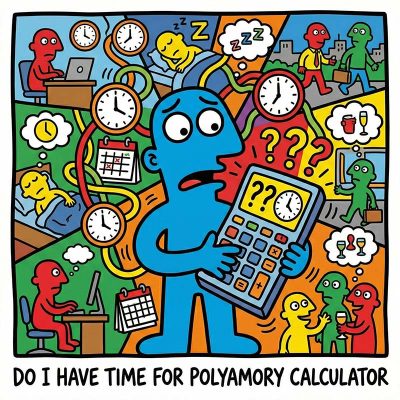
Love is infinite, but your calendar is brutally finite. The fantasy is deep connection; the reality is often just exhausted "calendar tetris." Promising time you don't actually have isn't romantic, it’s a recipe for burnout and broken trust. That sinking feeling when you have to cancel again? That’s the sound of overextension destroying your relationships.
This calculator forces you to confront the math of your life. Do you actually have space for another heart, or are you just setting everyone up for disappointment?

The fantasy is total autonomy and connection. The reality? It can feel like drowning in scheduling chaos and misunderstood expectations. That anxiety you feel isn’t just stress; it’s the wobble of living without a default "anchor." Without a solid architecture, Solo Polyamory stops being a life design and starts being a recipe for burnout and confusion.
The Essential Guide replaces the drift with a concrete anchor. We provide the "Solo Ethic," boundary scripts, and burnout protocols needed to protect your peace. Don't just date around—build a life that actually works for you.

Hierarchy sounds like a corporate org chart until someone gets their feelings hurt. That stomach-turning fear that you are just a "secondary" who can be fired at any time is real. If your relationship feels like a secret ranking system, you are doing it wrong.
Ambiguity is where resentment grows. The Essential Guide replaces the "who matters more" panic with a concrete charter. We provide the scripts and equity guardrails needed to protect every heart in the polycule. Stop guessing and start building.

The ideal is pure equality. The reality? It often slides into hidden rankings where someone gets hurt. That sinking feeling that you are secretly a "secondary" despite the label? That is your intuition detecting couple privilege. Ambiguity is where resentment thrives.
The Essential Guide replaces vague promises with concrete governance. We provide the charters, equity tools, and jealousy protocols needed to ensure "non-hierarchical" isn't just a fantasy. Stop guessing who matters most. Build a network that is actually fair.
The fantasy is total autonomy and connection. The reality? It can feel like drowning in scheduling chaos and misunderstood expectations. That anxiety you feel isn’t just stress; it’s the wobble of living without a default "anchor." Without a solid architecture, Solo Polyamory stops being a life design and starts being a recipe for burnout and confusion.
The Essential Guide replaces the drift with a concrete anchor. We provide the "Solo Ethic," boundary scripts, and burnout protocols needed to protect your peace. Don't just date around—build a life that actually works for you.
Hierarchy sounds like a corporate org chart until someone gets their feelings hurt. That stomach-turning fear that you are just a "secondary" who can be fired at any time is real. If your relationship feels like a secret ranking system, you are doing it wrong.
Ambiguity is where resentment grows. The Essential Guide replaces the "who matters more" panic with a concrete charter. We provide the scripts and equity guardrails needed to protect every heart in the polycule. Stop guessing and start building.
Where jealousy tends to come from in NH polyamory
Jealousy in non hierarchical setups often grows from a few common sources. Recognizing these can help you address the underlying needs rather than attacking the person you love. Here are the big patterns you will likely encounter.
- Time and attention gaps When one relationship seems to be getting more of your partner's time it can trigger fear of being forgotten or replaced.
- Insecurity about value If you question your own value in the eyes of your partner you may react with jealousy or clinginess.
- NRE spikes New relationship energy can skew perceptions and make old relationships feel less important even if they are still strong.
- Communication misreads If messages are vague or if there is a lack of transparency you may fill the gaps with worst case stories.
- Boundary drift When agreements drift or feel like they are not respected jealousy grows as you try to recenter safety and trust.
- Fear of losing closeness Non hierarchical systems rely on many forms of closeness. The fear of losing that closeness to one person can fuel jealousy.
How jealousy operates in practice in ENM
Jealousy is not just a feeling. It is a signal that something in the relationship ecosystem needs attention. Sometimes the signal is about time and energy controlling access. Other times it is about emotional safety or the perception that one person is getting more of something you value highly. In ENM the focus shifts from trying to eliminate jealousy to understanding what it is telling you and then taking steps to address the underlying need while maintaining autonomy and consent for everyone involved.
Think of jealousy as a map not a verdict. It points toward a place you want to visit in your relationship world. It also shows you where you might be holding onto a rule that needs updating. The goal is to use jealousy as a conversation starter not as a weapon. When you approach jealousy with curiosity you create space for growth and stronger trust.
Practical framework for addressing jealousy in NH poly
Use this flexible five step framework to translate feelings into action. The steps are designed to be simple to apply in real life and to be re used as needs change.
Step 1 Name the emotion
Take a moment to label what you feel. Is it insecurity fear sadness anger or a mix? You can even write it down. Naming the emotion reduces its power because it moves from a big storm in your head to a concrete thing you can discuss.
Step 2 Identify the need behind the emotion
Behind jealousy there are often needs like safety predictability appreciation or autonomy. If you can name the need you have a target for your conversation with your partner. It is easier to find a practical solution when you know what you actually need.
Step 3 Gather context data
Ask yourself what facts you are missing. Do you know how much time is being spent with a new partner? Are there changes to agreements on the table? Collect information before you go into a conversation. When you have context you can speak with less guess work and more clarity.
Step 4 Communicate using I statements
When you are ready to talk use I statements to describe your experience without blaming. For example say I feel anxious when you spend late nights with your new partner and I would like to talk about how we can keep both of us feeling secure. This approach communicates your experience and invites collaboration rather than confrontation.
Step 5 Create a plan together
Ask questions that invite negotiation rather than argument. What would help you feel more secure? What boundaries feel fair to you both? How can we adjust our schedule to share attention more evenly? What compromises can we try this week and what can we revisit later? The plan can be small and practical and then you can test it and adjust as needed.
Concrete communication scripts for NH poly jealousy
Examples use I statements and invite collaboration. Use them as starting points and tailor them to your voice and your real life.
Scenario A: Time balancing jealousy
Partner A I notice I feel a bit anxious when you have back to back dates with Partner B this week. I value the time we share and I want to figure out a rhythm that keeps both of us feeling seen. Could we map a weekly schedule that ensures we have at least two focused evenings together and still keep space for your other connections?
Scenario B: Onboarding a new partner
When I first heard about Partner C I felt unsettled because I was not sure how our boundaries would apply to your new relationship. I would like to talk about how we introduce new partners and how we maintain our routine while we all learn to navigate this new energy. Can we set a two week onboarding plan with check ins?
Scenario C: NRE and sense of priority
I am glad you are excited about your new relationship and I want to celebrate that with you. At the same time I sometimes worry that your energy is shifting away from our established connection. How can we acknowledge the new energy while keeping our core connection strong? Could we set a weekly connection ritual that is just for the two of us?
Scenario D: Boundary drift
I think our boundaries have drifted since we last talked about them. I would like to revisit our agreements and see what still makes sense. What changes would you be comfortable with and what would you need from me to feel secure?
Tools to reduce jealousy over time
Jealousy often wanes as the relationship framework becomes clearer and more reliable. Here are practical tools you can implement to reduce jealousy over time rather than letting it run the show.
- Regular check ins Schedule predictable moments to talk about feelings and agreements. Keep these conversations consistent so they do not get crowded out by busyness or stress.
- Jealousy journal Keep a simple log of situations that trigger jealousy. Note what happened what you felt what you needed and what solved or did not solve the issue. Review weekly to spot patterns.
- Clarity on NRE Acknowledge NRE as a phase not a permanent shift. Talk about how long you expect it to last and what the plan is to maintain balance with existing relationships.
- Visit autonomy and dependency needs Reflect on what parts of your life you want to retain as personal autonomy and what you are happy sharing. Reassert the balance with your partner in a respectful way.
- Safe space agreements Create emotional safety by outlining how you handle disagreements with care. Include how you will pause and how you will restart conversations after a pause.
- Onboarding protocol Develop a repeatable onboarding plan for new partners that includes introductions to key boundaries and rituals and a plan for early check ins.
- Time mapping Use a simple chart to map weekly time commitments across partners. Ensure you maintain rituals that nurture each important connection while staying realistic about schedules.
- Compersion practice Actively practice feeling happiness for your partner’s joy. It is a muscle that grows with intention and reinforcement.
Onboarding a new partner in NH polyamory
Bringing someone new into a non hierarchical setup can trigger jealousy not just in the person being left out but in the entire ecosystem. The goal is to normalize introductions explain the agreements and invite feedback. Start with a slow careful onboarding plan that protects emotional safety for everyone involved.
Begin with a clear introduction that includes the new partner in the group chat or a social event when feasible. Then outline existing agreements around communication time boundaries and respect for all relationships. Schedule a series of check ins starting with a low stakes conversation about expectations and gradually moving to deeper topics as comfort grows. It helps to practice a formal onboarding script that can be adapted as the relationship evolves.
A practical onboarding blueprint looks like this three steps. First share the basic structure of the network and the shape of the agreements. Second create a welcome plan for the new partner including introductions and a first date with the existing partner. Third schedule a mid onboarding check in to discuss comfort level and adjust rules if needed. This approach reduces uncertainty and helps everyone feel included and valued.
Realistic scenarios and case studies
Stories can teach better than rules alone. Here are two realistic scenarios with outcomes that illustrate how jealousy can be faced with honesty and practical steps.
Case study 1 The late night shift
Alex and Casey are in NH poly with a rotating set of partners. Casey recently started seeing Dana and that relationship has its own energy. Alex began to feel left out because Casey often spends evenings with Dana. They used the five step framework naming the emotion and identifying the need. Alex admitted I feel left out when evenings are devoted to Dana and I want more predictable time with you. They discussed and agreed on two actions a weekly date night for the two of them and a shared night with Dana twice a month. They also created a short text check in for days when schedules get tight. After the changes Alex felt more secure and Casey felt they were still making space for Dana while preserving their bond with Alex. The result was stronger communication and less emotional friction.
Case study 2 NRE and boundary clarity
Bri and Chen are connected with two other partners in a NH poly network. When Bri started dating a new partner Zed the NRE energy caused friction. Bri enjoyed the excitement and wanted to invest more time with Zed while Chen worried about losing closeness. They used I statements and a boundary review session. Bri said I feel excited by Zed and I want to maintain our weekly deep connection time with you. Chen responded I value our closeness and would like to keep a standing weekly date night as well as flexible times for social growth. They updated their agreements to include a shared weekly check in and defined what counts as a priority date night for both. The outcome was more predictable energy in the system and less jealousy spikes when new energy arrived.
Maintaining fairness and avoiding control dynamics
In NH poly there is temptation to use jealousy to exert control or to restrict a partner's freedom. Clear communication and consent based negotiation are essential to prevent that path. Here are a few guard rails that help keep things fair and respectful.
- Consent first Ensure all changes and additions to agreements are discussed and accepted by everyone involved. No one should feel forced into a change.
- Respect for autonomy Remember that all adults have the right to pursue relationships they want as long as consent is maintained and agreements are honored.
- Transparent boundaries White lying and vague answers breed mistrust. Be precise about what is allowed and what is not and revisit these rules periodically.
- Mutual reparations If a boundary is crossed students or partners should have a clear path back to safety and trust which may include apologies renegotiated terms or time to rebuild closeness.
Self care and building resilience in ENM
Jealousy can be intense especially when a new energy arrives in a NH poly network. Self care helps you manage the stress and keep your personal well being intact. Here are practical self care ideas that blend well with ENM living.
- Grounding practices Simple breathing exercises short walks or a quick stretch can reset your nervous system during heavy moments.
- Personal time Keep a reserve of alone time for reflection journaling or solo activities that remind you who you are outside the relationship web.
- Support networks Lean on trusted friends or therapists who understand ENM dynamics and can offer unbiased support.
- Creativity Channel feelings into creative outputs like writing music art or movement. It provides an outlet and helps process emotions.
- Body care Prioritize sleep nutrition and regular activity. A well cared for body responds more resiliently to stress and conflict.
Risk management and safety in non hierarchical polyamory
Safety in ENM is not just about physical safety but emotional safety too. Open agreements make dealing with risk easier. Here are some practical safety considerations that help protect everyone involved.
- Communication safety Learn and practice nonviolent communication to express needs without blame. This helps maintain respect even when emotions run high.
- Privacy and disclosure Agree on what information is shared with others outside the core group. Set boundaries around what is shared publicly and what stays private.
- Sexual health Maintain explicit consent and practice safe sex if applicable. Regular health checks and transparent communication about sexual activity reduce risk and build trust.
- Emotional boundaries Decide what topics are off limits or require extra care. Protect your core relationship and the well being of all involved by respecting these boundaries.
Glossary of useful terms and acronyms
- ENM Ethically non monogamous relationships where consent and clear communication govern multiple intimate connections.
- NH poly Non hierarchical polyamory where no relationship holds a higher status than another.
- NRE New Relationship Energy the rush and excitement that comes with a new connection.
- Jealousy as data A mindset that treats jealousy as information about needs rather than a personal failing.
- Compersion Feeling joy from a partner's happiness with another person.
- I statements A communication technique that centers on expressing your own feelings and needs without blaming others.
- Boundaries Agreed limits about what is acceptable in a relationship and how interactions occur.
- Negotiation The process of discussing and agreeing on how to balance multiple relationships with fairness and care.
- Onboarding The process of introducing a new partner to the relationship structure and agreements.
- Check in A scheduled conversation to assess how things are going and whether adjustments are needed.
Frequently asked questions
What is jealousy in non hierarchical polyamory
Jealousy is a natural feeling that can arise when a person experiences insecurity about attention time or emotional closeness. In NH poly it is a signal that something in the relationship system could be improved such as communication schedules boundaries or safety nets. It is not a personal failing and it does not mean you cannot be part of multiple loving relationships.
How can I tell if jealousy is a red flag or a data signal
Use a simple test. If the feeling leads you to want harm blame or control it is a red flag. If the feeling motivates you to ask for more time more clarity or new agreements it is data that can help the system improve.
What is compersion and how can I practice it
Compersion is the feeling of happiness when a partner has good experiences with someone else. It can be practiced by acknowledging the other relationship and recognizing that someone you care about can share happiness with others. Start with small moments and build up to bigger ones as trust grows.
What if I am scared I will lose my partner to someone else
Fear of loss is common in ENM. Focus on strengthening your own sense of security through clear communication and reliable rituals. Build shared routines and make space for your needs to be heard. If the fear becomes overwhelming consider speaking with a professional who understands ENM dynamics.
How do I initiate a conversation about jealousy without blame
Begin with I statements and a request for collaboration. For example I feel anxious when our plan to have weekly date nights is crowded by new conversations with others. Could we plan a weekly block of time just for us and revisit this if it starts to shift again? This keeps the discussion constructive and future oriented.
How long should NRE last and how does it affect NH poly relationships
NRE varies widely from weeks to months. In NH poly the key is to acknowledge its presence and manage energy with the rest of the network. Establish check ins and boundaries that respect existing connections while allowing new energy to unfold in a safe controlled way.
Should I involve all partners in every discussion about jealousy
Not always. Start with the partner most closely affected by the issue and then decide together whether others should be included. In some cases a group discussion improves transparency while in others a one on one conversation is enough to resolve the concern. Always consider the emotions and dynamics of all involved before bringing others into the loop.
What if I am new to ENM and I feel overwhelmed
Give yourself permission to be imperfect. Start with small steps such as learning one new term every week and practicing I statements. Seek support from a trusted friend or a therapist who understands ENM dynamics and can help you build confidence and competence over time.
Is it okay to modify agreements as life changes
Absolutely. Agreements should be living documents that evolve with the relationship. Schedule regular reviews and adjust boundaries and expectations as needed. The point is to maintain consent clarity and mutual respect as life conditions change.
Love is infinite, but your calendar is brutally finite. The fantasy is deep connection; the reality is often just exhausted "calendar tetris." Promising time you don't actually have isn't romantic, it’s a recipe for burnout and broken trust. That sinking feeling when you have to cancel again? That’s the sound of overextension destroying your relationships.
This calculator forces you to confront the math of your life. Do you actually have space for another heart, or are you just setting everyone up for disappointment?
The fantasy is total autonomy and connection. The reality? It can feel like drowning in scheduling chaos and misunderstood expectations. That anxiety you feel isn’t just stress; it’s the wobble of living without a default "anchor." Without a solid architecture, Solo Polyamory stops being a life design and starts being a recipe for burnout and confusion.
The Essential Guide replaces the drift with a concrete anchor. We provide the "Solo Ethic," boundary scripts, and burnout protocols needed to protect your peace. Don't just date around—build a life that actually works for you.
Hierarchy sounds like a corporate org chart until someone gets their feelings hurt. That stomach-turning fear that you are just a "secondary" who can be fired at any time is real. If your relationship feels like a secret ranking system, you are doing it wrong.
Ambiguity is where resentment grows. The Essential Guide replaces the "who matters more" panic with a concrete charter. We provide the scripts and equity guardrails needed to protect every heart in the polycule. Stop guessing and start building.
The ideal is pure equality. The reality? It often slides into hidden rankings where someone gets hurt. That sinking feeling that you are secretly a "secondary" despite the label? That is your intuition detecting couple privilege. Ambiguity is where resentment thrives.
The Essential Guide replaces vague promises with concrete governance. We provide the charters, equity tools, and jealousy protocols needed to ensure "non-hierarchical" isn't just a fantasy. Stop guessing who matters most. Build a network that is actually fair.
The fantasy is total autonomy and connection. The reality? It can feel like drowning in scheduling chaos and misunderstood expectations. That anxiety you feel isn’t just stress; it’s the wobble of living without a default "anchor." Without a solid architecture, Solo Polyamory stops being a life design and starts being a recipe for burnout and confusion.
The Essential Guide replaces the drift with a concrete anchor. We provide the "Solo Ethic," boundary scripts, and burnout protocols needed to protect your peace. Don't just date around—build a life that actually works for you.
Hierarchy sounds like a corporate org chart until someone gets their feelings hurt. That stomach-turning fear that you are just a "secondary" who can be fired at any time is real. If your relationship feels like a secret ranking system, you are doing it wrong.
Ambiguity is where resentment grows. The Essential Guide replaces the "who matters more" panic with a concrete charter. We provide the scripts and equity guardrails needed to protect every heart in the polycule. Stop guessing and start building.
