
Recognizing Hidden Hierarchies


Welcome to a practical expedition into the subtle world of power hidden in plain sight. This guide is written for anyone exploring non hierarchical polyamory and ethically non monogamous ENM relationships. ENM stands for ethically non monogamous which means all parties agree to more than one romantic or intimate connection. In a non hierarchical setup we do not rank partners as primary or secondary but hidden hierarchies can creep in anyway. Think of this as a friendly audit you can run with your crew to keep things fair, open and truly consent based.
Quick Links to Useful Sections
- What non hierarchical polyamory means in plain language
- Hidden hierarchies in a non hierarchical world why they arise
- Recognizing the signs a practical starter kit
- Tools you can use to dismantle hidden hierarchies
- 1. A living agreements audit
- 2. Time equity audits
- 3. Shared emotional labor ledger
- 4. Explicit consent based decision making
- 5. Transparent information sharing
- 6. Rituals that reinforce equity
- Real world scenarios with practical language you can use
- Scenario A how to address a quiet partner who feels unseen
- Scenario B handling resource related power imbalances
- Scenario C addressing cultural or identity based bias
- Practical checklists to keep your dynamic fair and fun
- Knock on effect benefits when hidden hierarchies are recognized
- Glossary of terms and acronyms you might see on the topic
- Frequently asked questions
Imagine a group where everyone agreed to be equal on paper and then found that in practice someone always gets more say about which dates happen first who plans the monthly outings or who handles the heavy emotional lifting. Recognizing these hidden hierarchies is not about assigning blame. It is about leveling the playing field so that consent stays real and joy stays central. Below you will find a field guide packed with actionable steps and simple language you can use in real conversations with your partners. We will unpack terms as we go so nothing stays unclear or exoticized. You deserve clarity and connection without the drama of hidden power plays.
What non hierarchical polyamory means in plain language
Non hierarchical polyamory is an approach where there is no formal ranking of partners. There is no best or most important partner, no designated primary relationship, and no assumed priority. Everyone has a voice and time together is negotiated rather than assumed. In practice this means shared calendars you all consent to follow flexible enough to accommodate life changes. It means decisions about safety events and boundaries are made through open conversation rather than automatic loyalty to one person or another. The aim is to nurture honesty mutual respect and mutual joy rather than a power structure that quietly makes some people feel less valued.
Here are a few terms you might encounter while exploring this space. If a term is new to you we will explain it in a simple way so you can use it in conversation today.
- ENM Ethically non monogamous a broad term for relationships that involve more than one romantic or sexual connection with the knowledge and consent of everyone involved.
- Non hierarchical A setup where no partner is formally regarded as more important or more deserving of time than others.
- Relationship anarch y A philosophy within ENM that rejects rigid labels and prioritizes consent communication and autonomy.
- Emotional labor The effort required to manage feelings for others including caring listening planning and supporting the group as a whole.
- Time equity Ensuring all partners get fair access to time with each other and with the group rather than allowing one relationship to dominate the schedule.
- Consent based Every person has given clear agreement to a plan or boundary and understands that consent can be withdrawn at any time.
- Meta level communication Talking about the group structure the agreements the way the group functions at a practical level rather than only addressing surface issues.
- Privilege Any advantage someone has in the form of class race gender or other identities that can influence how power is distributed in relationships.
Hidden hierarchies in a non hierarchical world why they arise
- Time and energy differences Some partners have more flexibility in their schedules which means they can say yes to dates more often or attend social events more frequently. That extra presence can quietly shift who holds influence in planning and decision making.
- Emotional labor distribution A small subset of partners may shoulder more of the emotional support planning communication and coordination which leads to a sense of hidden priority or burden.
- Financial realities Access to resources for dates trips or activities can tilt group decisions even when everyone claims to be equal on paper.
- Social and cultural capital People with more experience or broader social networks may effectively steer conversations because others look to them for guidance or validation.
- Communication style and safety Some voices may be louder or more assertive while others are quiet hesitant or uncertain how to speak up in a group setting that feels charged or vulnerable.
- Relationship history and patterns Past dynamics can leak into the present making certain voices feel like they carry more legitimacy even without formal hierarchy.
- Physiological or emotional needs If someone is navigating heavier mental health or life stress it can shift who is able to advocate for themselves and how often.
All of these factors exist in many groups and none of them are inherently bad by themselves. The problem shows up when they become unspoken rules that guide decisions without consent. When a pattern becomes invisible it can feel like a hidden hierarchy even though the surface structure says otherwise. The good news is you can shine a light on these patterns and re align the group with consent centered practices.
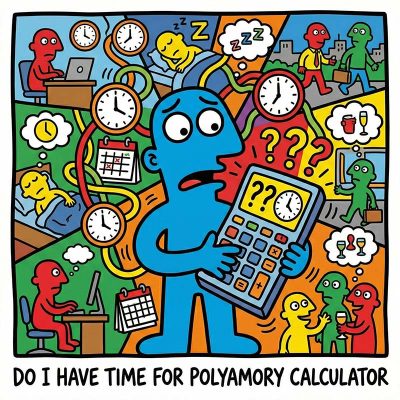
Love is infinite, but your calendar is brutally finite. The fantasy is deep connection; the reality is often just exhausted "calendar tetris." Promising time you don't actually have isn't romantic, it’s a recipe for burnout and broken trust. That sinking feeling when you have to cancel again? That’s the sound of overextension destroying your relationships.
This calculator forces you to confront the math of your life. Do you actually have space for another heart, or are you just setting everyone up for disappointment?

The fantasy is total autonomy and connection. The reality? It can feel like drowning in scheduling chaos and misunderstood expectations. That anxiety you feel isn’t just stress; it’s the wobble of living without a default "anchor." Without a solid architecture, Solo Polyamory stops being a life design and starts being a recipe for burnout and confusion.
The Essential Guide replaces the drift with a concrete anchor. We provide the "Solo Ethic," boundary scripts, and burnout protocols needed to protect your peace. Don't just date around—build a life that actually works for you.

Hierarchy sounds like a corporate org chart until someone gets their feelings hurt. That stomach-turning fear that you are just a "secondary" who can be fired at any time is real. If your relationship feels like a secret ranking system, you are doing it wrong.
Ambiguity is where resentment grows. The Essential Guide replaces the "who matters more" panic with a concrete charter. We provide the scripts and equity guardrails needed to protect every heart in the polycule. Stop guessing and start building.

The ideal is pure equality. The reality? It often slides into hidden rankings where someone gets hurt. That sinking feeling that you are secretly a "secondary" despite the label? That is your intuition detecting couple privilege. Ambiguity is where resentment thrives.
The Essential Guide replaces vague promises with concrete governance. We provide the charters, equity tools, and jealousy protocols needed to ensure "non-hierarchical" isn't just a fantasy. Stop guessing who matters most. Build a network that is actually fair.
The fantasy is total autonomy and connection. The reality? It can feel like drowning in scheduling chaos and misunderstood expectations. That anxiety you feel isn’t just stress; it’s the wobble of living without a default "anchor." Without a solid architecture, Solo Polyamory stops being a life design and starts being a recipe for burnout and confusion.
The Essential Guide replaces the drift with a concrete anchor. We provide the "Solo Ethic," boundary scripts, and burnout protocols needed to protect your peace. Don't just date around—build a life that actually works for you.
Hierarchy sounds like a corporate org chart until someone gets their feelings hurt. That stomach-turning fear that you are just a "secondary" who can be fired at any time is real. If your relationship feels like a secret ranking system, you are doing it wrong.
Ambiguity is where resentment grows. The Essential Guide replaces the "who matters more" panic with a concrete charter. We provide the scripts and equity guardrails needed to protect every heart in the polycule. Stop guessing and start building.
Recognizing the signs a practical starter kit
If one person consistently chooses dates or prioritizes their schedule over others that can indicate a subtle edge in the group dynamic. When one partner consistently receives more information about plans or decisions before others especially about who is invited where and when that is a red flag. If several partners feel they cannot speak up in conversations without facing pushback or ridicule that is a signal that equity is off balance. When the same people repeatedly take on emotional labor or coordinate the social calendar while others disappear from the load. When resources such as finances logistics or access to experiences skew toward certain partners rather than being shared according to need and consent. When big group decisions happen through informal channels rather than public discussion and transparent voting or consensus building. If the group avoids labels or the topic of hierarchy altogether because people fear conflict or the perception of rocking the boat.
Remember that spotting signs is not about pointing fingers. It is about noticing patterns you can discuss openly with the group in a way that invites everyone to participate in redesigning the process so it feels fair to all.
Tools you can use to dismantle hidden hierarchies
1. A living agreements audit
Set aside time to review your agreements as a group not as individuals. Ask these questions in a neutral tone and write down the answers so there is a clear record to refer back to.
- Are time commitments distributed fairly based on need and consent?
- Who makes decisions about events and outings and how are those decisions reached?
- Is emotional labor acknowledged and shared or is it concentrated in a small subset of partners?
- Do all partners have access to the same information about plans and changes?
- Are there any unspoken expectations that someone will handle certain tasks without discussion?
Use a rotating facilitator for this session so it feels like a group process rather than a critique aimed at one person. The goal is clarity not blame.
2. Time equity audits
Build a simple calendar approach that tracks how much time each person spends in planning dates and in one on one connections with others in the group. The goal is even distribution not rigid equality. Some people may need more time at certain moments and the point is to have a shared baseline that can flex with life events without creating a silent winner takes all dynamic.
- Agree on a baseline for how much planning time is reasonable per person each month.
- Record actual time and review at a monthly check in.
- Adjust invites and planning rules to keep balance fair and transparent.
3. Shared emotional labor ledger
Create a simple ledger where emotional labor tasks are listed and assigned on a rotating basis. Include tasks like checking in with partners who seem withdrawn planning group events coordinating after care and holding space for difficult conversations. Rotate tasks so no one shoulders more than their fair share over time.
- Examples of tasks include planning dates coordinating after care debriefs after big conversations and following up on agreements.
- Publish the ledger in a central place where everyone can see it and add their name to new tasks as needed.
4. Explicit consent based decision making
Agree on how decisions will be made when multiple views exist. Options range from consensus style discussions to rotating votes to time bounded majority rules. The key is to document the chosen method and use it consistently. If the group keeps switching methods it creates confusion and a sense that someone is always getting their way by stealth.
- Decide how long a discussion will run before a decision is made.
- Agree how to handle disagreement including agreed upon fallback options such as a mediator or a time out period.
5. Transparent information sharing
All partners should have access to the same information about plans invites boundaries and changes. Create a shared document or a private group space where updates are posted in real time and everyone can comment with questions or concerns.
- Use a simple format for updates so the information is easy to scan.
- Encourage questions and clarifications in a respectful manner.
6. Rituals that reinforce equity
Create group rituals that reinforce a sense of equality. This could be a monthly check in where everyone speaks in turn without interruption a rotating facilitator who runs the meeting a gratitude round where each person acknowledges someone else for something they did well that month or a shared meal where conversation topics are carefully guided to invite voices from everyone.
Real world scenarios with practical language you can use
Concrete scenarios help translate theory into everyday practice. Here are three realistic situations with scripts you can tailor to your group. The goal is to open dialogue not to shame or overwhelm anyone.
Scenario A how to address a quiet partner who feels unseen
Situation
In your group a partner notices that meetings and date planning often happen in the presence of a more vocal member. They feel their own ideas are not heard or valued equally.
How to respond with care
Start with a simple invitation to talk in a neutral moment. Example script you can use or adapt
Hey I want to check in with you about how our group makes decisions. I have noticed that when we plan events the more vocal voices tend to steer the conversation and I want to ensure everyone feels heard. What do you think would help you feel more present in the planning conversations?
What to do next
- Schedule a specific time where everyone is invited to contribute an idea without interruption.
- Assign the role of note taker and ensure their ideas are captured and acknowledged.
- Rotate facilitation so the person who was quieter last time gets a turn to guide the discussion.
Scenario B handling resource related power imbalances
Situation
One partner with greater financial flexibility consistently funds group events which unintentionally places them in a position of influence about where and how money is spent.
How to respond with care
Use a transparent budgeting approach that treats money as a shared resource.
Script
We all want to create experiences that feel meaningful without creating any sense of obligation. Let us review a monthly budget together and agree on a cap for each event and a rule that no one is expected to cover more than they are comfortable with. If someone wants to contribute more sometimes that should be a choice not a requirement.
What to do next
- Set a monthly budget and publish it in your shared space.
- Offer one off voluntary contributions with no expectations of reciprocity.
- Monitor how often money influences decisions and adjust rules if needed.
Scenario C addressing cultural or identity based bias
Situation
In a diverse group a partner from a minority background notices that stories about certain experiences are prioritized while others are minimized. This creates subtle exclusion which is a hidden hierarchy in disguise.
How to respond with care
Invite a conversation that centers respect and inclusion. Script
We value all experiences and know that each person brings a different perspective. Let us create a space where every voice is welcomed equally and where misunderstandings can be addressed with curiosity rather than defensiveness. What would help you feel more included in our conversations and planning?
What to do next
- Introduce a rotating speaking order to ensure everyone contributes without being interrupted.
- Ask for feedback after events to learn what could be improved for future gatherings.
- Consider a facilitator from outside the immediate circle if tensions rise.
Practical checklists to keep your dynamic fair and fun
- Pre meeting checklist Share an agenda in advance including topics for consent and boundary checks. Invite questions. Rotate the facilitator.
- During meeting Use a talking stick or a timer to ensure everyone has a chance to speak. Capture ideas in real time for everyone to review later.
- Post meeting Send a short summary of decisions and any follow up tasks with owners and due dates.
- Ongoing practice Schedule monthly mini check ins to reflect on how well the equity tools are working and adjust as needed.
Knock on effect benefits when hidden hierarchies are recognized
When hidden hierarchies are named and addressed several positive changes tend to appear. People feel safer more respected and more connected. Trust grows because conversations happen with transparency rather than in whispers. The group becomes more adaptable because decisions are not anchored to a single loud voice. The energy that was spent managing discomfort is redirected to growing closeness and shared joy. That is a win for every partner and it creates a healthier foundation for future adventures together.
Glossary of terms and acronyms you might see on the topic
- ENM Ethically non monogamous a broad umbrella for relationship styles that involve more than one romantic or sexual connection with consent from all involved.
- Non hierarchical A framework where there is no formal ranking of partners or relationships.
- Relationship anarch y A philosophy guiding ENM that prioritizes autonomy consent and flexibility over labels and fixed roles.
- Consent A clear and ongoing agreement that all parties are comfortable with a plan or boundary.
- Emotional labor The energy and effort required to care for others including planning coordinating and supporting feelings within the group.
- Time equity Sharing time and attention fairly across partners rather than letting one dynamic dominate.
- Privilege Un earned social advantages that can influence how power operates within the group.
- Meta communication Talking about the way the group communicates and how decisions are made at a practical level.
Frequently asked questions
Love is infinite, but your calendar is brutally finite. The fantasy is deep connection; the reality is often just exhausted "calendar tetris." Promising time you don't actually have isn't romantic, it’s a recipe for burnout and broken trust. That sinking feeling when you have to cancel again? That’s the sound of overextension destroying your relationships.
This calculator forces you to confront the math of your life. Do you actually have space for another heart, or are you just setting everyone up for disappointment?
The fantasy is total autonomy and connection. The reality? It can feel like drowning in scheduling chaos and misunderstood expectations. That anxiety you feel isn’t just stress; it’s the wobble of living without a default "anchor." Without a solid architecture, Solo Polyamory stops being a life design and starts being a recipe for burnout and confusion.
The Essential Guide replaces the drift with a concrete anchor. We provide the "Solo Ethic," boundary scripts, and burnout protocols needed to protect your peace. Don't just date around—build a life that actually works for you.
Hierarchy sounds like a corporate org chart until someone gets their feelings hurt. That stomach-turning fear that you are just a "secondary" who can be fired at any time is real. If your relationship feels like a secret ranking system, you are doing it wrong.
Ambiguity is where resentment grows. The Essential Guide replaces the "who matters more" panic with a concrete charter. We provide the scripts and equity guardrails needed to protect every heart in the polycule. Stop guessing and start building.
The ideal is pure equality. The reality? It often slides into hidden rankings where someone gets hurt. That sinking feeling that you are secretly a "secondary" despite the label? That is your intuition detecting couple privilege. Ambiguity is where resentment thrives.
The Essential Guide replaces vague promises with concrete governance. We provide the charters, equity tools, and jealousy protocols needed to ensure "non-hierarchical" isn't just a fantasy. Stop guessing who matters most. Build a network that is actually fair.
The fantasy is total autonomy and connection. The reality? It can feel like drowning in scheduling chaos and misunderstood expectations. That anxiety you feel isn’t just stress; it’s the wobble of living without a default "anchor." Without a solid architecture, Solo Polyamory stops being a life design and starts being a recipe for burnout and confusion.
The Essential Guide replaces the drift with a concrete anchor. We provide the "Solo Ethic," boundary scripts, and burnout protocols needed to protect your peace. Don't just date around—build a life that actually works for you.
Hierarchy sounds like a corporate org chart until someone gets their feelings hurt. That stomach-turning fear that you are just a "secondary" who can be fired at any time is real. If your relationship feels like a secret ranking system, you are doing it wrong.
Ambiguity is where resentment grows. The Essential Guide replaces the "who matters more" panic with a concrete charter. We provide the scripts and equity guardrails needed to protect every heart in the polycule. Stop guessing and start building.
