
Unlearning Couple Privilege


Let us start with a truth that sometimes feels obvious and other times feels impossible to admit. In the world of ethical non monogamy or ENM the social script around couples can still shape how we think about dating, time, and energy. Even in a non hierarchical setup where relationships are not ranked by a central couple authority two people can still hold a lot of social power without meaning to. This is what we call couple privilege. It is not a moral failing it is a blind spot that shows up in everyday choices and conversations. Unlearning this privilege means learning to share space and resources more equitably with metamours and solo partners while staying honest about needs and boundaries. In this deep dive we break down what couple privilege looks like in a non hierarchical polyamory dynamic and how to unlearn it in practical, doable steps that fit real life.
Quick Links to Useful Sections
- What is couple privilege and how does it show up in ENM
- Understanding Non Hierarchical Polyamory ENM in practice
- Why unlearning couple privilege matters in a non hierarchical setup
- Unlearning steps you can take started today
- Step one start with awareness
- Step two map your values and needs
- Step three identify privilege patterns
- Step four practice inclusive communication
- Step five renegotiate time energy and emotional labor
- Step six practice compersion and healthy jealousy management
- Step seven build a supportive community
- Real life scenarios with scripts you can adapt
- Scenario one: a couple oriented energy is crowding out a metamour
- Scenario two: two partners want a romantic date and a metamour wants time too
- Scenario three: a dating app profile that defaults to couple language
- Tools and exercises to help you unlearn
- Boundaries versus agreements in non hierarchical ENM
- Common myths about non hierarchical polyamory and couple privilege
- Navigating family and social circles as a non hierarchical poly
- Glossary of useful terms and acronyms
- Frequently asked questions
What is couple privilege and how does it show up in ENM
Couple privilege is a pattern where a couple system navigates social worlds with an assumption of shared time energy and attention that is not automatically extended to single partners or to larger polyamorous networks. In order to understand this we need to unpack a few terms in plain language.
- Couple privilege The unseen advantages that come from being a couple in a dating world that still centers two person relational norms. This can show up as priority in planning social events access to resources and long term decision making that acts as if the couple is the default unit.
- Non hierarchical polyamory Also called non hierarchical polyamory or non hierarchical ENM this is a form of ethical non monogamy where there is no ranking of relationships. Each connection is valued on its own terms rather than being placed above or below others. People may have multiple partners but none is explicitly a primary or secondary by default unless all parties consent to such an arrangement.
- Ethical non monogamy A relationship framework in which all parties consent to and communicate about relationships that go beyond one exclusive pair bond. ENM emphasizes consent honesty and ongoing communication over ownership or control.
- Metamour A person who is in a relationship with one of your partners but not with you. In a non hierarchical setup metamours are meant to be treated with respect and included in the network as peers rather than as rivals.
- Jealousy and compersion Jealousy is a normal emotional response to perceived threat or insecurity. Compersion is the feeling of happiness when a partner experiences joy or love with someone else. In healthy ENM the goal is to cultivate compersion while acknowledging jealousy honestly.
In a simple two person couple world it is common to assume that partners will coordinate calendars and time in a way that leaves room for each other. When we add more people this assumption can morph into a default that favors couple time over solo or metamour time. Even with the best of intentions the social environment around events spaces and rituals can subtly center the needs of the couple unit. This is how couple privilege shows up in a non hierarchical polyamory setting.
Understanding how this works is not about blame. It is about noticing patterns and choosing to adjust. A non hierarchical world is designed to prevent a single unit from controlling what others may do or who they may be with. But human habits are powerful and the best way to unlearn is to name the patterns and practice alternatives until they feel natural.
Understanding Non Hierarchical Polyamory ENM in practice
Non hierarchical polyamory is not about rejecting commitment or love. It is about honoring that many people can have meaningful connections at once without one relationship being the gatekeeper that decides access for others. In practice this means designing relationship norms that work for everyone involved rather than defaulting to the fastest path to couple status. It also means recognizing that social spaces often still respond to the couple as the default unit and then choosing how to respond with intention.
Let us break down a few core ideas you will want to carry into every conversation and every planning session.
- Equity over equity by accident Equity means giving attention and resources where they are needed rather than giving everyone the same amount regardless of context. In ENM that often means prioritizing clear communication about who needs time with whom and when.
- Visible consent and ongoing renegotiation Consent is not a one time moment it is a continuous process. In a non hierarchical space you constantly renegotiate time boundaries gatekeeping and emotional labor demands as new relationships start and existing ones evolve.
- Inclusive planning When planning events or social activities make space for metamours solo partners and group dynamics. This prevents the default from becoming a couple only zone.
- Language matters The words we choose shape what feels possible. Using neutral language and inviting feedback helps prevent assumptions from taking root.
In real life you may notice situations where a couple is given more space or time than a solo partner or where decisions are made by the couple without input from others. These are cues that couple privilege is at play and that a recalibration is warranted. The aim is not to diminish love or commitment but to widen the circle so that all meaningful connections can thrive with recognition and respect.
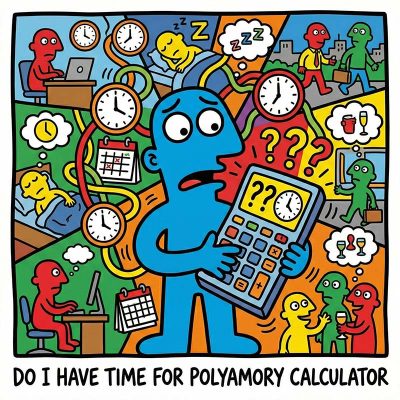
Love is infinite, but your calendar is brutally finite. The fantasy is deep connection; the reality is often just exhausted "calendar tetris." Promising time you don't actually have isn't romantic, it’s a recipe for burnout and broken trust. That sinking feeling when you have to cancel again? That’s the sound of overextension destroying your relationships.
This calculator forces you to confront the math of your life. Do you actually have space for another heart, or are you just setting everyone up for disappointment?

The fantasy is total autonomy and connection. The reality? It can feel like drowning in scheduling chaos and misunderstood expectations. That anxiety you feel isn’t just stress; it’s the wobble of living without a default "anchor." Without a solid architecture, Solo Polyamory stops being a life design and starts being a recipe for burnout and confusion.
The Essential Guide replaces the drift with a concrete anchor. We provide the "Solo Ethic," boundary scripts, and burnout protocols needed to protect your peace. Don't just date around—build a life that actually works for you.
Hierarchy sounds like a corporate org chart until someone gets their feelings hurt. That stomach-turning fear that you are just a "secondary" who can be fired at any time is real. If your relationship feels like a secret ranking system, you are doing it wrong.
Ambiguity is where resentment grows. The Essential Guide replaces the "who matters more" panic with a concrete charter. We provide the scripts and equity guardrails needed to protect every heart in the polycule. Stop guessing and start building.
The ideal is pure equality. The reality? It often slides into hidden rankings where someone gets hurt. That sinking feeling that you are secretly a "secondary" despite the label? That is your intuition detecting couple privilege. Ambiguity is where resentment thrives.
The Essential Guide replaces vague promises with concrete governance. We provide the charters, equity tools, and jealousy protocols needed to ensure "non-hierarchical" isn't just a fantasy. Stop guessing who matters most. Build a network that is actually fair.
The fantasy is total autonomy and connection. The reality? It can feel like drowning in scheduling chaos and misunderstood expectations. That anxiety you feel isn’t just stress; it’s the wobble of living without a default "anchor." Without a solid architecture, Solo Polyamory stops being a life design and starts being a recipe for burnout and confusion.
The Essential Guide replaces the drift with a concrete anchor. We provide the "Solo Ethic," boundary scripts, and burnout protocols needed to protect your peace. Don't just date around—build a life that actually works for you.
Hierarchy sounds like a corporate org chart until someone gets their feelings hurt. That stomach-turning fear that you are just a "secondary" who can be fired at any time is real. If your relationship feels like a secret ranking system, you are doing it wrong.
Ambiguity is where resentment grows. The Essential Guide replaces the "who matters more" panic with a concrete charter. We provide the scripts and equity guardrails needed to protect every heart in the polycule. Stop guessing and start building.
Why unlearning couple privilege matters in a non hierarchical setup
Unlearning is not a throwaway exercise. It is the process of aligning your actions with the values you claim to hold. For many people the journey toward true non hierarchical polyamory involves three big shifts.
- From ownership to consent Instead of assuming you own your partner you practice ongoing consent with everyone involved and you value boundaries as living agreements that can shift over time.
- From solo default to shared space You move away from planning around a two person center and you learn to plan with a multi relational ecosystem in mind.
- From fairness by sameness to fairness by context You acknowledge that not every situation will require the same amount of attention or energy and you design systems that reflect current needs rather than a one size fits all approach.
These shifts can be challenging and they require a willingness to pause to listen and to change. The goal is to create a relational world where every connection is treated as valuable and where time energy and love are allocated with openness and care.
Unlearning steps you can take started today
Here is a practical, no fluff plan you can actually apply. Each step builds on the previous one and is designed to fit busy lives while moving the needle toward a more equitable ENM dynamic.
Step one start with awareness
The first step is naming the patterns you notice. Do you see events or social spaces where the couple is prioritized or where solo or metamour needs are overlooked? Keep a simple log for two weeks. Note what happened who was involved how decisions were made who was consulted and what the outcome was. This awareness is the map you will use to plan real change.
Step two map your values and needs
Create a short list of values that matter most to you in a multi relational life. Examples might include equality honesty respect autonomy and care. Then write down your needs in different situations. For example what level of time and energy do you want to commit to new partners in the first three months? How do you want to handle date nights with metamours? When you feel rushed or sidelined what do you need from your partners to feel heard?
Step three identify privilege patterns
Look at your log and your values and start naming where privilege shows up. Do you notice that you and your partner often decide group activities without asking a metamour if they want to join? Are calendars constantly cleared for a couple date night with little notice to others? Are conversations about future plans dominated by the couple while others are left out? The goal is not guilt it is clarity and next steps.
Step four practice inclusive communication
Develop a habit of asking open questions and inviting input from everyone involved. A few examples you can reuse include the following.
- Would you like to join us for this event or would you prefer something different this week?
- What is your preferred cadence for communication about new partners or changes to schedules?
- Are there any constraints we should be aware of so we can plan in a way that works for you as well?
Repeat these questions in casual conversations if needed and when agreements are in place write them down in a shared document or a simple agreement sheet that everyone can access and update. This keeps everyone on the same page and it prevents the couple from speaking for the whole group without input.
Step five renegotiate time energy and emotional labor
Time energy and emotional labor are scarce resources. In a non hierarchical world you can budget them for each relationship in a way that respects everyone’s needs. Start by listing all ongoing commitments and who they involve. Then discuss how to distribute time and energy fairly by context rather than by the old rule of thumb that the couple must be prioritized. Small changes such as scheduling metamour coffee time or group check ins can make a surprising difference.
Step six practice compersion and healthy jealousy management
Compersion is the feeling of joy when your partner is happy with someone else. It is not a magic switch. It requires empathy and practice. When jealousy arises acknowledge it accept it and then re center on a conversation about needs and boundaries. This is a continuous practice not a one time fix.
Step seven build a supportive community
Connection matters. Create or join spaces where solo partners metamours and couples can share experiences and strategies. A supportive community normalizes the hard feelings and the wins and offers practical tips from people who have lived through similar dynamics. The more voices you hear the more you realize unlearning couple privilege is not a solo project it is a shared project.
Real life scenarios with scripts you can adapt
To bring the theory into practice we offer some realistic scenarios and ready to use scripts. These are meant to be starting points. Adapt them to your relationships and your language. The goal is to invite participation not to control outcomes.
Scenario one: a couple oriented energy is crowding out a metamour
Situation The couple has a next level social date planned with another partner who feels left out of the planning loop. They want to join but the couple has kept the calendar private and exclusive to the two of them. Dialogue A sample conversation can begin with a calm invitation and a genuine check in.
Script We would love to include you in the upcoming plan. Would you be available to join us for dinner next Thursday or is there another time that would work better for you? We want to make sure you feel welcomed and part of the plans. If the timing is hard we can revise together and find something that works for everyone.
Outcome The metamour feels seen and the couple learns to share calendar space and invites rather than assuming availability. This reduces feelings of exclusion and starts a pattern of inclusive planning.
Scenario two: two partners want a romantic date and a metamour wants time too
Situation A common dynamic in non hierarchical polyamory is balancing multiple kinds of connection. The two partners may want a date together but the metamour also wants time with the partners. Dialogue A practical approach is to propose a shared time followed by separate connections so no one feels sidelined.
Script It would be great to have a date with both of you this Friday. We can do a late dinner for the three of us and then separately schedule some time with each of you later in the week. How does that sound? We want to make sure everyone gets the attention they need and deserves.
Outcome The group experiences a sense of fairness that respects each relationship. The calendar begins to reflect all connections rather than just the primary couple.
Scenario three: a dating app profile that defaults to couple language
Situation A lot of dating platforms and social spaces still present a default couple narrative. This can signal to singles or solo poly people that the two person unit is the norm. Dialogue A practical approach is to address the language directly and offer an inclusive alternative in your profile.
Script When updating profiles or meeting people in person say something like We are a non hierarchical polyamorous group that values honesty and consent and we welcome conversations with solo people metamours and couples alike. We are looking to build connections with people who want to explore ethical non monogamy together with us. We want you to be part of the conversation and the plan from the start.
Tools and exercises to help you unlearn
Below are practical exercises you can do alone or with partners to root out couple centered habits from your routines.
- Privilege audit worksheet Create a simple table with columns for situation action outcome and who was involved. Fill this out after social events meetups or conversations to reveal hidden biases.
- Time and energy ledger Track how much time you commit to each relationship weekly. Compare the totals and adjust to ensure nobody is consistently left waiting or unheard.
- Calendar sharing practice Use a shared calendar that everyone can access. Invite metamours and solo partners to add events and propose alternative times when conflicts arise.
- Communication prompts Keep a small set of prompts handy for quick check ins. Examples include What would help you feel more included this week? Where do you want more or less visibility right now?
- Reflection journaling End each week with a short reflection on what felt fair and what did not. Note any commitments you want to renegotiate the following week.
Boundaries versus agreements in non hierarchical ENM
Boundaries are about protection and safety. Agreements are about shared norms that guide behavior. In a non hierarchical setting both are essential but they must be revisited regularly. Agreements should never lock in a way that excludes others from meaningful connections or makes anyone feel unsafe to express themselves. Boundaries can be adjusted as you grow and new dynamics emerge while agreements should reflect the current health of the shared network. This flexible approach helps reduce the friction that can come from a couple centered default while keeping relationships respectful and honest.
Common myths about non hierarchical polyamory and couple privilege
- Myth: Non hierarchical means there are no rules.
Reality: There are rules and they are negotiated with all involved. The rules evolve as the dynamics shift. - Myth: If you are single you cannot be trusted.
Reality: Trust is earned by consistent communication and demonstrated respect not by the presence of a partner. - Myth: Jealousy means you should exit the relationship.
Reality: Jealousy is a signal to communicate and adjust. It is a normal part of the landscape not a reason to quit. - Myth: Being a couple means you automatically have more rights.
Reality: Rights in ENM are earned through consent and ongoing agreements with everyone involved. - Myth: Non hierarchical polyamory just equals more drama.
Reality: Drama is often a sign of legacy patterns and unspoken expectations. When you stop hiding behind couple status you can address issues with clarity and care.
Navigating family and social circles as a non hierarchical poly
Family contexts can add pressure to adopt conventional scripts. You can approach these spaces with honesty and a well prepared short explanation. Focus on values and communication and be ready to answer questions with kindness while also setting boundaries about privacy. It is perfectly acceptable to correct misinformation and to invite people to meet your diverse network one relationship at a time. Slow introductions and gradual openness can help families adapt without feeling overwhelmed.
Glossary of useful terms and acronyms
- ENM Ethical non monogamy a framework that emphasizes consent honesty and ongoing communication about multiple romantic or sexual relationships.
- Non Hierarchical Polyamory An approach to polyamory where there is no intended or implied ranking of relationships. All connections are valued on their own terms.
- Metamour A partner of your partner who is not connected romantically to you.
- Compersion The feeling of joy at seeing a partner experience happiness with someone else.
- Jealousy An emotion that signals a perceived threat or insecurity in a relationship. It can be explored and managed through conversation and self reflection.
- Privilege audit A process of identifying unearned advantages that come from social scripts and relationships and planning adjustments to address them.
Frequently asked questions
FAQ
Love is infinite, but your calendar is brutally finite. The fantasy is deep connection; the reality is often just exhausted "calendar tetris." Promising time you don't actually have isn't romantic, it’s a recipe for burnout and broken trust. That sinking feeling when you have to cancel again? That’s the sound of overextension destroying your relationships.
This calculator forces you to confront the math of your life. Do you actually have space for another heart, or are you just setting everyone up for disappointment?
The fantasy is total autonomy and connection. The reality? It can feel like drowning in scheduling chaos and misunderstood expectations. That anxiety you feel isn’t just stress; it’s the wobble of living without a default "anchor." Without a solid architecture, Solo Polyamory stops being a life design and starts being a recipe for burnout and confusion.
The Essential Guide replaces the drift with a concrete anchor. We provide the "Solo Ethic," boundary scripts, and burnout protocols needed to protect your peace. Don't just date around—build a life that actually works for you.
Hierarchy sounds like a corporate org chart until someone gets their feelings hurt. That stomach-turning fear that you are just a "secondary" who can be fired at any time is real. If your relationship feels like a secret ranking system, you are doing it wrong.
Ambiguity is where resentment grows. The Essential Guide replaces the "who matters more" panic with a concrete charter. We provide the scripts and equity guardrails needed to protect every heart in the polycule. Stop guessing and start building.
The ideal is pure equality. The reality? It often slides into hidden rankings where someone gets hurt. That sinking feeling that you are secretly a "secondary" despite the label? That is your intuition detecting couple privilege. Ambiguity is where resentment thrives.
The Essential Guide replaces vague promises with concrete governance. We provide the charters, equity tools, and jealousy protocols needed to ensure "non-hierarchical" isn't just a fantasy. Stop guessing who matters most. Build a network that is actually fair.
The fantasy is total autonomy and connection. The reality? It can feel like drowning in scheduling chaos and misunderstood expectations. That anxiety you feel isn’t just stress; it’s the wobble of living without a default "anchor." Without a solid architecture, Solo Polyamory stops being a life design and starts being a recipe for burnout and confusion.
The Essential Guide replaces the drift with a concrete anchor. We provide the "Solo Ethic," boundary scripts, and burnout protocols needed to protect your peace. Don't just date around—build a life that actually works for you.
Hierarchy sounds like a corporate org chart until someone gets their feelings hurt. That stomach-turning fear that you are just a "secondary" who can be fired at any time is real. If your relationship feels like a secret ranking system, you are doing it wrong.
Ambiguity is where resentment grows. The Essential Guide replaces the "who matters more" panic with a concrete charter. We provide the scripts and equity guardrails needed to protect every heart in the polycule. Stop guessing and start building.
