
What Non Hierarchical Polyamory Is and What It Is Not


Non hierarchical polyamory is a way of loving more than one person without ranking those relationships in a strict ladder of importance. It is a dynamic within ethical non monogamy that prioritises consent, clear communication, and flexible boundaries over rigid labels like primary or secondary. This guide dives into what non hierarchical polyamory really means, what it does not mean, and how it can work in real life for people who want deep connections with more than one person at the same time.
Quick Links to Useful Sections
- What Non Hierarchical Polyamory Is
- What Non Hierarchical Polyamory Is Not
- Core Principles of Non Hierarchical Polyamory
- Boundaries versus Agreements
- Jealousy, Insecurity and How Non Hierarchical Polyamory Handles It
- Real World Scenarios in Non Hierarchical Polyamory
- Scenario 1 A busy professional with two strong romantic connections
- Scenario 2 A couple exploring with a new partner while maintaining existing bonds
- Scenario 3 A group orbiting scenario with a meta partner coordinating activities
- Scenario 4 Managing time when work and family commitments change
- Scenario 5 Navigating public spaces and social boundaries
- Communication Tools and Practices That Help
- Ethical Health, Safety and Consent Practices
- Myths About Non Hierarchical Polyamory Debunked
- Glossary of Useful Terms and Acronyms
- Frequently asked questions
Before we dive in, let us break down a few terms so we are all speaking the same language. We will explain acronyms and common phrases used in this ecosystem so you can read on with confidence. If you are new to ethical non monogamy you might hear words that sound like a foreign language. That is okay. We will translate and illustrate with practical examples you can picture in your own life.
What Non Hierarchical Polyamory Is
Non hierarchical polyamory is a relationship model within ethical non monogamy that rejects the idea of a single dominant relationship as the apex or control center of your life. In a non hierarchical setup there is no automatic ranking of partners. Each relationship is valued for its own strengths, boundaries, and emotional resonance. People in non hierarchical arrangements choose how they want to show up with each partner rather than slot each connection into a fixed hierarchy.
Key ideas that define this approach include openness, consent based agreements, and a willingness to renegotiate as needs or life circumstances change. Partners may be involved with each other in various ways such as dating, friendship with benefits, long term emotional connections, or intimate partnerships. The point is that all connections are formed with respect and mutual agency rather than an assumed order of importance.
In practice non hierarchical polyamory can look very different from couple based or triad oriented polyamory. You might have three or more people where no one partner is designated as a primary. A person might have a strong emotional bond with one partner while enjoying a casual and flexible connection with another. In other cases there could be a very steady relationship with one person and a more spontaneous connection with someone else. The common thread is that all relationships are negotiated on their own terms with each person involved having a voice and agency.
Another important part is the concept of autonomy. Everyone involved keeps a sense of self that is not defined entirely by a shared relationship circle. People keep their own circles of friends, family, and personal aims while still choosing to overlap with others in meaningful ways. Autonomy means you can pursue your own goals, time, and energy without feeling obliged to align every decision with a single partner or group expectation.
Non hierarchical polyamory also recognises the reality that life can be busy. Work, school, health, children, and travel will shape how much time and energy you can bring to each connection. The structure aims to accommodate those fluctuations rather than pretend they do not exist. The goal is sustainable intimacy that respects everyone involved and keeps communication clear and ongoing.
What Non Hierarchical Polyamory Is Not
To avoid sugar coating the picture, it helps to call out a few common misunderstandings. Non hierarchical polyamory is not a free for all. It is not a plan with no boundaries or a sign that you cannot commit to anyone. It is not a way to avoid dealing with difficult feelings or to dodge hard conversations about what you want and need. It is not about keeping people around without caring how they feel or about keeping secret relationships under cover for convenience.
So what does it look like when those caveats apply? A non hierarchical approach requires consent from all involved, honest communication, and a willingness to renegotiate when life changes. There is still respect for each partner as an individual with their own boundaries and needs. Messy times can happen and that is normal. The difference is how you handle those moments. In a non hierarchical setup you face tough situations with openness rather than sweeping them under the rug or muting your own needs to protect a single relationship at the expense of others.
It is also important to understand that non hierarchical does not mean everything must be equal. Equality as a concept in relationships is nuanced. It means fairness and respect for each person s experience rather than a beach of time or energy that must be distributed equally across every connection. People in this dynamic may allocate more time to one relationship in a given season and shift as feelings develop or as life changes. The point is that decisions come from a shared negotiation rather than from a habit of ranking or forced sameness.
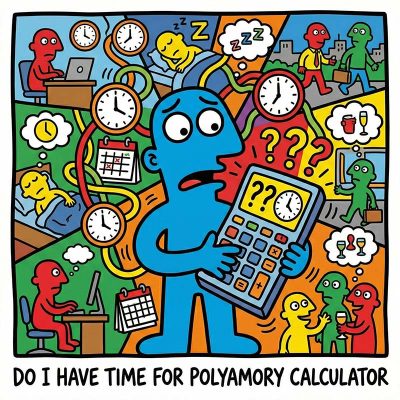
Love is infinite, but your calendar is brutally finite. The fantasy is deep connection; the reality is often just exhausted "calendar tetris." Promising time you don't actually have isn't romantic, it’s a recipe for burnout and broken trust. That sinking feeling when you have to cancel again? That’s the sound of overextension destroying your relationships.
This calculator forces you to confront the math of your life. Do you actually have space for another heart, or are you just setting everyone up for disappointment?

The fantasy is total autonomy and connection. The reality? It can feel like drowning in scheduling chaos and misunderstood expectations. That anxiety you feel isn’t just stress; it’s the wobble of living without a default "anchor." Without a solid architecture, Solo Polyamory stops being a life design and starts being a recipe for burnout and confusion.
The Essential Guide replaces the drift with a concrete anchor. We provide the "Solo Ethic," boundary scripts, and burnout protocols needed to protect your peace. Don't just date around—build a life that actually works for you.

Hierarchy sounds like a corporate org chart until someone gets their feelings hurt. That stomach-turning fear that you are just a "secondary" who can be fired at any time is real. If your relationship feels like a secret ranking system, you are doing it wrong.
Ambiguity is where resentment grows. The Essential Guide replaces the "who matters more" panic with a concrete charter. We provide the scripts and equity guardrails needed to protect every heart in the polycule. Stop guessing and start building.

The ideal is pure equality. The reality? It often slides into hidden rankings where someone gets hurt. That sinking feeling that you are secretly a "secondary" despite the label? That is your intuition detecting couple privilege. Ambiguity is where resentment thrives.
The Essential Guide replaces vague promises with concrete governance. We provide the charters, equity tools, and jealousy protocols needed to ensure "non-hierarchical" isn't just a fantasy. Stop guessing who matters most. Build a network that is actually fair.
The fantasy is total autonomy and connection. The reality? It can feel like drowning in scheduling chaos and misunderstood expectations. That anxiety you feel isn’t just stress; it’s the wobble of living without a default "anchor." Without a solid architecture, Solo Polyamory stops being a life design and starts being a recipe for burnout and confusion.
The Essential Guide replaces the drift with a concrete anchor. We provide the "Solo Ethic," boundary scripts, and burnout protocols needed to protect your peace. Don't just date around—build a life that actually works for you.
Hierarchy sounds like a corporate org chart until someone gets their feelings hurt. That stomach-turning fear that you are just a "secondary" who can be fired at any time is real. If your relationship feels like a secret ranking system, you are doing it wrong.
Ambiguity is where resentment grows. The Essential Guide replaces the "who matters more" panic with a concrete charter. We provide the scripts and equity guardrails needed to protect every heart in the polycule. Stop guessing and start building.
Core Principles of Non Hierarchical Polyamory
These principles help distinguish NH polyamory from other forms of polyamory and from jealousy heavy or exclusive setups. Keep them in mind as you explore or reflect on your own desires.
- Consent as a living process Consent is not a one time checkbox. It is a continual conversation and a mutual agreement that can be revisited at any time as feelings or life circumstances change.
- Open communication Honest, timely, and respectful communication is essential. People share their needs, preferences, boundaries and updates about their emotional life.
- Autonomy and agency Everyone retains personal autonomy. You do not give up your independence or your right to form connections with other people.
- Equal consideration of all connections There is no automatic prime partner. Each relationship is given space to develop and matters are decided through dialogue rather than hierarchy.
- Clear boundaries and negotiated agreements Boundaries are discussed and written down when helpful. Agreements can be modified as life changes and feelings evolve.
- Respect and non ownership No one belongs to anyone else. People set boundaries that protect their wellbeing rather than trying to contain others for convenience or control.
- Self awareness and emotional management You take responsibility for your own emotions. You learn tools to work with difficult feelings rather than expecting others to fix them for you.
Boundaries versus Agreements
In this framework you will hear two terms a lot. Boundaries are about what you are not comfortable with and what you need to feel safe. Agreements are the practical steps you take together to make those boundaries work in real life. Boundaries can include contact limits like how often you want to see a partner, what activities you are comfortable sharing, or how you handle information about other relationships. Agreements can cover scheduling, safe sex practices and how you will communicate about new partners or flirtations. Both are living tools that can be adjusted as needed. The aim is to feel safe while staying emotionally connected to the people you care about.
Here are some example boundaries and agreements to illustrate how this works in real life. These are not universal rules but templates that partners can adapt to their own lives.
- Boundary example I need at least one night per week to recharge alone time. This helps me maintain energy for my primary relationship and I expect that to be respected by my partners.
- Agreement example We will have a monthly check in where we review feelings, schedule, and new needs. We will document decisions in a shared note so everyone is on the same page.
- Boundary example I do not want social media posts about other partners to be made without context. We will discuss what feels comfortable and respectful for everyone involved.
- Agreement example If a partner develops a new relationship, we will talk about how much information is shared and how to handle public events to protect everyone s privacy.
Jealousy, Insecurity and How Non Hierarchical Polyamory Handles It
Practical strategies can include journaling, talking things through with a trusted partner, or taking a short break with a single relationship to recalibrate. Some people find it helpful to rotate in a neutral third party or a relationship coach to learn new communication tools. The point is not to pretend jealousy does not exist but to transform it into a catalyst for deeper understanding and closer connection with the people involved.
Real World Scenarios in Non Hierarchical Polyamory
To see how this works, let us walk through several practical situations. These examples are designed to spark ideas and show how negotiations play out in daily life. Remember that each scenario can unfold in many different ways depending on people s needs and the life context they are in.
Scenario 1 A busy professional with two strong romantic connections
Alex is a project manager who loves spending evenings with two partners. One relationship is built on long conversations about ideas and future plans, while the other is more about spontaneous fun and shared hobbies. Both partners know about each other and support each other s role in Alex s life. They hold a monthly group check in to adjust boundaries. During a stressful work period Alex notices time constraints increasing. Together the trio agrees to a lighter schedule with shorter dates and more asynchronous communication. The key here is transparency and a willingness to adjust without anyone feeling neglected or sidelined.
Scenario 2 A couple exploring with a new partner while maintaining existing bonds
Rhea and Jay are a couple who decide to explore with a new partner while keeping their primary connection intact. They discuss safety boundaries, privacy preferences, and how much information to share in group chats. The new partner learns about Rhea and Jays shared life and agrees to respect their existing commitments. They all practice clear consent before escalating intimacy and commit to ongoing check ins about emotional needs. Over time Rhea and Jay discover that their bond deepens even as they welcome a fresh dynamic into their lives.
Scenario 3 A group orbiting scenario with a meta partner coordinating activities
Sam has two partners and a third person called the meta who helps coordinate social activities. The meta does not replace any of the emotional ties but helps ensure everyone has time together and that plans fit into busy schedules. The arrangement is clear. Everyone knows who is dating whom and the boundaries around public displays are respected. Communication flows through a shared schedule and a monthly planning session. People feel connected without feeling owned or forced into a specific pattern by any one person or couple.
Scenario 4 Managing time when work and family commitments change
Avery loves spending time with partners but has a demanding work schedule and caregiving duties. The non hierarchical approach helps because there is room to renegotiate who spends time when. The group creates a flexible calendar that prioritises essential commitments but also makes space for spontaneous connections. When a partner s health fluctuates, others adjust their expectations with care and courtesy rather than criticism. This flexibility keeps relationships alive even during tense life periods.
Scenario 5 Navigating public spaces and social boundaries
In social settings there can be awkward moments when people ask about the number of partners or the structure behind the scenes. The people involved in this scenario have agreed on a respectful level of disclosure. They choose to share what is comfortable for them and maintain privacy where needed. The aim is to be honest about relationships without turning every social interaction into a personal audit of everyone else s love life. This approach helps preserve trust and protects everyone s sense of safety in public spaces.
Communication Tools and Practices That Help
Effective communication is the bedrock of non hierarchical polyamory. Here are practical tools that many people find helpful. Adapt them to fit your own style and needs.
- Regular check ins Schedule predictable conversations about feelings, boundaries, and life updates. Consistency helps prevent small issues from becoming big problems.
- Neutral ground conversations Have tough talks in a neutral space for calm focus. This can be a cafe or a quiet park rather than a crowded venue where emotions might run high.
- Written agreements A shared document or notes can capture boundaries and agreements. It reduces miscommunication and helps everyone stay aligned even when memory fog sets in.
- Checklists and reminders Use simple checklists for things like health, safety, and consent. Reminders keep essential topics from slipping through the cracks.
- Non violent communication When discussing sensitive topics use language that expresses feelings without blame. For example say I feel anxious when planning a date without you rather than You never consider my time.
Ethical Health, Safety and Consent Practices
In any polyamorous setting health and safety should be a shared priority. This especially matters in non hierarchical arrangements where multiple partners may interact with each other and the same circles. Practicing regular sexual health checks and open dialogue about STI testing frequency is wise. Partners decide together what kinds of testing are appropriate and how to share results while maintaining privacy and respect for everyone involved.
Consent in non hierarchical polyamory is ongoing. It is not a one off event. People can change their minds and updates should be welcomed. The right to pause or pause completely should be respected. The goal is to nurture trust so that everyone feels safe to express concerns and to change plans if needed.
Myths About Non Hierarchical Polyamory Debunked
Let us tackle some myths that often surface in conversations about this dynamic. Clearing up misinformation helps people decide whether this path fits their own needs and values.
- Myth There is no romance in non hierarchical polyamory. Reality Romantic feelings can exist with multiple partners. The relationship style does not erase romance. It changes how you manage time, energy and transparency.
- Myth It means you must split attention evenly among all partners. Reality Equal attention is not required or always possible. The aim is fair consideration and honest communication about what is feasible for you at any moment.
- Myth It is less serious than hierarchical arrangements. Reality Serious commitments can exist in non hierarchical setups. The difference is that there is no automatic ranking and the value of each relationship is negotiated.
- Myth It is a path to avoid commitment altogether. Reality People in NH polyamory can be deeply committed to multiple people. Commitment here refers to consistency, care, and mutual responsibility rather than ownership or control.
Glossary of Useful Terms and Acronyms
- NH polyamory Non hierarchical polyamory a form of ethical non monogamy where no partner has an automatic higher priority than another.
- Ethical non monogamy A framework that embraces multiple intimate relationships with consent and honesty as foundations.
- ENM Short for ethical non monogamy. We will spell it out fully so everyone knows what we mean.
- Hierarchical polyamory A structure in which one relationship is treated as the primary or most important and others are viewed in relation to it.
- Primary partner A term used in some polyamory circles to describe the main relationship. In non hierarchical setups this concept does not automatically apply.
- Secondary partner A partner who is not designated as primary. In non hierarchical arrangements no automatic ranking exists.
- Compersion The experience of joy from seeing a partner have happiness with someone else rather than jealous frustration.
- Orbiting A term for staying connected with someone socially and emotionally even when not in a primary relationship with them.
- Negotiation The process of discussing and agreeing on boundaries, rules, and expectations.
- Boundary A line that defines what you are comfortable with. Boundaries protect wellbeing and autonomy.
- Agreement A practical string of expectations that help relationships function smoothly.
Frequently asked questions
- What does non hierarchical polyamory really look like in everyday life? It looks like transparent conversations about dating, time management that fits life, and mutual respect for each person s needs. It is about choosing connections that work for all involved rather than forcing a single path onto everyone.
- Can someone be emotionally attached to two people at the same time in this setup? Yes. Emotional attachment can occur with multiple people. The challenge is managing those attachments in a way that feels fair and respectful to everyone involved.
- Is there a standard length of time people spend with partners? Not really. It depends on life demands and negotiated agreements. Some weeks may bring long dates while others may rely on text messages and casual meetups.
- How do I start a conversation about moving to a non hierarchical arrangement? Start with your own feelings and needs. Ask your partner how they feel about multiple connections and whether they are open to exploring a more flexible dynamic. Agree to slow and careful steps and use a check in to monitor comfort levels.
- What if someone feels left out or overwhelmed? Address the feeling directly, validate it, and adjust plans. It may require more time, a shift in boundaries, or more transparent boundaries to restore a sense of safety for everyone involved.
- Is it possible to sustain this without outside help? Yes many people build robust non hierarchical networks on their own. Some find relationship coaching or therapy helpful to strengthen communication and boundary setting.
- What about dating within a larger group or community? People often form circles or communities where multiple relationships exist. The key is consent, openness and ongoing negotiation about what works for everyone involved.
- How do we handle secrecy or privacy in NH polyamory? Privacy is a shared value. Decide what information is appropriate to share with others in your life and respect those boundaries. No one should feel betrayed by limited disclosures.
- Are there common mistakes to avoid? One common pitfall is assuming equal time always equals happiness. Another is ignoring boundaries or failing to renegotiate when life changes. The antidote is ongoing, compassionate communication.
- Where can I learn more about this topic? Look for reputable books and communities that focus on ethical non monogamy and non hierarchical arrangements. Talking to a therapist who understands polyamory can also help.
- How do we introduce new partners to existing relationships? Discuss expectations first, share boundaries, and keep conversations inclusive. A soft start can be helpful for everyone to adjust before introducing more intimacy or commitment.
Love is infinite, but your calendar is brutally finite. The fantasy is deep connection; the reality is often just exhausted "calendar tetris." Promising time you don't actually have isn't romantic, it’s a recipe for burnout and broken trust. That sinking feeling when you have to cancel again? That’s the sound of overextension destroying your relationships.
This calculator forces you to confront the math of your life. Do you actually have space for another heart, or are you just setting everyone up for disappointment?
The fantasy is total autonomy and connection. The reality? It can feel like drowning in scheduling chaos and misunderstood expectations. That anxiety you feel isn’t just stress; it’s the wobble of living without a default "anchor." Without a solid architecture, Solo Polyamory stops being a life design and starts being a recipe for burnout and confusion.
The Essential Guide replaces the drift with a concrete anchor. We provide the "Solo Ethic," boundary scripts, and burnout protocols needed to protect your peace. Don't just date around—build a life that actually works for you.
Hierarchy sounds like a corporate org chart until someone gets their feelings hurt. That stomach-turning fear that you are just a "secondary" who can be fired at any time is real. If your relationship feels like a secret ranking system, you are doing it wrong.
Ambiguity is where resentment grows. The Essential Guide replaces the "who matters more" panic with a concrete charter. We provide the scripts and equity guardrails needed to protect every heart in the polycule. Stop guessing and start building.
The ideal is pure equality. The reality? It often slides into hidden rankings where someone gets hurt. That sinking feeling that you are secretly a "secondary" despite the label? That is your intuition detecting couple privilege. Ambiguity is where resentment thrives.
The Essential Guide replaces vague promises with concrete governance. We provide the charters, equity tools, and jealousy protocols needed to ensure "non-hierarchical" isn't just a fantasy. Stop guessing who matters most. Build a network that is actually fair.
The fantasy is total autonomy and connection. The reality? It can feel like drowning in scheduling chaos and misunderstood expectations. That anxiety you feel isn’t just stress; it’s the wobble of living without a default "anchor." Without a solid architecture, Solo Polyamory stops being a life design and starts being a recipe for burnout and confusion.
The Essential Guide replaces the drift with a concrete anchor. We provide the "Solo Ethic," boundary scripts, and burnout protocols needed to protect your peace. Don't just date around—build a life that actually works for you.
Hierarchy sounds like a corporate org chart until someone gets their feelings hurt. That stomach-turning fear that you are just a "secondary" who can be fired at any time is real. If your relationship feels like a secret ranking system, you are doing it wrong.
Ambiguity is where resentment grows. The Essential Guide replaces the "who matters more" panic with a concrete charter. We provide the scripts and equity guardrails needed to protect every heart in the polycule. Stop guessing and start building.
