
Avoiding Being Treated as an Accessory Relationship

In the world of ethical non monogamy or ENM the solo polyamory dynamic can feel exciting and freeing yet it can also lead to relationships where you end up on the side rather than in the center. This guide is a practical, no nonsense playbook for staying seen heard and valued as a full partner in solo poly situations. We will break down terms share real world strategies and give you ready to use scripts and templates. You deserve relationships where you are equally important and respected. No excuses and no apologies needed.
Quick Links to Useful Sections
- Who this guide is for
- Key terms you should know
- Why solo poly dynamics can lead to accessory patterns
- Signs you are being treated as an accessory
- What to do when you notice accessory patterns
- Boundaries that protect your place in solo poly dynamics
- Communication strategies that work in solo poly settings
- Starting conversations without blame
- Opening lines you can use
- Handling defensiveness without chaos
- Negotiating a trial period
- Scripts you can adapt for fast use
- Templates you can adapt for real conversations
- Realistic scenarios and how to handle them
- Scenario one , a plan changes and you feel left out
- Scenario two , a partner wants to keep you at distance from their other relationships
- Scenario three , you are asked to accept being a casual option
- Self care and sustaining your sense of value
- Red flags that say it is time to reassess the connection
- When to walk away and how to do it with care
- Glossary of useful terms and acronyms
- Frequently asked questions
Who this guide is for
This guide is for people who identify with solo polyamory or who love the idea of not having a single dominant relationship structure. If you want dynamic freedom but also want to be treated as a real partner by your lovers this is for you. You might be new to solo polyamory or you might have been in the space for a while. Either way you want practical strategies that actually work in real life not just theory.
Key terms you should know
Understanding the vocabulary helps you set boundaries with clarity. Here are the essential terms explained in plain language.
- Ethical non monogamy ENM A style of romance and sex life where people choose to have romantic or sexual connections with more than one person with honesty consent and transparency.
- Solo polyamory A form of ENM where individuals prefer not to have a traditional primary partnership or a single anchor. People practicing solo polyamory often maintain independence and personal autonomy while pursuing multiple connections.
- Accessory relationship A relationship that is treated as a secondary option or last priority. The person may be included in some activities but not given equal weight or visibility in the other person s life.
- Primary partner In many poly setups this is the person who has top level priority or life integration. In solo poly this label is often avoided or renegotiated to keep everyone equal and free.
- Non primary relationships Connections that do not have the same level of time visibility or life integration as a primary relationship would in other setups.
- Meta The partner of your partner. A meta relationship is about how your lives overlap and how you relate to each other as adults with respect and consent.
- Boundaries Clear statements about what is allowed what is not and how you expect to be treated in a relationship.
- Communication plan A structure for how you talk about needs expectations and changes with your partners in a way that reduces drama and confusion.
- Jealousy and compersion Normal emotions that can appear in all relationships. Jealousy is a protective response while compersion is the joy you feel when your partner is happy with someone else.
- Equity not control The goal is to treat all partners with equal respect and care rather than trying to control others lives.
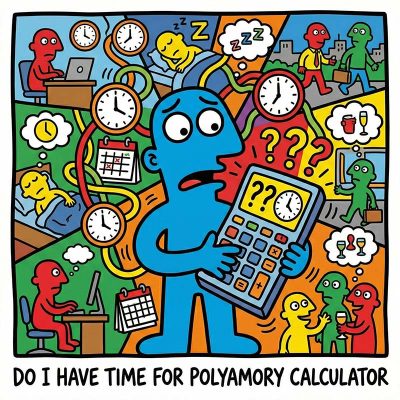
Love is infinite, but your calendar is brutally finite. The fantasy is deep connection; the reality is often just exhausted "calendar tetris." Promising time you don't actually have isn't romantic, it’s a recipe for burnout and broken trust. That sinking feeling when you have to cancel again? That’s the sound of overextension destroying your relationships.
This calculator forces you to confront the math of your life. Do you actually have space for another heart, or are you just setting everyone up for disappointment?

The fantasy is total autonomy and connection. The reality? It can feel like drowning in scheduling chaos and misunderstood expectations. That anxiety you feel isn’t just stress; it’s the wobble of living without a default "anchor." Without a solid architecture, Solo Polyamory stops being a life design and starts being a recipe for burnout and confusion.
The Essential Guide replaces the drift with a concrete anchor. We provide the "Solo Ethic," boundary scripts, and burnout protocols needed to protect your peace. Don't just date around—build a life that actually works for you.

Hierarchy sounds like a corporate org chart until someone gets their feelings hurt. That stomach-turning fear that you are just a "secondary" who can be fired at any time is real. If your relationship feels like a secret ranking system, you are doing it wrong.
Ambiguity is where resentment grows. The Essential Guide replaces the "who matters more" panic with a concrete charter. We provide the scripts and equity guardrails needed to protect every heart in the polycule. Stop guessing and start building.
The ideal is pure equality. The reality? It often slides into hidden rankings where someone gets hurt. That sinking feeling that you are secretly a "secondary" despite the label? That is your intuition detecting couple privilege. Ambiguity is where resentment thrives.
The Essential Guide replaces vague promises with concrete governance. We provide the charters, equity tools, and jealousy protocols needed to ensure "non-hierarchical" isn't just a fantasy. Stop guessing who matters most. Build a network that is actually fair.
The fantasy is total autonomy and connection. The reality? It can feel like drowning in scheduling chaos and misunderstood expectations. That anxiety you feel isn’t just stress; it’s the wobble of living without a default "anchor." Without a solid architecture, Solo Polyamory stops being a life design and starts being a recipe for burnout and confusion.
The Essential Guide replaces the drift with a concrete anchor. We provide the "Solo Ethic," boundary scripts, and burnout protocols needed to protect your peace. Don't just date around—build a life that actually works for you.
Hierarchy sounds like a corporate org chart until someone gets their feelings hurt. That stomach-turning fear that you are just a "secondary" who can be fired at any time is real. If your relationship feels like a secret ranking system, you are doing it wrong.
Ambiguity is where resentment grows. The Essential Guide replaces the "who matters more" panic with a concrete charter. We provide the scripts and equity guardrails needed to protect every heart in the polycule. Stop guessing and start building.
Why solo poly dynamics can lead to accessory patterns
- Time and energy drift away from you because a partner has taught themselves to reserve energy for a main life and other relationships beyond what you are comfortable with.
- Label confusion makes you feel less visible. If your partner uses special terms for other connections but not for your relationship you can feel erased.
- Privacy and secrecy creep in. When others life and events become private while your presence is not equally recognized you can feel like an afterthought.
- Communication gaps create misunderstanding. When updates about other relationships come late or never you lose a sense of inclusion.
Recognizing these patterns early makes it easier to stop them before they grow into a habit and a habit is a hard thing to break. You deserve clarity range and intentionality in how every connection is treated.
Signs you are being treated as an accessory
Knowing the signs helps you act before the dynamic becomes a pattern you accept. Look for these indicators in your life and conversations.
- You rarely get included in plans that involve your partner s social circle or family life.
- Your time with your partner is not balanced with time they spend with others and there is little to no attempt to create equal space for you.
- Where you stand is not named or discussed. You are simply expected to go along with whatever is happening in their life.
- You are not introduced to key people in your partner s life such as close friends or family and you are treated as a casual afterthought.
- Public posts or social media announcements never include you or acknowledge your connection while other partners are highlighted.
- Conversations about your relationship feel reactive rather than proactive. You often have to push for important topics rather than them bringing them up.
- When you raise a boundary you are told that you are being difficult or that it is not possible to meet your request.
- Complicity from others in your partner s life makes you feel alone or unseen. You sense a silent hierarchy favoring other partners.
What to do when you notice accessory patterns
First steps matter. Slow careful moves protect your energy and your effort while you renegotiate the dynamic. Here is a practical approach you can use starting today.
- Take stock of your own needs. Ask yourself what would feeling seen and valued look like in this setup.
- Decide what you are not willing to compromise on. This could be time quality communication or inclusion in certain life events.
- Choose a calm moment to start a conversation with your partner about your needs. Do not wait for a crisis to begin this talk.
- Present clear boundaries and a plan for equity that does not demand control but emphasizes mutual respect and shared responsibility.
- Offer concrete requests rather than abstract statements. For example ask for a weekly date evening or a standing invite to certain events with a plan for when you both could participate with other partners.
- Agree on a check in schedule to review how the dynamic is working for both of you and your other relationships.
These steps keep you anchored in your own value while you negotiate with care and honesty. You have a right to direct your own time and to be treated as a real partner not as an accessory.
Boundaries that protect your place in solo poly dynamics
Boundaries are not walls they are protective guidelines that help everyone grow in a healthy direction. Here are practical boundaries tailored for solo poly scenarios.
- Visibility boundary I want to be kept in the loop about major life events and major plans even when you are with other people.
- Scheduling boundary I need a predictable pattern for time with you that respects both my life and yours without leaving me waiting with no answer.
- Inclusion boundary I want to be introduced to anyone who matters to you and to be included meaningfully in the social and family circles where appropriate.
- Label boundary I prefer not to be called the side or back up or anything that implies I am not a core partner. If a different term is used talk about why it is chosen and what it will mean in practice.
- Privacy boundary I respect your privacy and I ask for the same respect in return. I want you to share what helps me understand the dynamic and the rest can stay private unless it affects me.
- Sexual health boundary We will share information about sexual health and safety that is relevant to me and to my other partners. I want all concerns discussed openly and with care.
- Impact boundary If a new relationship affects our time or emotional space I want to address it early with a plan that keeps us both safe and supported.
Boundaries work best when they are specific concrete and revisited. Don t rely on vague promises. You deserve explicit agreements you can reference when needed.
Communication strategies that work in solo poly settings
Clear honest and respectful communication is the backbone of any healthy non monogamous setup. Here are practical strategies you can use to keep conversations productive not painful.
Starting conversations without blame
Lead with ownership. Use I statements to keep the focus on your experience rather than accusations. For example say I want us to talk about how we balance our time so I feel valued rather than you never make time for me.
Opening lines you can use
- I love our connection and I want to make sure I feel equal and respected in all the ways it matters to me.
- Can we set a time to talk about how we include each other in our plans and how we handle other relationships.
- What would it take for both of us to feel like we have real space in each other s lives.
Handling defensiveness without chaos
If your partner gets defensive stay curious. Reflect what you hear and ask a clarifying question. For example you might say I hear you feel attacked by this request. What would help you feel safe and heard while we work on this together.
Negotiating a trial period
Trial periods reduce pressure while you test new boundaries. Propose a time bound plan with a clear check in date. For example let us try this for eight weeks and then revisit what is working and what is not. This keeps both people accountable and reduces resentment.
Scripts you can adapt for fast use
- I value you and our connection. I want to be sure I am treated as an equal partner in your life. How can we make that happen while you enjoy other relationships.
- When I hear about plans with other partners I want to be included in conversations that affect our time together. Is there a way we can make that happen.
- I am happy to celebrate your other relationships but I also want to know that you are prioritizing our time as well. How would you like to handle this so we both feel seen.
Templates you can adapt for real conversations
Use these fill in the blank templates to jump start a boundary or check in conversation. Personalize them with your voice and your specifics.
Template A Boundaries talk
Hi I am [Your Name]. I want to talk about how we handle our time and our relationships. I value you and I want to feel like an equal partner in your life. My goal is to be treated with the same care and visibility as your other connections. I would like us to agree on [specific boundary], [another boundary], and a plan for checking in every [time period]. How does that sound to you.
Template B For complicated relationships
I value our connection and I know we have a complex history. I want to move toward clarity and fairness. I would like to set three concrete checkpoints where we review how we are balancing our lives. I also want us to agree on how to handle updates about other relationships so we both feel respected.
Template C Light and sincere
Hey I care about what we have. I want us to keep growing together while we both explore with others. Let s figure out a plan that makes us both feel seen and safe. I think a first step could be [first step] and then we can add the rest together.
Realistic scenarios and how to handle them
Scenario one , a plan changes and you feel left out
You find out about a date or event you were not included in and you feel you are treated as an after thought. You respond with calm curiosity. You say I noticed we did not talk about this weekend s plans and I would like to understand what happened. I want to make sure I am included in future decisions that affect our time together. How can we adjust our planning so I am informed and included moving forward.
Scenario two , a partner wants to keep you at distance from their other relationships
You might say I support your autonomy but I also want to feel like we are building a shared life rather than we are living separate lives. Can we agree on a minimum level of transparency about plans that involve other partners and a time we share for our own connection each week.
Scenario three , you are asked to accept being a casual option
That request uses a boundary you do not want to cross. A respectful response is I am not interested in being treated as a casual option. If we cannot align our needs and values on time visibility and respect I need to step back. You can propose a specific time to revisit if and when the dynamic shifts to equity and mutual care.
Self care and sustaining your sense of value
Your self worth matters and it does not hinge on the approval of a single partner. Here are practical steps to keep your energy healthy and your heart protected while you navigate solo poly life.
- Maintain your own life with friends hobbies and goals that are independent of your partners.
- Document your boundaries and what you want in writing so you can reference them in moments of stress.
- Practice regular check ins with yourself about how you feel in the relationship and what you need to feel alive and safe.
- Build a support network of trusted friends who can offer outside perspectives and remind you of your value.
Red flags that say it is time to reassess the connection
Listen to your gut and watch for persistent patterns that undermine your agency and dignity. Red flags include repeated boundary dismissals pressure to keep quiet about needs removal from important conversations frequent cancellations without reasonable explanation and a pattern of emotional withdrawal when you propose changes.
When to walk away and how to do it with care
Leaving a dynamic that consistently treats you as an accessory is not a failure. It is a recognition of what you deserve and a choice to protect your well being. Use clear direct communication focus on your own needs and be honest about your reasons. You can say I value our connection but I need a setup where I am seen as an equal partner. I would like to continue this journey with someone who can meet those expectations. I wish you the best and I will be stepping back from this arrangement.
Glossary of useful terms and acronyms
- ENM Abbreviation for ethical non monogamy a term used to describe relationships that involve more than one romantic or sexual connection with honesty consent and transparency.
- Solo poly See solo polyamory a form of ENM that emphasizes independence and multiple high quality connections rather than a single primary partnership.
- Accessory relationship A relationship that lacks parity and visibility within the other person s life and may feel secondary or optional.
- Meta The partner of your partner. This is the person you may share spaces with and may intersect lives with in various ways.
- Primary partner In some setups this is the person who is treated as the central relationship. In solo poly this label may be intentionally avoided to promote equality.
- Non primary Relationships that do not hold the same life integration or time emphasis as a primary connection in other setups.
- Equity The principle of fair respectful treatment for all partners rather than dominance by one relation.
- Boundaries Clear statements about what is acceptable and what is not in a relationship and how you want to be treated.
Frequently asked questions
How can I avoid being treated as an accessory in a solo poly dynamic
Start with clear boundaries and a plan for equal time and visibility. Ask to be included in key decisions and demand upfront openness about plans with other partners. Use specific requests and set a time to revisit the agreements regularly.
What signals mean I am not being treated as an equal partner
Signals include limited inclusion in plans or life events lack of communication about other relationships and messages that make you feel secondary or unimportant. If you notice these patterns you deserve a direct conversation to address them.
How do I start a conversation about equality and visibility
Choose a calm moment explain how you feel and what you need. Use I statements avoid blaming language and present concrete requests with a timeline for checking in again.
What if my partner resists these boundaries
Resisting boundaries is a strong signal to pause. Explain that the change is essential for your well being and outline what you will do if the pattern continues such as stepping back from the arrangement or reevaluating the fit.
Should I involve others in this conversation
If there are multiple partners for your person it can help to have a coordinated approach. You can request a group conversation or ask for separate individual discussions as long as everyone respects your safety and time.
How do I handle jealousy in solo poly life
Jealousy is a natural feeling in poly life. Practice naming the feeling and what need is not being met. Then create a plan to meet that need whether through communication time or shared activities that feel fair to all involved.
What if I realize I want something different from solo poly life
Be honest with yourself and your partners. It is okay to switch paths you can choose a different dynamic that aligns with your values and needs. The key is to communicate openly and respectfully.
Is there a quick way to assess if I am being treated as an equal
Make a short list of what you want regularly such as time space visibility and decision making. If you consistently meet those standards in your relationship you are probably in a good place. If not it is time to adjust the dynamic or consider stepping back.
Love is infinite, but your calendar is brutally finite. The fantasy is deep connection; the reality is often just exhausted "calendar tetris." Promising time you don't actually have isn't romantic, it’s a recipe for burnout and broken trust. That sinking feeling when you have to cancel again? That’s the sound of overextension destroying your relationships.
This calculator forces you to confront the math of your life. Do you actually have space for another heart, or are you just setting everyone up for disappointment?
The fantasy is total autonomy and connection. The reality? It can feel like drowning in scheduling chaos and misunderstood expectations. That anxiety you feel isn’t just stress; it’s the wobble of living without a default "anchor." Without a solid architecture, Solo Polyamory stops being a life design and starts being a recipe for burnout and confusion.
The Essential Guide replaces the drift with a concrete anchor. We provide the "Solo Ethic," boundary scripts, and burnout protocols needed to protect your peace. Don't just date around—build a life that actually works for you.
Hierarchy sounds like a corporate org chart until someone gets their feelings hurt. That stomach-turning fear that you are just a "secondary" who can be fired at any time is real. If your relationship feels like a secret ranking system, you are doing it wrong.
Ambiguity is where resentment grows. The Essential Guide replaces the "who matters more" panic with a concrete charter. We provide the scripts and equity guardrails needed to protect every heart in the polycule. Stop guessing and start building.
The ideal is pure equality. The reality? It often slides into hidden rankings where someone gets hurt. That sinking feeling that you are secretly a "secondary" despite the label? That is your intuition detecting couple privilege. Ambiguity is where resentment thrives.
The Essential Guide replaces vague promises with concrete governance. We provide the charters, equity tools, and jealousy protocols needed to ensure "non-hierarchical" isn't just a fantasy. Stop guessing who matters most. Build a network that is actually fair.
The fantasy is total autonomy and connection. The reality? It can feel like drowning in scheduling chaos and misunderstood expectations. That anxiety you feel isn’t just stress; it’s the wobble of living without a default "anchor." Without a solid architecture, Solo Polyamory stops being a life design and starts being a recipe for burnout and confusion.
The Essential Guide replaces the drift with a concrete anchor. We provide the "Solo Ethic," boundary scripts, and burnout protocols needed to protect your peace. Don't just date around—build a life that actually works for you.
Hierarchy sounds like a corporate org chart until someone gets their feelings hurt. That stomach-turning fear that you are just a "secondary" who can be fired at any time is real. If your relationship feels like a secret ranking system, you are doing it wrong.
Ambiguity is where resentment grows. The Essential Guide replaces the "who matters more" panic with a concrete charter. We provide the scripts and equity guardrails needed to protect every heart in the polycule. Stop guessing and start building.
