
Dating People Who Want Escalation


Welcome to a frank, funny and practical guide on dating people who want escalation within the solo polyamory world. If you are navigating ethical non monogamy that puts personal autonomy and self directed connection first then you are in the right place. We will break down terms we will share real world signals and we will give you concrete scripts you can use in your next conversation. Think of this as your quirky friend who tells it like it is while keeping things respectful and grounded.
Quick Links to Useful Sections
- What this guide is for
- Key terms you should know
- Understanding escalation in a solo poly framework
- Signals that someone wants escalation
- How to approach escalation conversations
- Conversation starters you can actually use
- Escalation timelines and practical steps
- Realistic scenarios with scripts you can adapt
- Scenario A: You want more closeness but your partner asks for time
- Scenario B: You want to explore exclusivity with a boundary respectful of autonomy
- Scenario C: You need to discuss how escalation affects time management
- What to avoid when dating someone who wants escalation
- Jealousy and emotional work
- Handling mismatches and boundaries
- Practical tips for solo poly dating
- Glossary of useful terms and acronyms
- FAQ
What this guide is for
This guide is for anyone who identifies with a solo polyamory ethos and finds themselves dating people who are looking for escalating levels of closeness or commitment. Solo polyamory is a form of ethical non monogamy where people emphasize autonomy and personal agency rather than relying on a single traditional couple structure. Escalation means moving toward deeper emotional connection more time together more intimacy or more shared life variables while still honoring personal independence. If you want to keep your own life in your control while exploring deeper bonds with others this guide will help you understand how escalation can fit into a solo poly framework.
Key terms you should know
- Ethical Non Monogamy ENM A relationship approach that values honesty consent and transparent communication about non traditional dating and sexual boundaries.
- Solo Polyamory A form of ENM in which individuals pursue multiple relationships while prioritizing personal autonomy and non exclusive partnerships rather than a single primary couple.
- Escalation The process of moving toward deeper connection increased together time or greater levels of intimacy with a partner while maintaining autonomy.
- Boundaries Personal limits about what you are willing to do think feel or share in a relationship.
- Negotiation A dialogue where both people express needs and come to an agreement about how a relationship will function.
- Consent Clear voluntary agreement to participate in a specific activity at a specific level and time.
- Jealousy A normal emotion that can signal insecurity fear of loss or a need for more reassurance.
- Time management How you allocate energy time and attention among your own life and your partners.
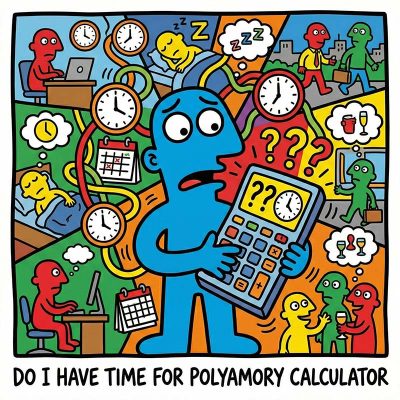
Love is infinite, but your calendar is brutally finite. The fantasy is deep connection; the reality is often just exhausted "calendar tetris." Promising time you don't actually have isn't romantic, it’s a recipe for burnout and broken trust. That sinking feeling when you have to cancel again? That’s the sound of overextension destroying your relationships.
This calculator forces you to confront the math of your life. Do you actually have space for another heart, or are you just setting everyone up for disappointment?
The fantasy is total autonomy and connection. The reality? It can feel like drowning in scheduling chaos and misunderstood expectations. That anxiety you feel isn’t just stress; it’s the wobble of living without a default "anchor." Without a solid architecture, Solo Polyamory stops being a life design and starts being a recipe for burnout and confusion.
The Essential Guide replaces the drift with a concrete anchor. We provide the "Solo Ethic," boundary scripts, and burnout protocols needed to protect your peace. Don't just date around—build a life that actually works for you.

Hierarchy sounds like a corporate org chart until someone gets their feelings hurt. That stomach-turning fear that you are just a "secondary" who can be fired at any time is real. If your relationship feels like a secret ranking system, you are doing it wrong.
Ambiguity is where resentment grows. The Essential Guide replaces the "who matters more" panic with a concrete charter. We provide the scripts and equity guardrails needed to protect every heart in the polycule. Stop guessing and start building.

The ideal is pure equality. The reality? It often slides into hidden rankings where someone gets hurt. That sinking feeling that you are secretly a "secondary" despite the label? That is your intuition detecting couple privilege. Ambiguity is where resentment thrives.
The Essential Guide replaces vague promises with concrete governance. We provide the charters, equity tools, and jealousy protocols needed to ensure "non-hierarchical" isn't just a fantasy. Stop guessing who matters most. Build a network that is actually fair.
The fantasy is total autonomy and connection. The reality? It can feel like drowning in scheduling chaos and misunderstood expectations. That anxiety you feel isn’t just stress; it’s the wobble of living without a default "anchor." Without a solid architecture, Solo Polyamory stops being a life design and starts being a recipe for burnout and confusion.
The Essential Guide replaces the drift with a concrete anchor. We provide the "Solo Ethic," boundary scripts, and burnout protocols needed to protect your peace. Don't just date around—build a life that actually works for you.
Hierarchy sounds like a corporate org chart until someone gets their feelings hurt. That stomach-turning fear that you are just a "secondary" who can be fired at any time is real. If your relationship feels like a secret ranking system, you are doing it wrong.
Ambiguity is where resentment grows. The Essential Guide replaces the "who matters more" panic with a concrete charter. We provide the scripts and equity guardrails needed to protect every heart in the polycule. Stop guessing and start building.
Understanding escalation in a solo poly framework
In a solo poly setup the emphasis is on autonomy and personal sovereignty. Escalation is not about ownership or controlling someone else. It is about increasing closeness while each person retains the liberty to pursue other connections and life goals. This means conversations about exclusivity timelines expectations and shared life variables like housing or finances may come up but they should be handled in a way that respects each person independence. Escalation can look different from person to person. For one it might mean more frequent dates and longer conversations. For another it might mean moving from casual dating to a more serious emotional bond while still dating others. The key is ongoing honest communication and careful consent every step of the way.
Signals that someone wants escalation
Not every sign means they want the same level of escalation as you do. Here are common indicators that a partner may be seeking more closeness or commitment within a solo poly context:
- They initiate more frequent communication including long messages and personal sharing beyond surface level.
- They start scheduling more time together and propose regular meet ups or weekend plans.
- They ask about your other connections and how you fit into their life including routines or rituals you might share.
- They talk about future plans that involve both of you even if those plans do not include a traditional couple status.
- They show sensitivity to your boundaries asking for permission before introducing new dynamics or activities.
- They express a desire for deeper emotional conversations and vulnerability while still respecting your need for space.
- They ask about how much energy you can devote to the relationship or how you balance other relationships and personal goals.
Recognize that signals can vary and do not assume intent from a single message or moment. The simplest way to know where things stand is to ask a direct clear question about their vision for the relationship and about timing for escalated closeness.
How to approach escalation conversations
A good escalation conversation in a solo poly context is about authenticity clarity and consent. You want to understand your own needs and reflect them in a respectful way while inviting your partner to do the same. Here is a simple process you can use in your next talk:
- Set a good frame Choose a moment where you both feel calm and not rushed and ensure privacy. You want space to think and to be heard.
- Share your current truth Use a direct but kind statement about where you are at and what you want. For example I am enjoying this connection and I want to explore more closeness but I also want to keep my independence intact.
- Invite their perspective Ask open questions like What feels exciting to you about escalating or what worries you about moving quicker?
- Negotiate boundaries Propose boundaries and ask for theirs. Think about time energy access to other partners and emotional bandwidth.
- Agree on a plan Create a concrete plan with check ins a timeline and a clear idea of what escalation looks like in practice. Include a date for a follow up conversation.
Use language that reflects autonomy and collaboration. Avoid phrases that imply possessiveness. Respect the fact that both of you may have other relationships and other life goals. The aim is a shared understanding that serves both of you without erasing personal sovereignty.
Conversation starters you can actually use
- I really value what we have and I would like to explore deeper connection while keeping my independence intact. How do you feel about that?
- What does escalation look like for you and what feels comfortable at this stage?
- Are there boundaries you want to set around time together or involvement with other partners as we explore more closeness?
- How should we handle check ins and adjustments if we find ourselves moving faster or slower than expected?
- What would be a reasonable timeline for us to reassess how things are going without losing our autonomy?
Escalation timelines and practical steps
Escalation is not a single moment it is a series of small steps that build trust and connection. Here is a practical framework you can adapt to your situation:
- Step one Increase regularity of contact while preserving space for your other commitments. This might mean a few longer conversations each week and a couple of in person meetups.
- Step two Introduce a shared activity that strengthens emotional bond such as a recurring date night or a weekly activity you both enjoy.
- Step three Create a joint plan that acknowledges other partners in your life and how you will coordinate communication around important events or milestones.
- Step four Review the plan with a scheduled check in to discuss what is working and what needs to be adjusted. Keep the focus on mutual growth and autonomy.
Always keep room for flexibility. If one person feels overwhelmed for any reason the best move is to pause and revisit boundaries rather than push forward and risk damage to the connection.
Realistic scenarios with scripts you can adapt
Scenario A: You want more closeness but your partner asks for time
Dialogue you can adapt
You: I enjoy time with you and I am curious about moving toward a deeper connection. I want to understand what pace feels comfortable for you while I honor my need for closeness too.
Partner: I am also enjoying us but I need more space for other relationships this month.
You: That makes sense. How about we schedule two longer dates this month and a midweek check in to see how we feel about increasing closeness gradually?
Partner: That could work. Let us try two dates and a check in and we can reassess in four weeks.
Scenario B: You want to explore exclusivity with a boundary respectful of autonomy
Dialogue you can adapt
You: I value our connection a lot and I want to explore the idea of focusing more on us while keeping my ability to date others. How would you feel about a time limited exclusivity window with a clear review date?
Partner: I would be open to a window but I want it to be truly conditional and not permanent.
You: Great. Let us set a three month window with a mid point check in and a final decision at the end. During the window we will commit to one shared activity per week and be honest about any concerns.
Scenario C: You need to discuss how escalation affects time management
Dialogue you can adapt
You: My calendar is packed with personal goals and other relationships so I need to be mindful of energy and time. What is realistic for you in terms of time together every week a text check in and shared plans?
Partner: I want more consistent time but I can do two to three evenings a week and a longer weekend plan occasionally.
You: That feels doable. Let us aim for two solid evenings and one longer weekend plan per month with a quarterly review to adjust as needed.
What to avoid when dating someone who wants escalation
- Do not pressure or guilt the other person into faster progression than they are comfortable with.
- Avoid assuming that escalation equals exclusivity or marriage or a single path forward.
- Do not pretend you are less autonomous than you are or try to rope in expectations that do not match your life reality.
- Avoid secretive behavior or hidden arrangements. Honesty is essential in ENM and solo poly dynamics.
Jealousy and emotional work
Jealousy is a signal not a verdict. It can guide you toward needs that may be unmet. In solo poly contexts jealousy often points to a desire for more communication clarity or dedicated time. Here are some practical strategies to handle it:
- Practice name it and own it when you feel jealous. Say I feel jealous right now because I worry about losing you or about not having enough time with you.
- Ask for what would help you feel secure such as more regular check ins or a specific reassurance gesture.
- Use curiosity to explore the root cause instead of making accusations. Ask what would help you feel more secure.
- Engage in self care and lean on your own communities for support while you work through the emotion.
Handling mismatches and boundaries
Not every pairing will align perfectly on escalation. If you want more depth and your partner wants to maintain a casual stance you have a few healthy options:
- renegotiate the pace with a formal check in about timelines and desires
- redefine the nature of the relationship to reflect a different level of closeness
- decide to pause escalation and continue dating other partners while you both reassess
- part ways if the mismatch undermines your core values and needs
Remember that autonomy means you have the right to pause or end a dynamic that no longer serves you even if your partner wants to continue.
Practical tips for solo poly dating
- Be explicit about your own boundaries Do not assume your partner understands what you can or cannot do. Spell it out.
- Keep communication regular Short but frequent check ins help prevent drift and build trust.
- Document agreements It can be as simple as an email recap or a shared note that lists the agreed boundaries and timeline.
- Honor your own life goals Do not compromise your career health or personal goals for someone else's pace.
- Practice compassionate honesty You can be honest without being brutal. You can express needs while honoring the other person.
- Safeguard your friendships and support networks Closer connections outside the dating world provide balance.
Glossary of useful terms and acronyms
- ENM Ethical non monogamy a framework that values consent honesty and open communication about non traditional relationships.
- Solo Polyamory A form of ENM where the individual maintains autonomy and does not place a primary partner above others.
- Escalation The process of increasing closeness or commitment while preserving personal freedom.
- Boundaries Personal rules about what you are comfortable with in relationships.
- Consent Clear voluntary agreement to participate in a given activity or level of involvement.
- Negotiation A mutual discussion to align needs and boundaries across relationships.
- Jealousy An emotional signal that can indicate insecurity or a need for reassurance.
- Time management How you allocate energy and attention between your personal life and relationships.
FAQ
How do you know if escalation is right for you
If you value autonomy and desire more depth without losing independence escalation can be a good fit. Answer honestly what you want and assess whether your life can accommodate more closeness while staying true to your own goals.
What should I ask before escalating
Ask about pace boundaries and what closeness means to your partner. Clarify whether there will be changes to time together other relationships or living arrangements. Establish a review timeline.
How do I bring up escalation with a new partner
Start with your own needs and invite a response. Use a calm tone and specific questions like what does escalating closeness look like to you and what would you be comfortable with during the next few months.
Is exclusivity ever off the table in solo poly
Yes sometimes exclusivity is not appropriate or desired in a solo poly dynamic. If exclusivity is on the table it should be a mutual decision with a clear definition and a timeframe.
How can I handle jealousy during escalation
Name the emotion then ask what would help you feel more secure. Increase clear communication and create small trusted rituals that support the relationship without forcing ownership.
What if my partner wants to escalate but I do not
Be honest about your boundaries and feelings. Propose a compromise like a slower pace or a clear exit plan if your needs diverge. It is better to part ways with honesty than to force a dynamic that harms you.
What are practical boundaries to consider
Consider boundaries around how you spend time together what you share publicly with others how you handle privacy with other partners and how decisions about major life events are made.
Can escalation happen in a long term solo poly setup
Absolutely. Escalation in a long term solo poly arrangement focuses on sustaining autonomy while deepening trust and connection through deliberate communication and shared experiences.
What is the best way to record agreements
A simple follow up email a shared document or a note in a planning app can help both partners stay aligned and reduce misinterpretation.
How can I keep balance with multiple partners
Build a weekly routine that protects your own goals and ensure you have time blocked for each important relationship. Communicate early about conflicts and practice flexible planning.
Love is infinite, but your calendar is brutally finite. The fantasy is deep connection; the reality is often just exhausted "calendar tetris." Promising time you don't actually have isn't romantic, it’s a recipe for burnout and broken trust. That sinking feeling when you have to cancel again? That’s the sound of overextension destroying your relationships.
This calculator forces you to confront the math of your life. Do you actually have space for another heart, or are you just setting everyone up for disappointment?
The fantasy is total autonomy and connection. The reality? It can feel like drowning in scheduling chaos and misunderstood expectations. That anxiety you feel isn’t just stress; it’s the wobble of living without a default "anchor." Without a solid architecture, Solo Polyamory stops being a life design and starts being a recipe for burnout and confusion.
The Essential Guide replaces the drift with a concrete anchor. We provide the "Solo Ethic," boundary scripts, and burnout protocols needed to protect your peace. Don't just date around—build a life that actually works for you.
Hierarchy sounds like a corporate org chart until someone gets their feelings hurt. That stomach-turning fear that you are just a "secondary" who can be fired at any time is real. If your relationship feels like a secret ranking system, you are doing it wrong.
Ambiguity is where resentment grows. The Essential Guide replaces the "who matters more" panic with a concrete charter. We provide the scripts and equity guardrails needed to protect every heart in the polycule. Stop guessing and start building.
The ideal is pure equality. The reality? It often slides into hidden rankings where someone gets hurt. That sinking feeling that you are secretly a "secondary" despite the label? That is your intuition detecting couple privilege. Ambiguity is where resentment thrives.
The Essential Guide replaces vague promises with concrete governance. We provide the charters, equity tools, and jealousy protocols needed to ensure "non-hierarchical" isn't just a fantasy. Stop guessing who matters most. Build a network that is actually fair.
The fantasy is total autonomy and connection. The reality? It can feel like drowning in scheduling chaos and misunderstood expectations. That anxiety you feel isn’t just stress; it’s the wobble of living without a default "anchor." Without a solid architecture, Solo Polyamory stops being a life design and starts being a recipe for burnout and confusion.
The Essential Guide replaces the drift with a concrete anchor. We provide the "Solo Ethic," boundary scripts, and burnout protocols needed to protect your peace. Don't just date around—build a life that actually works for you.
Hierarchy sounds like a corporate org chart until someone gets their feelings hurt. That stomach-turning fear that you are just a "secondary" who can be fired at any time is real. If your relationship feels like a secret ranking system, you are doing it wrong.
Ambiguity is where resentment grows. The Essential Guide replaces the "who matters more" panic with a concrete charter. We provide the scripts and equity guardrails needed to protect every heart in the polycule. Stop guessing and start building.
