
Parallel Versus Kitchen Table Preferences

Welcome to a straight talking, no fluff deep dive into how solo polyamory players navigate two big preference camps. If you are dating in an ethical non monogamy world you have likely heard terms like parallel polyamory and kitchen table polyamory. Today we break those ideas down with real world examples, practical tips and clear definitions. We speak plainly about boundaries communication and the emotional work involved. No drama fear today just useful guidance from someone who has seen most of the wild side and still believes in respectful honest connection.
Quick Links to Useful Sections
- Key terms you need to know
- Parallel vs kitchen table explained
- What parallel poly looks like in practice
- What kitchen table poly looks like in practice
- Why solo poly people may pick one over the other
- Real world scenarios you might encounter
- Scenario one: You are dating two people who do not know each other well
- Scenario two: A group event where all partners are invited
- Scenario three: New partner introduces a desire to meet metamours
- Scenario four: Shifting needs over time
- Tips for negotiating and maintaning healthy boundaries
- Common mistakes to avoid in parallel and kitchen table life
- Practical tactics for a healthy dynamic
- Transitioning between dynamics
- Handling jealousy and building compersion
- Safety and consent in ENM life
- Glossary of useful terms and acronyms
- Frequently asked questions
Key terms you need to know
In this guide we focus on a few core terms that pop up a lot in solo polyamory circles. If you see an acronym or word you are not sure about we explain it right away so you can follow the thread without getting stuck. Here are the basics you will want at your fingertips.
- ENM Ethical non monogamy. A labeling choice for relationship styles that embrace more than one ongoing romantic or sexual connection with the knowledge and consent of everyone involved.
- Solo poly A form of ENM where the person maintains autonomy and does not prioritize cohabitation or a primary partnership. The emphasis is on personal agency and flexible connections.
- Polyamory A philosophy or practice of having intimate relationships with more than one person at a time with consent from all involved.
- Kitchen table poly A relationship style where partners and metamours comfortably socialize and interact. The aim is to create a sense of communal harmony that can include all people in the love web.
- Parallel poly A relationship style where partners are aware of each other but do not socialize as a group. Interactions are kept separate and boundaries around contact between partners are common.
- Metamour A partner of your partner. The person you are not romantically involved with but who shares a connection through a person you do date.
- Monogamy A relationship model in which one partner is involved with only one romantic or sexual relationship at a time. The opposite of ENM.
- Primary partner A term used in some poly circles to designate a person who holds a central role in someone’s life, often linked to time or resource decisions. In solo poly this concept may be downplayed or re defined depending on personal agreements.
- Secondary partner A partner who has a place in a person life but not as central as a primary partner. Roles can vary widely from couple to couple.
- Compersion The feeling of joy because a partner experiences happiness with another person. The opposite of jealousy in many contexts and a common goal in healthy ENM dynamics.
- Jealousy A natural feeling when confronted with the idea of losing emotional or sexual access to someone you care about. The energy can be redirected through communication and boundary work.
- Boundaries Personal rules or limits that guide behavior and protect emotional safety for each person involved.
Parallel vs kitchen table explained
What parallel poly looks like in practice
In a parallel poly setup the core idea is autonomy and limited cross contact between partners. You might have two romantic connections with two different people who do not meet in social contexts unless everyone is on board. Key features include:
- Separate social circles. Each partner navigates life with their own set of friends and activities.
- Limited cross talk about the details of one relationship with the other partner. The goal is to avoid drift between relationships that can become messy.
- Clear boundaries about what to share and with whom. People choose what stories stay private and what stories are comfortable to swap.
- Selective meeting of partners only if all parties are comfortable. Some people may choose to have no face to face contact with metamours.
- A focus on personal goals and independence. This approach is often attractive to folks who have career changes schedules or family commitments that make constant coordination difficult.
Reality check. Parallel is not a refusal to care for partners. It is a deliberate choice to compartmentalize aspects of life so two different relationships can coexist with minimal spillover. It can feel calm and tidy or it can feel isolating. The value comes from aligning boundaries with real needs rather than chasing social perfection.
What kitchen table poly looks like in practice
Kitchen table poly is about social harmony and visible community. Partners meet each other share meals attend events together and build a broader sense of interconnected relationships. Key features include:
- Socially integrated circles where metamours know and even enjoy each other. The metaphor kitchen table is used because the idea is all hands around the table in a shared space.
- Open communication about plans and feelings. Because everyone is in shared social environments, conversations tend to be more explicit and inclusive.
- Strategic cooperation on scheduling decisions. The calendar becomes a tool to coordinate multiple relationships rather than a source of friction.
- A potential for greater emotional labor and energy use. Meeting expectations in a social group can demand more time and effort but can also offer more support and understanding.
- Defined role clarity. People often have a clear sense of who is the primary social hub and who is more on the periphery, with room to negotiate as needs change.
Kitchen table dynamics can feel warm and connected or heavy and demanding depending on personalities and communication habits. The promise is more social transparency and shared memory but the trade off is more frequent negotiation and a potential for group tension.
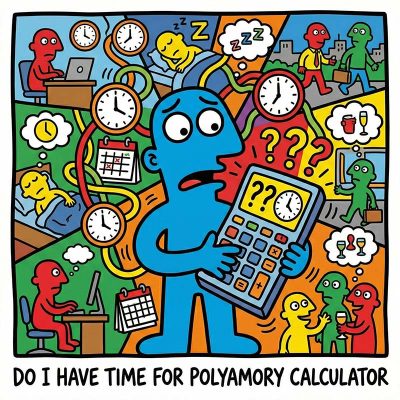
Love is infinite, but your calendar is brutally finite. The fantasy is deep connection; the reality is often just exhausted "calendar tetris." Promising time you don't actually have isn't romantic, it’s a recipe for burnout and broken trust. That sinking feeling when you have to cancel again? That’s the sound of overextension destroying your relationships.
This calculator forces you to confront the math of your life. Do you actually have space for another heart, or are you just setting everyone up for disappointment?

The fantasy is total autonomy and connection. The reality? It can feel like drowning in scheduling chaos and misunderstood expectations. That anxiety you feel isn’t just stress; it’s the wobble of living without a default "anchor." Without a solid architecture, Solo Polyamory stops being a life design and starts being a recipe for burnout and confusion.
The Essential Guide replaces the drift with a concrete anchor. We provide the "Solo Ethic," boundary scripts, and burnout protocols needed to protect your peace. Don't just date around—build a life that actually works for you.
Hierarchy sounds like a corporate org chart until someone gets their feelings hurt. That stomach-turning fear that you are just a "secondary" who can be fired at any time is real. If your relationship feels like a secret ranking system, you are doing it wrong.
Ambiguity is where resentment grows. The Essential Guide replaces the "who matters more" panic with a concrete charter. We provide the scripts and equity guardrails needed to protect every heart in the polycule. Stop guessing and start building.

The ideal is pure equality. The reality? It often slides into hidden rankings where someone gets hurt. That sinking feeling that you are secretly a "secondary" despite the label? That is your intuition detecting couple privilege. Ambiguity is where resentment thrives.
The Essential Guide replaces vague promises with concrete governance. We provide the charters, equity tools, and jealousy protocols needed to ensure "non-hierarchical" isn't just a fantasy. Stop guessing who matters most. Build a network that is actually fair.
The fantasy is total autonomy and connection. The reality? It can feel like drowning in scheduling chaos and misunderstood expectations. That anxiety you feel isn’t just stress; it’s the wobble of living without a default "anchor." Without a solid architecture, Solo Polyamory stops being a life design and starts being a recipe for burnout and confusion.
The Essential Guide replaces the drift with a concrete anchor. We provide the "Solo Ethic," boundary scripts, and burnout protocols needed to protect your peace. Don't just date around—build a life that actually works for you.
Hierarchy sounds like a corporate org chart until someone gets their feelings hurt. That stomach-turning fear that you are just a "secondary" who can be fired at any time is real. If your relationship feels like a secret ranking system, you are doing it wrong.
Ambiguity is where resentment grows. The Essential Guide replaces the "who matters more" panic with a concrete charter. We provide the scripts and equity guardrails needed to protect every heart in the polycule. Stop guessing and start building.
Why solo poly people may pick one over the other
Choosing between parallel and kitchen table styles is rarely about one style being better. It is about aligning with personal needs values and daily life realities. Reasons people tilt toward parallel include:
- Demanding work schedules or irregular hours that make regular group social time impractical.
- A preference for privacy or privacy oriented boundaries that feel safer or more manageable.
- Past experiences of group dynamics that felt overwhelming or unsupportive.
Reasons people tilt toward kitchen table include:
- Enjoyment of social connection and a strong sense of community with partners and metamours.
- Feeling more secure when trust is reinforced through visible everyday interactions.
- A belief that open communication and shared social spaces help prevent miscommunications and rumors.
Many solo poly people do not stay fixed in one lane. They test both approaches at different times with different partners. The key is to renegotiate boundaries and expectations when life changes such as new jobs living situations or family priorities occur.
Real world scenarios you might encounter
Scenario one: You are dating two people who do not know each other well
In this scenario you prefer parallel. You schedule separate dates with each partner and you keep plans in different circles. You do not introduce partners to each other unless all parties agree and are comfortable. When a new social event arises you decide who attends with you to minimize overlap. If a friend asks about your dating life you share a tailored version with each partner about what the other person enjoys learning holds and how to respect their boundaries. The practice keeps things clean and reduces the risk of awkward first meetings that feel staged.
Scenario two: A group event where all partners are invited
You may gracefully opt into a kitchen table approach at this point or decide to keep most conversations strictly one on one. The kitchen table option might look like a planning conversation ahead of time where you discuss boundaries with both partners about topics acceptable for group discussion and topics to avoid. You can also designate a lead facilitator for the evening such as yourself or a trusted friend who can help manage conversations. The goal is to create a space where everyone feels safe and seen even if the relationships exist in different physics. If you choose parallel in this scenario you will likely coordinate with each partner separately letting the group know only what is necessary while still honoring their privacy.
Scenario three: New partner introduces a desire to meet metamours
The new partner expresses curiosity about meeting your other partners and perhaps building a kitchen table dynamic. You can respond by saying that you are open to exploring a kitchen table connection if all involved parties feel comfortable with the setup. You may propose a phased approach such as starting with a casual group dinner and then evaluating how things feel after that first encounter. If the energy feels supportive you can expand the social circle. If not you can maintain a parallel arrangement and keep the interactions minimal while still maintaining honesty about your needs.
Scenario four: Shifting needs over time
People change and relationship needs shift. You might start with a kitchen table approach and later realize you need more autonomy or more space to breathe. Or you may begin with parallel and later decide to bring more integration into your life. The move can be gradual such as choosing a few social events to share then expanding to larger gatherings. The crucial part is to keep communication clear and to check in with each partner about how the changes feel and what adjustments are needed.
Tips for negotiating and maintaning healthy boundaries
- Start with a shared language Agree on a common vocabulary for all romances including metamour what is comfortable and what is off limits.
- Clarify your own needs first Before talking with partners make a personal inventory of what you want from parallel life or a kitchen table life. Write it down and be ready to share.
- Be transparent with boundaries Describe what you will share about other relationships who you will introduce to and how much time you will allocate to each connection.
- Respect consent and pace Allow space for others to process new ideas and be willing to pause a discussion if someone feels overwhelmed.
- Use structured check ins Schedule regular conversations to revisit boundaries celebrate growth and adjust routines as necessary.
- Plan for conflict resolution Have a plan for how to address disagreements without escalation. This may involve a neutral mediator or agreed time outs.
- Keep privacy boundaries clear Decide what you share publicly and what you keep private to respect your own limits and those of your partners.
Common mistakes to avoid in parallel and kitchen table life
- Assuming one size fits all Every person and every couple has unique needs. Don t apply a single template to all relationships.
- Over scheduling Piling too many social obligations into one period can lead to exhaustion and resentment. Pace yourself and respect your energy budget.
- Ignoring metamour dynamics Metamours matter. A lack of attention to how your partners interact can create hidden tensions.
- Rushing into a social structure Jumping into kitchen table dynamics without proper consent can backfire. Take time to test comfort levels and boundaries.
- Equating emotion with betrayal Jealousy happens to everyone sometimes. Treat it as a signal that something needs adjustment rather than as a verdict about a relationship.
- Forgetting to revisit agreements Needs and life circumstances change. Revisit agreements on a scheduled basis and after major life events.
Practical tactics for a healthy dynamic
- Calendar collaboration Use a shared or aligned calendar to track dates and events. This helps prevent double bookings and reduces stress for everyone involved.
- Public and private communication lanes Decide what is discussed with all partners publicly and what stays private or is discussed in one to one conversations.
- Safety and health first Prioritize sexual health practices and regular testing. Clear conversations about health boundaries are essential in ENM.
- Celebrate the wins Acknowledge when a parallel transition into a kitchen table dynamic feels good and when it raises new challenges. Positive feedback reinforces healthy growth.
- Emotional energy mapping Track how different configurations influence your energy. If you start feeling depleted consider dialing back or seeking support.
Transitioning between dynamics
Moving from parallel to kitchen table or vice versa is a meaningful shift. It is best handled with patience and a well prepared plan. Steps to consider include:
- Discuss motivations openly. Why is the shift desirable and what needs will be satisfied or challenged by the change.
- Prorate the transition. Start with one turning point such as an introductory dinner where everyone meets and evaluate before expanding to more interactions.
- Set a trial period. Use a defined time frame to test the new configuration and agree on how you will measure success or call a time out.
- Document agreements. Write down who will do what how often and when you will revisit the changes.
Handling jealousy and building compersion
Jealousy is a natural signal not a failure. The goal is to understand what it is asking for. Often jealousy points to a boundary that needs adjustment or a need for more reassurance. Compersion is the experience of feeling happiness for a partner s joy with another person. Building compersion takes practice and honest communication. Strategies include:
- Acknowledging the feeling without judgment
- Expressing needs clearly to the partner who is involved
- Seeking reassurance in a way that respects the other person and the shared agreements
- Engaging in activities that strengthen your own life and sense of self
Safety and consent in ENM life
Consent is ongoing and dynamic. In both parallel and kitchen table styles you want consent around what is shared who is invited to what and how much contact is appropriate. Practice ethical non monogamy by staying communicative reliable and respectful. Always move at a pace that suits the slowest person in the group and never pressure anyone into a configuration they are not ready for. Safety also means digital boundaries and data protection. Share only what is comfortable and be mindful of information that could cause harm if leaked or misunderstood.
Glossary of useful terms and acronyms
- Ethical non monogamy A philosophy that supports romantic and sexual connections with more than one partner with consent and honesty guiding all interactions.
- Solo polyamory A form of ENM where the person prioritizes autonomy and does not assume a single central partner. Relationships exist rather than a single life pattern.
- Kitchen table ethics A practice where all partners and metamours are invited to socialize and be part of a common social circle.
- Parallel polyamory A practice where partners maintain separate lives with limited cross contact and formal introductions are often avoided until all people are ready.
- Metamour The partner of your partner. This is someone with whom you share a connection but not a romantic or sexual one.
- Compersion A feeling of joy when a partner experiences happiness or love with someone else.
- Jealousy An emotional response you may feel when a partner forms or deepens connections with others.
- Polylang The collection of specialized terms used within polyamory culture to describe roles experiences and relationships. It helps people communicate more precisely.
- Metamour refuge A compassionate space within a poly network where metamours support each other and share boundaries in a healthy way.
- Boundaries Personal rules and limits that help protect emotional health and secure ongoing consent from everyone involved.
Frequently asked questions
What is the difference between parallel and kitchen table polyamory
Parallel polyamory keeps partners separate with limited interaction between them. Kitchen table polyamory creates a social network where partners and metamours know each other and interact in shared spaces. Both styles aim for honest consent and healthy boundaries but they differ in how social life is organized.
How do I know which style suits me
Start with your energy level at social events do you enjoy integrating partners and metamours or do you feel more comfortable keeping circles distinct. Talk with each partner about their preferences and look for patterns that feel good and sustainable over time. It is common to experiment and adjust as life changes.
Is it okay to move from parallel to kitchen table later
Yes. Transitions happen as trust builds comfort grows and needs shift. Plan a gradual approach such as starting with a casual group dinner before moving to more integrated activities. Keep checking in with all involved and respect the pace of the slowest person.
How do I handle jealousy in a kitchen table dynamic
Open up about feelings in a non accusatory way. Focus on boundaries and needs rather than blame. Seek reassurance and practice compersion by noticing your partner s joys and translating those feelings into gratitude for the relationship growth.
What if my partner wants a kitchen table life but I want parallel
Have a clear conversation about why each mode appeals to you and where you feel safe. You may agree to a hybrid approach or set a trial period with specific rules. If one person feels unsafe or overwhelmed you can pause and reassess before proceeding.
Can I use these dynamics if we live together or have family obligations
Absolutely. Living together and family obligations do not bar you from ENM. The key is to renegotiate boundaries to fit your real life and to communicate about how much space you need and how much time you can allocate to relationships without sacrificing obligations like work or parenting.
What should I do if a boundary is violated
Address it directly with the person involved. Explain what happened and why it affected you. Revisit the boundary and decide together whether you need to adjust it or pause the relationship. If needed bring in a trusted mediator or friend to help facilitate the conversation.
Love is infinite, but your calendar is brutally finite. The fantasy is deep connection; the reality is often just exhausted "calendar tetris." Promising time you don't actually have isn't romantic, it’s a recipe for burnout and broken trust. That sinking feeling when you have to cancel again? That’s the sound of overextension destroying your relationships.
This calculator forces you to confront the math of your life. Do you actually have space for another heart, or are you just setting everyone up for disappointment?
The fantasy is total autonomy and connection. The reality? It can feel like drowning in scheduling chaos and misunderstood expectations. That anxiety you feel isn’t just stress; it’s the wobble of living without a default "anchor." Without a solid architecture, Solo Polyamory stops being a life design and starts being a recipe for burnout and confusion.
The Essential Guide replaces the drift with a concrete anchor. We provide the "Solo Ethic," boundary scripts, and burnout protocols needed to protect your peace. Don't just date around—build a life that actually works for you.
Hierarchy sounds like a corporate org chart until someone gets their feelings hurt. That stomach-turning fear that you are just a "secondary" who can be fired at any time is real. If your relationship feels like a secret ranking system, you are doing it wrong.
Ambiguity is where resentment grows. The Essential Guide replaces the "who matters more" panic with a concrete charter. We provide the scripts and equity guardrails needed to protect every heart in the polycule. Stop guessing and start building.
The ideal is pure equality. The reality? It often slides into hidden rankings where someone gets hurt. That sinking feeling that you are secretly a "secondary" despite the label? That is your intuition detecting couple privilege. Ambiguity is where resentment thrives.
The Essential Guide replaces vague promises with concrete governance. We provide the charters, equity tools, and jealousy protocols needed to ensure "non-hierarchical" isn't just a fantasy. Stop guessing who matters most. Build a network that is actually fair.
The fantasy is total autonomy and connection. The reality? It can feel like drowning in scheduling chaos and misunderstood expectations. That anxiety you feel isn’t just stress; it’s the wobble of living without a default "anchor." Without a solid architecture, Solo Polyamory stops being a life design and starts being a recipe for burnout and confusion.
The Essential Guide replaces the drift with a concrete anchor. We provide the "Solo Ethic," boundary scripts, and burnout protocols needed to protect your peace. Don't just date around—build a life that actually works for you.
Hierarchy sounds like a corporate org chart until someone gets their feelings hurt. That stomach-turning fear that you are just a "secondary" who can be fired at any time is real. If your relationship feels like a secret ranking system, you are doing it wrong.
Ambiguity is where resentment grows. The Essential Guide replaces the "who matters more" panic with a concrete charter. We provide the scripts and equity guardrails needed to protect every heart in the polycule. Stop guessing and start building.
