
Responding to Requests for Primary Status

Being part of an ethical non monogamy journey often means navigating some tricky conversations. In the world of solo polyamory we prioritise autonomy and consent while still building meaningful connections. When a partner or dating interest asks for primary status, it can feel like a ground shifting moment. You want to respond with honesty and care while protecting your own boundaries and needs. This guide is written in a down to earth, practical way with clear terms and real life scenarios. We explain terms as we go so you can follow along even if you are new to these ideas.
Quick Links to Useful Sections
- What does primary status mean in ENM and why it matters
- Why someone might request primary status a closer look
- What solo poly brings to the table
- Boundaries and consent in requests
- How to respond in the moment
- Approach 1 a clear no with empathy
- Approach 2 a cautious exploration with a time bound
- Approach 3 a partial acceptance and a reframe
- Practical negotiation framework you can use
- Real life scenarios and ready to use dialogues
- Scenario 1 a partner asks for primary status but you do not want to give it
- Scenario 2 you want to explore a stronger primary like commitment but without giving up your autonomy
- Scenario 3 you feel pressured or steamrolled into something that does not fit
- Scenario 4 you are asked to choose between partners
- Scenario 5 the conversation is about finances or living arrangements
- Red flags to watch for and when to walk away
- Self care after hard conversations
- Communication with other partners and transparency
- Putting it all together a practical plan you can implement now
- Glossary of useful terms and acronyms
- Frequently asked questions
Before we dive in we should set a couple of quick definitions so we know we are all on the same page. Ethical Non Monogamy ENM is a relationship style where people pursue romantic or sexual connections with more than one partner with consent and honesty. Solo polyamory is a dynamic within ENM where individuals maintain independence and do not seek a traditional pair bond as a lock step in a life plan. Primary status is often a misused term in ENM because it implies hierarchy or ownership. In solo poly playbooks many people reject rigid primary status. That can clash with someone who wants a clear hierarchy. The key is to communicate what you are willing to offer and what you expect in return. We will unpack all of that here.
What does primary status mean in ENM and why it matters
First up let us decode the idea of primary status. In monogamous or traditional poly setups a primary partner is often described as the main relationship with a given level of priority and influence over decisions. In ethical non monogamy the picture can be more flexible. A person might describe a primary or a non primary arrangement to indicate where time, resources or emotional energy are directed. The challenge is that words like primary and secondary can lead to misunderstood expectations. In solo polyamory the goal is usually to keep autonomy intact while managing expectations about time and emotional investment. You might hear expressions like an anchor relationship a core relationship or a non exclusive arrangement. The important thing is to clarify what you mean by primary and what you are prepared to offer or not offer.
Terms you might see
- ENM Ethical Non Monogamy a framework that values consent honesty and negotiated boundaries for multiple relationships.
- Solo poly A style within ENM where the person prioritises independence and does not structure life around a single primary partner.
- Primary status A label that can imply priority and long term commitment control over scheduling or decision making. It is used differently by different people.
- Non primary A label that indicates that someone is not treated as the main partner in every decision or resource allocation.
- Compersion Feeling happy for a partner s happiness with someone else without jealousy.
- Boundary A personal line that defines what is okay and not okay for you in a relationship.
Why someone might request primary status a closer look
Requests for primary status often come from a place of fear or need. Here are some common reasons people ask for that label or structure what they want to see in the relationship:
- Security and predictability. A sense that there will be consistent time and energy for them even when life gets busy.
- Limited bandwidth. They want to know how much of your life they will share and what that means for other connections.
- Clear decision making. Some people want a straightforward process for big life choices such as finances living arrangements or time off.
- Past experiences. If someone once felt neglected or hurt when a relationship shifted they may push for a stronger frame to avoid that pain again.
- Jealousy management. A label can feel like a shield against jealousy by setting expectations up front.
Understanding the motive behind the request can help you decide if you want to engage with it at all. You can address the underlying needs without signing up for a structure that does not fit your life as a solo poly person.
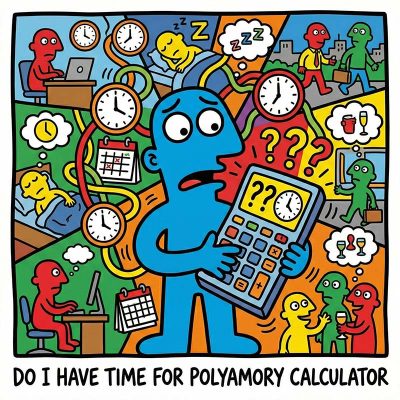
Love is infinite, but your calendar is brutally finite. The fantasy is deep connection; the reality is often just exhausted "calendar tetris." Promising time you don't actually have isn't romantic, it’s a recipe for burnout and broken trust. That sinking feeling when you have to cancel again? That’s the sound of overextension destroying your relationships.
This calculator forces you to confront the math of your life. Do you actually have space for another heart, or are you just setting everyone up for disappointment?
The fantasy is total autonomy and connection. The reality? It can feel like drowning in scheduling chaos and misunderstood expectations. That anxiety you feel isn’t just stress; it’s the wobble of living without a default "anchor." Without a solid architecture, Solo Polyamory stops being a life design and starts being a recipe for burnout and confusion.
The Essential Guide replaces the drift with a concrete anchor. We provide the "Solo Ethic," boundary scripts, and burnout protocols needed to protect your peace. Don't just date around—build a life that actually works for you.

Hierarchy sounds like a corporate org chart until someone gets their feelings hurt. That stomach-turning fear that you are just a "secondary" who can be fired at any time is real. If your relationship feels like a secret ranking system, you are doing it wrong.
Ambiguity is where resentment grows. The Essential Guide replaces the "who matters more" panic with a concrete charter. We provide the scripts and equity guardrails needed to protect every heart in the polycule. Stop guessing and start building.

The ideal is pure equality. The reality? It often slides into hidden rankings where someone gets hurt. That sinking feeling that you are secretly a "secondary" despite the label? That is your intuition detecting couple privilege. Ambiguity is where resentment thrives.
The Essential Guide replaces vague promises with concrete governance. We provide the charters, equity tools, and jealousy protocols needed to ensure "non-hierarchical" isn't just a fantasy. Stop guessing who matters most. Build a network that is actually fair.
The fantasy is total autonomy and connection. The reality? It can feel like drowning in scheduling chaos and misunderstood expectations. That anxiety you feel isn’t just stress; it’s the wobble of living without a default "anchor." Without a solid architecture, Solo Polyamory stops being a life design and starts being a recipe for burnout and confusion.
The Essential Guide replaces the drift with a concrete anchor. We provide the "Solo Ethic," boundary scripts, and burnout protocols needed to protect your peace. Don't just date around—build a life that actually works for you.
Hierarchy sounds like a corporate org chart until someone gets their feelings hurt. That stomach-turning fear that you are just a "secondary" who can be fired at any time is real. If your relationship feels like a secret ranking system, you are doing it wrong.
Ambiguity is where resentment grows. The Essential Guide replaces the "who matters more" panic with a concrete charter. We provide the scripts and equity guardrails needed to protect every heart in the polycule. Stop guessing and start building.
What solo poly brings to the table
Solo poly is not a rejection of love or commitment. It is a stance that prioritises personal autonomy while cultivating relationships with consent and respect. If you are a solo poly person you may value:
- Autonomy and personal growth beyond the relationship. You maintain your own living space finances friendships and life priorities outside of a single partner.
- Direct communication. You typically negotiate terms and revisit them as life changes.
- Transparent boundaries. You are not trying to own someone s time you want a shared sense of respect and negotiated expectations.
- Emotional clarity. You aim for honesty about needs desires and limits rather than sweeping those under the rug for convenience.
From a practical angle primary status can create friction for solo poly people because it concentrates power and expectations in a way that can clash with autonomy. The question is not whether to be open to love but how to define boundaries that protect freedom while carving out space for meaningful connection.
Boundaries and consent in requests
Boundaries are the guard rails of any relationship. They tell you what you will do what you won t do and what you will revisit later. When you face a request for primary status you can use a simple boundary framework to decide what is negotiable and what is not.
- Non negotiables These are things you will not compromise on. For example a hard limit on living arrangements or on commitments to a future partner. Be clear from the start.
- negotiables These are areas you are willing to explore with defined limits. They might include how much time you can devote to each partner or how you handle events that involve all partners together.
- Trial periods A structured trial can help you test a new arrangement without long term commitments. For example a two month trial of a different scheduling approach with a check in point.
- Check ins Regular conversations about how the arrangement feels and what could be adjusted. Make these part of the agreement rather than an afterthought.
When you set boundaries you want to keep them simple specific and actionable. Vague terms like fairness or balance can drift into feelings that are not easy to measure. You want measurable outcomes that you can reflect on during a check in.
How to respond in the moment
People bring requests into your life with emotion and intention. You can respond in a way that is honest but not dismissive. Here are several response approaches you can adapt to your style and the situation.
Approach 1 a clear no with empathy
If you know that primary status does not align with your values or your life as a solo poly person you can decline with care. Example script you can adapt:
- I hear that primary status matters to you and I respect your honesty. For me as a solo poly person I do not offer primary status because I want to keep my independence and flexibility. That doesn t mean I don t value you or our connection. It means we will design our time and energy around shared boundaries and mutual consent rather than a hierarchy.
- If you want we can discuss what a strong compatible arrangement would look like without labeling you as primary. We can talk about boundaries time and what needs to be prioritized for both of us.
Approach 2 a cautious exploration with a time bound
Sometimes you want to be open minded but you need to test the waters. A time bound approach keeps things honest and bounded:
- Let us try a two month period with clearly defined boundaries and a mid point check in. If either of us feels uncomfortable we will pause and reassess.
- During this period we will focus on scheduling that ensures you feel secure while I maintain autonomy. We will agree on how much emotional energy is directed toward each connection.
Approach 3 a partial acceptance and a reframe
For some people a full no feels too harsh or unfair. You can accept part of the request while reframing the concept of primary status into something that fits your life:
- We can structure our time as two strong ongoing relationships while I keep my own independence. We can define a core weekend plan and separate date nights with others. We will review every quarter to see if adjustments are needed.
- We can treat our bond as a primary level in emotional energy while living independently in other areas. The important thing is we communicate clearly and both feel respected.
Practical negotiation framework you can use
Negotiation is not about winning a battle it is about creating a life you both can live with. Here is a simple framework that works well in solo poly situations:
- Clarify what the other person means by primary Ask for specifics on time resources decision making and future plans. Write down the exact expectations.
- State your own needs Be explicit about what you can offer and what you cannot. The clarity helps avoid power struggles later.
- Propose a test run If you are unsure offer a limited trial period with set milestones and a scheduled review date.
- Agree on check in points Decide how often you will revisit the arrangement. Use neutral language during check ins. Focus on observable behaviours not emotions alone.
- Document the agreement Even a simple written note can help. You do not need a formal contract. A shared document or email summarising boundaries schedules and chosen terms can be enough.
This framework keeps the process practical and compassionate. It reduces ambiguity and helps prevent resentments from creeping in over time.
Real life scenarios and ready to use dialogues
Here are some common situations you might face and sample dialogues you can adapt. Use your own cadence and tone to make these feel natural for you.
Scenario 1 a partner asks for primary status but you do not want to give it
- Response: I hear what you are asking for and I respect your clarity. I do not offer primary status as a Solo Polyamorist. I do want to nurture our connection and keep space for my other relationships. I propose we set clear boundaries around time energy and major decisions and revisit them after a set period.
- Follow up question to understand needs: What would primary status change for you in real terms beyond the label? Is there a specific outcome you are seeking that we can work toward with boundaries instead of a hierarchy?
Scenario 2 you want to explore a stronger primary like commitment but without giving up your autonomy
- Response: I do value you and I want to deepen our connection. For me autonomy remains essential. Let us try a structured plan that emphasises shared moments while I keep my own living space and life outside our two conversations. We can agree on a cadence for our time together plus a clear plan for when life gets busy with other partners.
- Sample clause: We will schedule two dedicated date nights each month with you as a primary focus during those times. In weeks with other partners I will maintain a minimum three nights free for you unless we agree otherwise.
Scenario 3 you feel pressured or steamrolled into something that does not fit
- Response: I feel pressure right now which makes it hard to think clearly. I want to pause this conversation and return with a plan. Let us schedule a 48 hour pause. In that time I will reflect and we can come back to the table with calmer energy and shared notes.
- Follow up: If the pressure continues I might choose to step back from the relationship until we both feel safe and excited about where this is headed. I value you but I value my ability to choose my own path too.
Scenario 4 you are asked to choose between partners
- Response: I refuse to make you choose because that would undermine both of our autonomy and the trust we are trying to build. Let us agree to a framework where I support your needs while I maintain my independence. If that arrangement feels unacceptable we can part ways with respect and warmth.
- Follow up: Let us craft a plan for how we share space time and life events so you feel secure and I still feel free to connect openly with others.
Scenario 5 the conversation is about finances or living arrangements
- Response: We can talk about practicalities without collapsing into a power dynamic. Let us lay out what each of us brings what is expected and how we handle shared expenses. We will review this every six months and adjust as needed.
- Sample clause: If there is a major life event we will discuss how it affects our arrangements and allocate resources accordingly rather than making a unilateral decision.
Red flags to watch for and when to walk away
Not every request is a good fit for you. Here are signs that you might be dealing with coercion manipulation or an unhealthy dynamic:
- Ultimatums that force you to choose a hierarchy
- Persistent guilt trips that imply you are harming the other person by not agreeing
- Gaslighting that downplays your autonomy or sanity
- Pressure to sign up for life changing commitments without space to reflect
- Disrespect for your boundaries or repeated boundary violations
If you notice these patterns you deserve to pause the conversation and protect your own wellbeing. You can seek support from trusted friends or a therapist who understands ENM and solo poly dynamics. Remember no arrangement is worth sacrificing your core values or your sense of self.
Self care after hard conversations
Discussions about primary status can stir up a lot of feelings. Here are quick practices to support your wellbeing after a tough talk:
- Grounding exercises breathe slow and steady. Grounding can reduce stress and help you think clearly.
- Reach out to a friend or a peer who understands your dynamic. A quick chat can help you process.
- Journal about what you learned what you want to protect and what you are willing to experiment with in the future.
- Give yourself time before making big decisions. The best moves often come after a calm reflection period.
Communication with other partners and transparency
If you are part of a network of relationships in ENM the way you communicate about new boundaries matters. Be honest about what you are negotiating and when. Open disclosure helps build trust and reduces the risk of misunderstandings. If others are involved ask for space to explain your perspective and invite their input. This approach aligns with the core values of ethical non monogamy and solo polyamory which emphasise consent clear communication and mutual respect.
Putting it all together a practical plan you can implement now
Here is a simple one page plan you can adapt for your situation. This is not a contract just a practical reference to guide your conversations.
- State your current stance on primary status and express your commitment to autonomy.
- Define any non negotiables and negotiables clearly with concrete examples.
- Propose a trial period with a defined start and end date.
- Agree on regular check in points and the method for documenting the arrangement.
- Decide how you will handle life events such as moving in together starting a family or changing work patterns.
Glossary of useful terms and acronyms
- ENM Ethical Non Monogamy a flexible approach to relationships built on consent and honesty.
- Solo poly A form of ENM where individuals prioritise personal autonomy while maintaining meaningful connections with others.
- Primary status A label some people use to describe a preferred partner or higher level of commitment and resource allocation. In solo poly this label is often discouraged in favour of autonomy and negotiated boundaries.
- Non primary Partners who are not treated as the main or primary relationship in terms of time or decision making.
- Boundaries Personal lines that define what is allowed and what is not in a relationship.
- Check in A scheduled conversation to review how the arrangement is working and whether changes are needed.
- Compersion Feeling happy for a partner s joy even when it involves someone else.
Frequently asked questions
These questions often come up when people are navigating requests for primary status in a solo poly setup. If your question isn t here feel free to ask and we can tailor an answer for your situation.
How do I know if a request for primary status is a red flag?
Red flags show up when you feel pressured manipulated or when your basic autonomy is at stake. If you are asked to sign away your independence or to abandon other important connections you should pause. A healthy approach keeps open conversation allows time for reflection and respects your boundary lines.
Can I ever agree to primary status in a solo poly context?
Yes you can but it has to be a structure that fits your life and respects your autonomy. You can create a framework where you hold the final say on key decisions you maintain space for your own life and you schedule time in a predictable way that works for everyone involved. If a partner demands a lifelong commitment as a prerequisite to being with you that can be a warning sign.
What should I do if my partner insists on labels that create a hierarchy?
Ask questions about what the label means in practice. Then propose a practical boundary based plan instead of accepting a notional label. Clarify how time energy finances and decisions will be shared. If the other person still pushes back you may need to reassess the relationship in the long term.
How do I handle jealousy when discussing primary status?
Jealousy is normal in any relationship dynamic. You can respond with curiosity ask about the source of the jealousy and acknowledge the feeling. Offer reassurance about the care you give to all relationships while maintaining your own boundaries. If jealousy becomes overwhelming it may be time to slow down or pause the conversation.
What if I want to pause a discussion and revisit later?
That is a valid move. You can say I need some time to reflect and I want to come back with a clear plan. Set a concrete date for the follow up and stick to it. This approach protects both your agency and your partner s needs.
Is it okay to document agreements in writing?
Yes writing things down reduces misinterpretations and helps everyone stay aligned. A shared document or email summarising the boundaries check ins and trial period is a practical tool not a binding contract. It can be revised as life changes.
What if the other person wants to involve a lot of other people in the dynamic?
Bring up your boundaries around disclosure consent and time management. If the arrangement would cause distress or conflict with your own life you can express that clearly. It is perfectly acceptable to insist on certain limits or to walk away if the dynamic becomes unsustainable.
How do I maintain my own life when I am in multiple relationships?
Prioritise routines that protect your wellbeing such as regular sleep patterns self care practice and spaces that belong to you. Build a calendar that respects all relationships without erasing your own life. Clear communication keeps everyone aligned and reduces conflict.
Love is infinite, but your calendar is brutally finite. The fantasy is deep connection; the reality is often just exhausted "calendar tetris." Promising time you don't actually have isn't romantic, it’s a recipe for burnout and broken trust. That sinking feeling when you have to cancel again? That’s the sound of overextension destroying your relationships.
This calculator forces you to confront the math of your life. Do you actually have space for another heart, or are you just setting everyone up for disappointment?
The fantasy is total autonomy and connection. The reality? It can feel like drowning in scheduling chaos and misunderstood expectations. That anxiety you feel isn’t just stress; it’s the wobble of living without a default "anchor." Without a solid architecture, Solo Polyamory stops being a life design and starts being a recipe for burnout and confusion.
The Essential Guide replaces the drift with a concrete anchor. We provide the "Solo Ethic," boundary scripts, and burnout protocols needed to protect your peace. Don't just date around—build a life that actually works for you.
Hierarchy sounds like a corporate org chart until someone gets their feelings hurt. That stomach-turning fear that you are just a "secondary" who can be fired at any time is real. If your relationship feels like a secret ranking system, you are doing it wrong.
Ambiguity is where resentment grows. The Essential Guide replaces the "who matters more" panic with a concrete charter. We provide the scripts and equity guardrails needed to protect every heart in the polycule. Stop guessing and start building.
The ideal is pure equality. The reality? It often slides into hidden rankings where someone gets hurt. That sinking feeling that you are secretly a "secondary" despite the label? That is your intuition detecting couple privilege. Ambiguity is where resentment thrives.
The Essential Guide replaces vague promises with concrete governance. We provide the charters, equity tools, and jealousy protocols needed to ensure "non-hierarchical" isn't just a fantasy. Stop guessing who matters most. Build a network that is actually fair.
The fantasy is total autonomy and connection. The reality? It can feel like drowning in scheduling chaos and misunderstood expectations. That anxiety you feel isn’t just stress; it’s the wobble of living without a default "anchor." Without a solid architecture, Solo Polyamory stops being a life design and starts being a recipe for burnout and confusion.
The Essential Guide replaces the drift with a concrete anchor. We provide the "Solo Ethic," boundary scripts, and burnout protocols needed to protect your peace. Don't just date around—build a life that actually works for you.
Hierarchy sounds like a corporate org chart until someone gets their feelings hurt. That stomach-turning fear that you are just a "secondary" who can be fired at any time is real. If your relationship feels like a secret ranking system, you are doing it wrong.
Ambiguity is where resentment grows. The Essential Guide replaces the "who matters more" panic with a concrete charter. We provide the scripts and equity guardrails needed to protect every heart in the polycule. Stop guessing and start building.
