
Self Worth Outside Relationship Status


If you are navigating solo polyamory in the ethical non monogamy world you have probably heard the question or felt the pressure to define yourself by your relationship status. In this guide we are going to unpack why your value as a person does not depend on how many partners you have or what label you use. We will explore practical steps to build a strong sense of worth that stays solid whether you date one person, many people, or nobody at a given moment. This is about you and your life being meaningful on their own terms not because of how society defines your relationships.
Quick Links to Useful Sections
- Who this guide is for
- What solo polyamory ENM means and how it relates to self worth
- Terms explained in simple language
- The trap of tying worth to relationship status
- Reframing worth from external to internal
- Practical steps to build self worth in a solo polyamory life
- 1 Cultivate a clear sense of self
- 2 Create personal rituals that reinforce worth
- 3 Build a strong boundaries toolkit
- 4 Practice autonomous joy
- 5 Communicate openly with partners
- 6 Normalize and work with jealousy
- 7 Build a supportive community
- 8 Consider professional support
- Realistic life scenarios in a solo polyamory world
- Scenario one a new partner and a strong sense of self
- Scenario two a partner asks you to change your life to fit theirs
- Scenario three family pressure about relationship status
- Scenario four choosing to be solo for now
- Communication tips for talking about worth with others
- Self care and mental health resources for solo poly people
- Putting it all together a personal worth plan
- Glossary of useful terms and acronyms
- Frequently asked questions
Who this guide is for
This guide speaks directly to people who practice solo polyamory this form of ethical non monogamy where independence is valued and there is no single primary relationship that defines your life. It is also for anyone curious about how to cultivate self worth outside relationship status who wants a grounded and friendly approach. If you want to feel confident in who you are without needing a bestseller of romantic achievement this is for you. If you are new to the idea of solo polyamory you will find clear explanations of terms and how they show up in everyday life. If you are a veteran you will find fresh language and practical exercises you can try today.
What solo polyamory ENM means and how it relates to self worth
Solo polyamory is a dynamic within ethical non monogamy where a person maintains independence and does not seek to anchor their life around a single primary partner. People in this setup may date multiple partners but not in a way that creates a single dominate relationship that controls all time or resources. The emphasis is on autonomy freedom and consent. ENM stands for ethical non monogamy a broad umbrella that includes many relationship styles and agreements all guided by consent and clear communication.
In solo polyamory the idea of self worth takes a different shape. Worth is not measured by how many partners you have the status a label or how many check marks appear on a dating app. Worth comes from your inner life your values your ability to show up for yourself and others with honesty and kindness. The goal is to create a life you love and share with others without losing your own identity or independence. Let us break down the key terms you will hear a lot as you move through this topic.
Terms explained in simple language
- Ethical Non Monogamy ENM means relationships built on consent communication and respect for all involved. It is not about cheating or sneaking around it is about honest agreements that work for everyone.
- Solo polyamory A form of ENM where a person maintains independence and avoids a traditional primary partner model often choosing to weave several connections without ceding central life control to any one partner.
- Relationship anarchy A philosophy where relationships are not governed by external rules or hierarchies but by mutual agreements and respect. It emphasizes autonomy and personal responsibility.
- Compersion A positive feeling when a partner experiences joy with someone else. It is the opposite of jealousy and a sign of healthy functioning within a polyamorous dynamic.
- Jealousy An emotional response that can show up in any relationship style. In polyamory it is acknowledged and managed with communication boundaries and self reflection.
- Boundaries Personal lines you set to protect your wellbeing. Boundaries are about what you will and will not accept in your life and relationships.
- Agreements The stated rules and expectations that partners create together to guide how they interact with one another. Agreements are flexible and can change as life changes.
- Self worth A sense of value and dignity that comes from inside you rather than from external approval or relationship status.
- Self esteem A related idea focusing on how you appraise yourself. It can be influenced by others but the aim is to strengthen it from within.
- Affirmations Short statements that reinforce your positive qualities and your right to live a fulfilling life regardless of who you are dating.
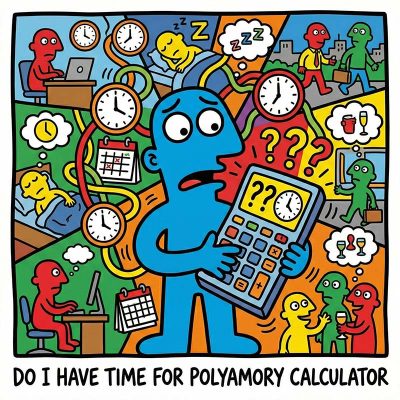
Love is infinite, but your calendar is brutally finite. The fantasy is deep connection; the reality is often just exhausted "calendar tetris." Promising time you don't actually have isn't romantic, it’s a recipe for burnout and broken trust. That sinking feeling when you have to cancel again? That’s the sound of overextension destroying your relationships.
This calculator forces you to confront the math of your life. Do you actually have space for another heart, or are you just setting everyone up for disappointment?
The fantasy is total autonomy and connection. The reality? It can feel like drowning in scheduling chaos and misunderstood expectations. That anxiety you feel isn’t just stress; it’s the wobble of living without a default "anchor." Without a solid architecture, Solo Polyamory stops being a life design and starts being a recipe for burnout and confusion.
The Essential Guide replaces the drift with a concrete anchor. We provide the "Solo Ethic," boundary scripts, and burnout protocols needed to protect your peace. Don't just date around—build a life that actually works for you.
Hierarchy sounds like a corporate org chart until someone gets their feelings hurt. That stomach-turning fear that you are just a "secondary" who can be fired at any time is real. If your relationship feels like a secret ranking system, you are doing it wrong.
Ambiguity is where resentment grows. The Essential Guide replaces the "who matters more" panic with a concrete charter. We provide the scripts and equity guardrails needed to protect every heart in the polycule. Stop guessing and start building.
The ideal is pure equality. The reality? It often slides into hidden rankings where someone gets hurt. That sinking feeling that you are secretly a "secondary" despite the label? That is your intuition detecting couple privilege. Ambiguity is where resentment thrives.
The Essential Guide replaces vague promises with concrete governance. We provide the charters, equity tools, and jealousy protocols needed to ensure "non-hierarchical" isn't just a fantasy. Stop guessing who matters most. Build a network that is actually fair.
The fantasy is total autonomy and connection. The reality? It can feel like drowning in scheduling chaos and misunderstood expectations. That anxiety you feel isn’t just stress; it’s the wobble of living without a default "anchor." Without a solid architecture, Solo Polyamory stops being a life design and starts being a recipe for burnout and confusion.
The Essential Guide replaces the drift with a concrete anchor. We provide the "Solo Ethic," boundary scripts, and burnout protocols needed to protect your peace. Don't just date around—build a life that actually works for you.
Hierarchy sounds like a corporate org chart until someone gets their feelings hurt. That stomach-turning fear that you are just a "secondary" who can be fired at any time is real. If your relationship feels like a secret ranking system, you are doing it wrong.
Ambiguity is where resentment grows. The Essential Guide replaces the "who matters more" panic with a concrete charter. We provide the scripts and equity guardrails needed to protect every heart in the polycule. Stop guessing and start building.
The trap of tying worth to relationship status
Social media feeds dating stories that celebrate grand relationship milestones. Friends and family may imply that a couple or a solid relationship equals success. In solo polyamory these messages can sting because they whisper that independence or multiple connections are not enough. The truth is that worth is a continuous practice not a trophy you earn at a single moment. When you tie your value to who you are with you set yourself up for cycles of pressure fear and comparison. Those feelings can dim your sense of self and make your choices less free less joyful.
How this shows up in daily life looks like this: a new date asks if you are single or taken and you feel a need to prove your status. A friend comments that you are still not in a relationship yet you start to question your direction. A family member asks why you spend time on multiple people and you worry about how you will be judged. In all of these moments the decision you face is whether you will allow external judgment to shape your self view or whether you will hold your own sense of worth steady and clear.
Reframing worth from external to internal
Reframing is about shifting where you place your sense of value. It does not mean ignoring relationships or pretending you do not care about others. It means letting your core sense of who you are come from inside your own being not from external approval. Here are eight mind shifts that help with this transition.
- Dance with your own rhythm Accept that your life follows its own tempo. You do not need to match someone else s pace to be worthwhile.
- Own your choices Recognize that your decisions around dating and independence are valid even if they look different from a traditional path.
- Define your values Write down the values you want your life to reflect and use them to guide your actions.
- Measure progress differently Focus on personal growth such as better communication clearer boundaries or stronger self care rather than counting partners.
- Compassion first Be kind to yourself when you stumble. Growth is often a bumpy ride and that is normal.
- Seek authentic connection Prioritize meaningful connections over quantity. Depth of connection matters more than the number of connections.
- Practice self talk Replace harsh judgments with supportive internal voice. Speak to yourself like you would speak to a good friend.
- Cherish your autonomy Respect your own space time and choices. Autonomy is a core part of your identity not a hurdle to love.
Practical steps to build self worth in a solo polyamory life
These steps are practical and doable in daily life. They help anchor your sense of value in who you are not in your relationship status.
1 Cultivate a clear sense of self
Spend time exploring who you are outside of relationship roles. This can be a creative project a hobby a volunteer activity or a course. Write a personal manifesto a short paragraph that describes your values your boundaries and your aspirations. Revisit and revise this document every few months as you grow.
2 Create personal rituals that reinforce worth
Rituals can be simple and consistent. A weekly check in with yourself a small celebration of your achievements or a quiet night devoted to a favorite activity can anchor your sense of self. Rituals help your inner voice feel familiar trustworthy and steady even when life is busy.
3 Build a strong boundaries toolkit
Boundaries are not walls they are guides that help you protect your wellbeing. Start with a few core boundaries that support your autonomy such as how you allocate time with partners how you share information and how you respond when someone asks you to change your life to suit their needs. Practice stating boundaries clearly and calmly using short direct sentences.
4 Practice autonomous joy
Engage in joy that is yours alone. This could be a solo hike a creative project a night out with friends or a personal dessert ritual. When your wellbeing feels solid you will bring more to your connections without needing external validation.
5 Communicate openly with partners
Honest communication is a cornerstone of ethical non monogamy. Share what you value about your independence what you need from your network and how you measure your own sense of worth. People appreciate clarity and you will often discover that alignment is possible even when lifestyles differ.
6 Normalize and work with jealousy
Jealousy is a signal not a verdict. It points to an area you might want to strengthen whether that is a boundary a need for reassurance or more information. Rather than denying jealousy acknowledge it name it and explore what it is telling you. You can use it as a stepping stone toward greater emotional resilience.
7 Build a supportive community
Surround yourself with people who value you for who you are not for who you sleep with. Find circles that celebrate autonomy curiosity and mutual care. A supportive community will reflect your worth back to you in tangible ways and help you stay grounded when life gets noisy.
8 Consider professional support
Therapy or coaching can be incredibly helpful especially when you are navigating complex feelings jealousy or family expectations. Look for a therapist who understands polyamory and non monogamy or a coach who specializes in relationship dynamics and self esteem growth. Professional support is a sign of strength not weakness.
Realistic life scenarios in a solo polyamory world
Scenario one a new partner and a strong sense of self
You start dating someone new who also practices ethical non monogamy. Your initial excitement is followed by a familiar wave of doubt because you notice your inner voice whispering that you must prove you are desirable. You pause take a breath and remind yourself that your worth is not tied to this person s interest. You and your new partner discuss boundaries agreements and expectations. You also set aside time for your own solo activities and check in with your own values. The result is a growing connection that does not erode your own autonomy and your self worth remains steady.
Scenario two a partner asks you to change your life to fit theirs
A partner asks you to reduce your time with other partners and to limit your social life to be more available. You listen and you respond with honesty. You acknowledge your partner s feelings then explain you value your independence and the diverse connections you have built. You propose a plan that preserves your autonomy while offering more shared time in areas that are important to both of you. You feel respected and clear about what you can change and what you cannot. Your self worth stays intact because you did not surrender your core needs for someone else s comfort.
Scenario three family pressure about relationship status
Family members question why you are not partnered up in a traditional way. You share a short description of your chosen lifestyle and you emphasize the value you place on honesty respect and consent in your friendships and romances. You set gentle boundaries around these conversations and you continue to live your life with integrity. Your inner sense of worth is not dependent on pleasing others you are living in alignment with your own truth.
Scenario four choosing to be solo for now
You decide that right now you want to focus on personal growth career and friendships rather than pursuing additional relationships. You let people know that your doors are open to connection but your path is focused on self development at the moment. People respect your honesty and you feel free to explore who you are without pressure to meet external expectations. This clarity strengthens your sense of worth and makes future connections more authentic.
Communication tips for talking about worth with others
Clear communication helps you protect your autonomy and invite others into your life in honest ways. Here are strategies you can use in conversations with partners friends and family.
- Lead with values Start by describing your core values and how they shape your choices. This makes it easier for others to understand your perspective.
- Be specific about boundaries Explain exactly what you can offer what you cannot and what you need to feel safe and supported.
- Use short direct phrases Keep statements concise to avoid misinterpretation especially when emotions rise.
- Invite dialogue Ask questions invite feedback and be willing to adjust agreements as life changes while protecting your essential needs.
Self care and mental health resources for solo poly people
Self care is not selfish it is practical. Caring for your mental health supports your sense of worth and helps you stay present for others without losing yourself. Consider a blend of activities that nourish your body mind and spirit. This could include regular exercise quality sleep time in nature creative outlets and structured reflection. When heavy emotions show up you may benefit from talking to a professional who understands polyamory and non monogamy or joining a peer support group where you can share experiences and receive practical feedback. Access to resources is a personal choice and one that often yields lasting gains in self confidence and resilience.
Putting it all together a personal worth plan
Craft a small plan you can follow for the next 30 days. Make it concrete and realistic. Start with a personal mission statement a few boundaries you want to protect a weekly ritual and one action you will take toward self care each day. Track your progress in a simple journal or a digital note. At the end of 30 days review what worked what did not and adjust accordingly. You are building a living practice not ticking boxes.
Glossary of useful terms and acronyms
- ENM Abbreviation for ethical non monogamy a broad approach to relationships based on consent and honesty not secrecy.
- Solo polyamory A form of ENM where independence is prioritized and traditional primary relationships are avoided.
- Relationship anarchy A philosophy that questions standard relationship hierarchies and focuses on personal agreements and mutual respect.
- Compersion A positive feeling of happiness when a partner experiences joy with someone else.
- Jealousy An emotion that can appear in any relationship style. It can signal needs that require attention and adjustment.
- Boundaries Personal lines that protect your wellbeing and dignity in relationships.
- Agreements Explicit statements about how partners will interact what is expected and how conflicts will be handled.
- Self worth An inner sense of value that you carry with you regardless of relationship status.
- Self esteem How you evaluate your own abilities and worth often shaped by experiences and feedback from others.
- Affirmations Short positive statements you repeat to yourself to reinforce a healthy self view.
Frequently asked questions
- What is solo polyamory Solo polyamory is a form of ethical non monogamy where the person maintains independence and a flexible approach to relationships rather than prioritizing a single primary partner.
- How can I build self worth outside relationship status Focus on your values create boundaries nurture supportive communities practice self compassion and engage in activities that fulfill you personally.
- Is it selfish to be solo and have multiple partners Not at all. When boundaries and consent are clear and you are honest about your needs you are respecting everyone involved including yourself.
- How does jealousy fit in Jealousy signals where you may want more security clarity or closeness. It can be a doorway to growth if you approach it with curiosity rather than fear.
- How do I talk about worth with a partner Be transparent about your values your need for autonomy and your boundaries. Use specific examples and invite feedback from your partner.
- Can I talk about worth with family and friends Yes share your truth with care and honesty. Explain that your life path is different but still meaningful and worthy of respect.
- What if I struggle with self worth Seek support from trusted friends counselors or support groups. Practice compassionate self talk and take small consistent steps toward your goals.
- Is compersion required in polyamory No it is not required but many people cultivate it as a way to feel happy for their partner s joy and to reduce resentment.
- What role does communication play Communication is foundational. It builds trust reduces miscommunication and supports healthier boundaries and agreements.
- Where can I find community Look for local meetups online groups and forums that focus on solo polyamory ethical non monogamy and relationship education.
Love is infinite, but your calendar is brutally finite. The fantasy is deep connection; the reality is often just exhausted "calendar tetris." Promising time you don't actually have isn't romantic, it’s a recipe for burnout and broken trust. That sinking feeling when you have to cancel again? That’s the sound of overextension destroying your relationships.
This calculator forces you to confront the math of your life. Do you actually have space for another heart, or are you just setting everyone up for disappointment?
The fantasy is total autonomy and connection. The reality? It can feel like drowning in scheduling chaos and misunderstood expectations. That anxiety you feel isn’t just stress; it’s the wobble of living without a default "anchor." Without a solid architecture, Solo Polyamory stops being a life design and starts being a recipe for burnout and confusion.
The Essential Guide replaces the drift with a concrete anchor. We provide the "Solo Ethic," boundary scripts, and burnout protocols needed to protect your peace. Don't just date around—build a life that actually works for you.
Hierarchy sounds like a corporate org chart until someone gets their feelings hurt. That stomach-turning fear that you are just a "secondary" who can be fired at any time is real. If your relationship feels like a secret ranking system, you are doing it wrong.
Ambiguity is where resentment grows. The Essential Guide replaces the "who matters more" panic with a concrete charter. We provide the scripts and equity guardrails needed to protect every heart in the polycule. Stop guessing and start building.
The ideal is pure equality. The reality? It often slides into hidden rankings where someone gets hurt. That sinking feeling that you are secretly a "secondary" despite the label? That is your intuition detecting couple privilege. Ambiguity is where resentment thrives.
The Essential Guide replaces vague promises with concrete governance. We provide the charters, equity tools, and jealousy protocols needed to ensure "non-hierarchical" isn't just a fantasy. Stop guessing who matters most. Build a network that is actually fair.
The fantasy is total autonomy and connection. The reality? It can feel like drowning in scheduling chaos and misunderstood expectations. That anxiety you feel isn’t just stress; it’s the wobble of living without a default "anchor." Without a solid architecture, Solo Polyamory stops being a life design and starts being a recipe for burnout and confusion.
The Essential Guide replaces the drift with a concrete anchor. We provide the "Solo Ethic," boundary scripts, and burnout protocols needed to protect your peace. Don't just date around—build a life that actually works for you.
Hierarchy sounds like a corporate org chart until someone gets their feelings hurt. That stomach-turning fear that you are just a "secondary" who can be fired at any time is real. If your relationship feels like a secret ranking system, you are doing it wrong.
Ambiguity is where resentment grows. The Essential Guide replaces the "who matters more" panic with a concrete charter. We provide the scripts and equity guardrails needed to protect every heart in the polycule. Stop guessing and start building.
