
Time and Scheduling as a Solo Poly Person


Welcome to a down to earth guide about managing time when you are a solo polyamorous person in ethically non monogamous dynamics. If you live this life you know there is a lot happening at once. You might be dating several people and you do not want any one relationship to overwhelm your life. The good news is you can design a system that respects your autonomy while keeping everyone feeling seen. Below you will find practical strategies, real world scenarios, and simple templates you can adapt to your own rhythm. We speak plainly and explain terms so you can implement right away.
Quick Links to Useful Sections
- What solo poly means and key terms
- Why scheduling is essential for solo poly life
- Core challenges you may face and how to address them
- Building your personal scheduling system
- 1. Create a weekly energy budget
- 2. Use a single planning system you actually use
- 3. Color code by relationship or energy level
- 4. Block time for each connection
- 5. Build extra guard time into travel and transitions
- 6. Plan for spontaneous moments with consent
- 7. Schedule regular check ins with yourself and partners
- Practical scheduling templates you can steal
- Template A: Simple weekly rhythm
- Template B: Energy aware planning
- Template C: The solo poly calendar snapshot
- Realistic scheduling scenarios you can relate to
- Communication strategies for scheduling in ENM dynamics
- Sample scripts for scheduling conversations
- Boundaries that support scheduling success
- Self care and mental load management
- Special considerations for ENM and solo poly life
- Tech tools and practical tips to support scheduling
- Frequently asked questions
What solo poly means and key terms
Solo polyamory is a form of ethically non monogamous dating where there is no single primary partner who controls your time. The person who is most important is you, and the idea is to balance multiple meaningful connections without giving up your independence. In solo poly you may have deep bonds with more than one person at once and you might also enjoy time alone as part of the relationship map. The focus is on consent, communication and personal autonomy.
Common terms you might see in this space and quick explanations
- ENM Ethically non monogamous. A family of relationship styles that includes solo poly and other configurations. It is about consent and honesty rather than ownership.
- Solo poly A form of ENM where the person values independence and does not have a fixed primary partner. Relationships are important but not centered on possession or control of time.
- Polyaul A situation where more than two people are involved in overlapping relationships. The term is used to describe the broader relationship network.
- Polycule The network of people connected through polyamorous relationships. Think of it as a web of people who know each other and interact in different ways.
- Compersion The feeling of happiness when a partner forms a positive connection with someone else. It is the opposite of jealousy in many cases.
- Time budgeting A practical approach to distributing time across relationships while protecting personal energy and well being.
- Energy accounting A method for tracking how much energy you have for social events, dates and conversations. It helps you avoid burnout.
- Boundaries Clear limits about what is acceptable and what is not. Boundaries protect your time, values and needs.
- Non negotiables The must have elements in your life or relationships that you will not compromise on. They are the deal breakers you do not bend.
- Scheduling rhythm The predictable pattern you follow for planning your week. It might include blocks of social time and blocks of personal time.
- Energy punch cards A playful term for a fixed amount of energy you allocate for social interactions during a period. When energy is spent you pause or scale back.
Why scheduling is essential for solo poly life
When you juggle multiple connections you can feel pulled in different directions. A solid scheduling approach helps you honor every connection while protecting your own space. It reduces surprises and makes it easier to adjust when plans shift. It also protects your mental health by making space for self care and rest rather than letting social life run you into burnout.
Key benefits of a good scheduling system include clarity for you and for your partners. Everyone can see when you are available and when you need time. It lowers the risk of miscommunication and last minute changes that can cause stress. It also empowers you to say yes to the things that matter and no to things that do not align with your energy levels.
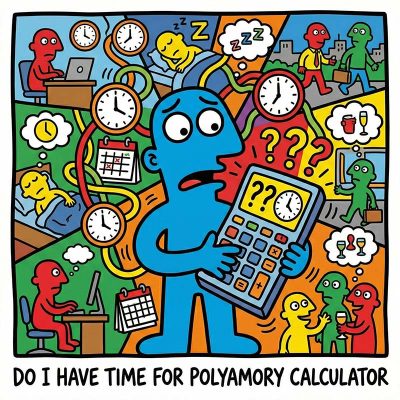
Love is infinite, but your calendar is brutally finite. The fantasy is deep connection; the reality is often just exhausted "calendar tetris." Promising time you don't actually have isn't romantic, it’s a recipe for burnout and broken trust. That sinking feeling when you have to cancel again? That’s the sound of overextension destroying your relationships.
This calculator forces you to confront the math of your life. Do you actually have space for another heart, or are you just setting everyone up for disappointment?

The fantasy is total autonomy and connection. The reality? It can feel like drowning in scheduling chaos and misunderstood expectations. That anxiety you feel isn’t just stress; it’s the wobble of living without a default "anchor." Without a solid architecture, Solo Polyamory stops being a life design and starts being a recipe for burnout and confusion.
The Essential Guide replaces the drift with a concrete anchor. We provide the "Solo Ethic," boundary scripts, and burnout protocols needed to protect your peace. Don't just date around—build a life that actually works for you.

Hierarchy sounds like a corporate org chart until someone gets their feelings hurt. That stomach-turning fear that you are just a "secondary" who can be fired at any time is real. If your relationship feels like a secret ranking system, you are doing it wrong.
Ambiguity is where resentment grows. The Essential Guide replaces the "who matters more" panic with a concrete charter. We provide the scripts and equity guardrails needed to protect every heart in the polycule. Stop guessing and start building.

The ideal is pure equality. The reality? It often slides into hidden rankings where someone gets hurt. That sinking feeling that you are secretly a "secondary" despite the label? That is your intuition detecting couple privilege. Ambiguity is where resentment thrives.
The Essential Guide replaces vague promises with concrete governance. We provide the charters, equity tools, and jealousy protocols needed to ensure "non-hierarchical" isn't just a fantasy. Stop guessing who matters most. Build a network that is actually fair.
The fantasy is total autonomy and connection. The reality? It can feel like drowning in scheduling chaos and misunderstood expectations. That anxiety you feel isn’t just stress; it’s the wobble of living without a default "anchor." Without a solid architecture, Solo Polyamory stops being a life design and starts being a recipe for burnout and confusion.
The Essential Guide replaces the drift with a concrete anchor. We provide the "Solo Ethic," boundary scripts, and burnout protocols needed to protect your peace. Don't just date around—build a life that actually works for you.
Hierarchy sounds like a corporate org chart until someone gets their feelings hurt. That stomach-turning fear that you are just a "secondary" who can be fired at any time is real. If your relationship feels like a secret ranking system, you are doing it wrong.
Ambiguity is where resentment grows. The Essential Guide replaces the "who matters more" panic with a concrete charter. We provide the scripts and equity guardrails needed to protect every heart in the polycule. Stop guessing and start building.
Core challenges you may face and how to address them
Challenge one is time conflict. You might want to see two or more people in the same week. The solution is honest transparency about your week and realistic planning. You can coordinate with partners to avoid double booking and to create buffer time for travel and recovery.
Challenge two is energy variability. Some days you have a large reserve of energy and other days you have little. The remedy is energy budgeting. You allocate your energy budget across the week and accept that some days you will not be up for social activity. Building flexibility into your schedule helps maintain balance.
Challenge three is consent and communication. People may have different expectations about how much time is spent together. The fix is regular check ins with clear expectations. You can discuss time boundaries and modify them as life changes. The goal is a shared sense of fairness and respect.
Challenge four is time zone differences. If you date across regions you may need to adjust for time differences and travel realities. A simple approach is to set fixed recurring time slots that you can maintain even with changes in location. You can also plan asynchronous communication that does not require real time contact every day.
Building your personal scheduling system
1. Create a weekly energy budget
Think of your energy as a currency. Each day or block of days you have a maximum amount you can spend on social time. Some days you feel strong and can invest more. Others you need rest. Start with a rough weekly budget such as a limit of three to five date oriented blocks and one or two nights of deep rest. You can adjust as you learn what drains or recharges you.
How to map energy budget in practice
- Identify your peak energy days. These are the days you feel sharp and focused.
- Mark days that are reserved for work or personal life. These days may limit social plans.
- Assign a rough energy value to social activities such as a date that requires travel or social energy. For example plan for two to three hours for a date on a high energy day and one hour on a low energy day.
- Reserve blocks of time for rest and recovery. Do not fill every moment with plans.
2. Use a single planning system you actually use
Pick a planning tool that feels easy. It could be a digital calendar, a notebook calendar or a simple to do list. The point is to have a single place where you plan and track. Avoid hopping between apps because it creates fragmentation and confusion.
3. Color code by relationship or energy level
Color coding makes it easy to see at a glance how your week is structured. You might dedicate one color to each partner, another for personal time, and another for work. You can also color by energy level for quick readability.
4. Block time for each connection
Set recurring blocks of time for each relationship or partner you want to invest in during the week. Fixed blocks create reliability while remaining flexible enough to adjust when needed. Avoid cramming too many blocks into a single day as that can feel exhausting.
5. Build extra guard time into travel and transitions
When you move from one date to another or travel between cities you may need extra time. Build buffer blocks into your schedule so you are not late and can arrive present and calm for the next connection.
6. Plan for spontaneous moments with consent
Consent does not mean you cannot be playful. It means you acknowledge others' needs and your own. Leave open windows for spontaneous moments while ensuring you have the capacity to honor them without over committing.
7. Schedule regular check ins with yourself and partners
Set a weekly or bi weekly time to review how your schedule is working. Check in with yourself and with your partners about balance, energy and happiness. Use this to adjust the plan moving forward.
Practical scheduling templates you can steal
Use these templates as starting points. They are simple to customize and work well for solo poly life.
Template A: Simple weekly rhythm
- Monday mornings clear head time for personal energy check in
- Tuesday evenings one on one time with Partner A for two hours
- Wednesday midday coffee with Partner B for one hour
- Thursday evening personal time for rest and hobbies
- Friday night social event once a week with friends or partners
- Saturday flexible date blocks with one or more partners if energy allows
- Sunday rest and planning for the next week
Template B: Energy aware planning
- Identify two high energy days per week and reserve them for important dates
- Schedule one low energy day with light social contact such as a quick chat or a walk
- Keep one dead simple day with no plans to recharge
Template C: The solo poly calendar snapshot
For your planner create a compact snapshot that shows the following for the week:
- Top three priorities for relationships
- Top three personal needs such as rest or exercise
- Three blocks of time reserved for social contact
- Two blocks for self care or hobbies
Realistic scheduling scenarios you can relate to
Scenario one. You are dating three people this week from different time zones. You have a Tuesday mid afternoon window that works for Partner A who is in your time zone. Partner B is in a different country and only available late evenings. Partner C is local and free on Wednesday night. You block two hours on Tuesday for A, two hours on Wednesday for C, and you reserve one short chat session with B on Thursday night. You keep your energy budget in mind and you stay flexible for any travel or work commitments. The key is clear communication. You tell each person when you are available and you confirm ahead of time what the plan is. If someone needs a last minute change you offer a reasonable alternative and you keep the other plans intact whenever possible.
Scenario two. A partner asks for more time together than you can give due to a heavy work week. You acknowledge their need and you propose a next available window that fits your energy budget. You explain honestly that you cannot increase the time without sacrificing your own health or your other commitments. They accept this and you create a plan that balances both sides. The important part is honesty and kindness in the conversation.
Scenario three. You planned a big date with one partner but you wake up with a heavy emotional load and limited energy. You shift the plan to a shorter hangout or switch to a more relaxed activity. You contact the partner ahead of time to explain the change and you offer to reschedule. Everyone understands that autonomy and consent apply not just to relationship formation but also to time and energy management.
Communication strategies for scheduling in ENM dynamics
Open and proactive communication is essential in solo poly life. You need to be honest about your capacity and you must listen to others about their needs. A few practical techniques can help you stay connected without creating a babysitting burden for yourself.
- Set expectations early about your scheduling rhythm and energy budget. This reduces last minute chaos.
- Use a neutral tone when discussing conflicts. Focus on the facts and the impact on your energy and time.
- Ask for preferences. Invite partners to share their ideal windows and any non negotiables they have when it comes to time together.
- Keep a simple log of commitments for reference. A quick note about what was scheduled and what happened can guide future planning.
- Acknowledge the emotions that come with scheduling. It is natural to feel overwhelmed or excited. Validate those feelings without letting them derail the plan.
Sample scripts for scheduling conversations
- Hey I am trying a new weekly rhythm to keep space for myself and for all my connections. I have time on Tuesday and Thursday evenings this week. Which window works for you or would you prefer a different day this week?
- I want to be fair to you and to my other commitments. My energy is lower after long days. I can meet this Friday for a shorter time or we can push to Saturday if you prefer longer time. What feels best for you?
- Would you be comfortable with a recurring two hour slot every other week and a shorter check in in between if needed? I want to keep space for rest while staying connected with you.
Boundaries that support scheduling success
Boundaries protect both your time and your well being. They help you keep relationships sustainable. If you are new to setting boundaries in ENM dynamics you may find it awkward at first. Boundaries can be refined over time as you learn what works for you and what does not.
- Non negotiables. Identify what you must have in order to feel safe and supported. This could be a certain amount of personal time per week, or a requirement that you are free of conflicts during certain days.
- Communication boundaries. Decide how often you will check in with each partner. Set expectations about how you will handle late changes or cancellations.
- Time boundaries. Do not accept plans that will push your energy past your limit. It is okay to say no and to propose an alternative.
- Financial boundaries. If you share gifts or plans that require spending, set limits and discuss fairness.
- Space boundaries. Protect private space and personal routines. Do not feel obligated to share every detail of your day if you are not comfortable.
Self care and mental load management
Managing multiple relationships can create a mental load that feels heavy at times. Self care is not selfish. It is the foundation that keeps you healthy enough to show up for others. Build rituals that recharge you and protect your well being. This might include daily walks, quiet mornings, time for a hobby, or dedicated rest days. Make these practices non negotiable parts of your weekly plan so you do not skip them when life gets busy.
Special considerations for ENM and solo poly life
In ethically non monogamous communities there is a wide range of practices and norms. You may hear about primary partnerships or hierarchical structures. In solo poly there is no fixed hierarchy. Your independence is valued. Because of this you may need to carve out additional time for self reflection and for communication with a diverse group of partners. The key is to maintain consent and respect for everyone involved while staying true to your own needs and energy levels.
Tech tools and practical tips to support scheduling
- Consolidate calendars. Use a single calendar to track your own life and your relationships. You can still have separate calendars for convenience but a central view helps you see conflicts and plan ahead.
- Color coding. Use colors to distinguish partners and personal time. It makes the week scan friendly and reduces planning errors.
- Reminders. Set gentle reminders for travel, preparation, and transitions. This helps you stay on track without rushing.
- Templates. Use simple templates for planning and check in notes. Reuse templates to reduce planning friction.
- Communication channels. Keep a reliable way to reach each partner such as text or a preferred chat app. Do not rely on a single channel that might slip your attention.
Frequently asked questions
What is solo polyamory
Solo polyamory is a form of ethical non monogamy where a person maintains autonomy and independence while forming meaningful connections with multiple partners. There is no required primary partner who makes all decisions about time. Each relationship has its own balance of time and energy.
How do you balance multiple partners without a core partner
Balance comes from clear planning and honest communication. Schedule blocks for each relationship, maintain energy budgets, and make space for self care. Invite input from partners about their needs and be open to renegotiation as life changes.
How can I avoid feeling overwhelmed by my schedule
Start with a conservative energy budget and gradually increase social commitments as you learn your limits. Build buffers and ensure you have rest days. Communicate early if you feel overwhelmed and ask for adjustments. Remember that autonomy means you control your time and can protect it when needed.
What if my partners want more time than I can give
Be honest about your limits. Offer a couple of alternates within your energy budget and propose a plan for the near future. If needed you can also set a longer term renegotiation to revisit the topic when your schedule allows.
How do you coordinate across different time zones
Use recurring slots at the same local times that fit your most stable days. For cross zone meetings you can rotate the windows so no one is always disadvantaged. Record messages or plan asynchronous check ins when live meetings are not possible.
Do I need to tell every partner about every plan
Be mindful about how much detail you share. You should share enough to maintain transparency and trust. It is okay to summarize plans and save private details for the right moments. With time you will learn what information is helpful for your partners and what is not necessary.
How can technology support this schedule without becoming overwhelming
Choose a reliable calendar system and stick with it. Use color coding and reminders. Do not over rely on notifications. Create a simple weekly planning ritual that happens at the same time every week so the tool supports you rather than distracts you.
Is it okay to change plans if I need more rest
Yes. The most important thing is to honor your own needs. When you need rest politely explain the change and offer a reasonable alternative if possible. Your health and well being should always be a priority.
Love is infinite, but your calendar is brutally finite. The fantasy is deep connection; the reality is often just exhausted "calendar tetris." Promising time you don't actually have isn't romantic, it’s a recipe for burnout and broken trust. That sinking feeling when you have to cancel again? That’s the sound of overextension destroying your relationships.
This calculator forces you to confront the math of your life. Do you actually have space for another heart, or are you just setting everyone up for disappointment?
The fantasy is total autonomy and connection. The reality? It can feel like drowning in scheduling chaos and misunderstood expectations. That anxiety you feel isn’t just stress; it’s the wobble of living without a default "anchor." Without a solid architecture, Solo Polyamory stops being a life design and starts being a recipe for burnout and confusion.
The Essential Guide replaces the drift with a concrete anchor. We provide the "Solo Ethic," boundary scripts, and burnout protocols needed to protect your peace. Don't just date around—build a life that actually works for you.
Hierarchy sounds like a corporate org chart until someone gets their feelings hurt. That stomach-turning fear that you are just a "secondary" who can be fired at any time is real. If your relationship feels like a secret ranking system, you are doing it wrong.
Ambiguity is where resentment grows. The Essential Guide replaces the "who matters more" panic with a concrete charter. We provide the scripts and equity guardrails needed to protect every heart in the polycule. Stop guessing and start building.
The ideal is pure equality. The reality? It often slides into hidden rankings where someone gets hurt. That sinking feeling that you are secretly a "secondary" despite the label? That is your intuition detecting couple privilege. Ambiguity is where resentment thrives.
The Essential Guide replaces vague promises with concrete governance. We provide the charters, equity tools, and jealousy protocols needed to ensure "non-hierarchical" isn't just a fantasy. Stop guessing who matters most. Build a network that is actually fair.
The fantasy is total autonomy and connection. The reality? It can feel like drowning in scheduling chaos and misunderstood expectations. That anxiety you feel isn’t just stress; it’s the wobble of living without a default "anchor." Without a solid architecture, Solo Polyamory stops being a life design and starts being a recipe for burnout and confusion.
The Essential Guide replaces the drift with a concrete anchor. We provide the "Solo Ethic," boundary scripts, and burnout protocols needed to protect your peace. Don't just date around—build a life that actually works for you.
Hierarchy sounds like a corporate org chart until someone gets their feelings hurt. That stomach-turning fear that you are just a "secondary" who can be fired at any time is real. If your relationship feels like a secret ranking system, you are doing it wrong.
Ambiguity is where resentment grows. The Essential Guide replaces the "who matters more" panic with a concrete charter. We provide the scripts and equity guardrails needed to protect every heart in the polycule. Stop guessing and start building.
