
Gift Giving and Resource Boundaries


Welcome to a no fluff guide that treats gift giving and resources with the seriousness they deserve in a swinging ethical non monogamy dynamic. We keep it real, practical and a little funny because relationships deserve both honesty and a little joy. If you are new to swinging ENM or you are already navigating a busy web of connections, this guide will help you craft fair boundaries that respect everyone involved while keeping your relationships thriving.
Quick Links to Useful Sections
- What swinging ENM means for gifts and resources
- Key terms you should know
- What counts as a gift in a swinging ENM dynamic
- Resource boundaries in a swinging ENM context
- Money
- Time
- Energy and emotional labor
- Space and living arrangements
- Must no s in Gift Giving and Resource Boundaries
- Practical strategies for setting gift and resource boundaries
- 1. Start with a boundary inventory
- 2. Create a gift policy document
- 3. Set budget guidelines
- 4. Schedule regular boundary check ins
- 5. Use explicit consent for each new gift or experience
- Conversation scripts you can use today
- Script A: Introducing a new gift policy
- Script B: Negotiating a shared experience
- Script C: Handling a gift that crosses a boundary
- Script D: If someone feels overwhelmed by resources
- Realistic scenarios and how to resolve them
- Scenario 1: A partner receives an expensive gift from another partner without prior discussion
- Scenario 2: A shared trip becomes financially heavy and nobody wants to shoulder a disproportionate share
- Scenario 3: Time is tight and a partner outside your primary asks for more attention than you can give
- Scenario 4: A boundary change is needed after a new partner enters the mix
- Gift ideas that respect boundaries and feel meaningful
- Templates and tools you can use now
- Gift and Resource Boundary Worksheet
- Simple boundary negotiation script
- Glossary of useful terms and acronyms
- Frequently asked questions
Before we dive in, a quick note on tone. This guide explains terms and acronyms so you can use the language that fits your world. It also gives you real life scenarios and actionable steps you can take today. We will keep the humor light and the strategies clear. Now let’s get into how gift giving and resource boundaries work when your dynamic includes swinging ENM. ENM stands for ethical non monogamy. When we say swinging we mean play or dating with partners outside your primary partnership with consent and communication at the center. That clarity helps us talk about gifts and resources without muddying the waters.
What swinging ENM means for gifts and resources
In a swinging ENM dynamic there are often multiple people involved who are not bound to a single romantic or sexual script. That reality affects how we think about gifts and resources in several ways. First the word gift does not always mean a physical object. A gift can be an experience, a favor, time spent, or even emotional energy offered to someone outside your primary couple. Second resources such as money, attention, time, and space become shared commodities that need respectful boundaries. The goal is to prevent resentment and ensure that generosity remains a choice not a pressure point.
Key terms you should know
- ENM Ethical non monogamy. A broad approach to relationships that emphasizes consent, communication and honesty among all participants.
- Swinging A form of ENM that focuses on intimate experiences involving other couples or single partners, usually with known boundaries and safety checks.
- Primary partner The person or couple that holds a central place in your life, often with shared assets or plans.
- Secondary partner A partner who is important but not the central anchor of daily life or long term plans.
- Boundary A limit that a person or couple agrees to honor. Boundaries can be about time, money, resources, or emotional space.
- Resource In this context anything you offer or withhold that requires time, money, energy or space. We include emotional energy in this list as a resource too.
- Gift etiquette The agreed rules about what kinds of gifts are acceptable, who can give them, and how they should be received.
- Negotiation The process of discussing and agreeing on boundaries that make everyone feel safe and respected.
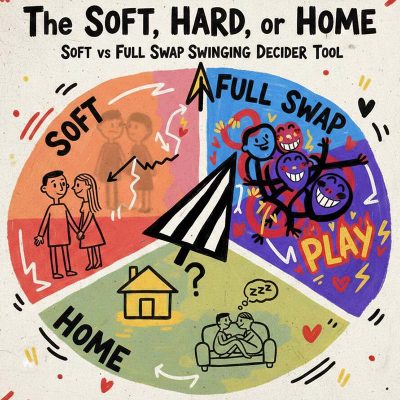
Don't let a "Soft Swap" night turn into a "Hard Feelings" morning.
Walking into the club with different expectations is a grenade waiting to explode. He thinks it’s a free-for-all; she thinks it’s just drinks and dancing. That silence in the car ride home? That’s the sound of a preventable disaster.
Stop guessing. Use this tool to sync your "sexual GPS" before you leave the driveway. Determine exactly how wild you’re getting tonight, so the only surprise is how much fun you have.
The fantasy of swinging is electric, but that cold sweat you feel when thinking about your partner with someone else? That’s your survival instinct warning you that your foundation is at stake. Most couples don’t fail because they lacked desire; they fail because they lacked a safety net. Ambiguity is where jealousy festers, and "winging it" is the fastest way to turn a dream into a nightmare of resentment and "what have we done?"
The Essential Guide to Swinging is your anxiety-proof roadmap through the chaos. Don't gamble your marriage on hope. Build a fortress of trust, master the repair chats, and ensure your exploration is defined by care, not a catastrophe
Full swap is the deep end. The rush is intense, but so is the risk of emotional wreckage. That tightening in your chest isn’t just nerves; it’s the fear that a "fun night" could become a permanent scar on your marriage. You can’t un-ring this bell, so never strike it without a plan.
The Essential Guide to Full Swap Swinging replaces reckless gambling with calculated discipline. From ironclad vetting to "emergency brake" scripts, we provide the safety architecture required to swap bodies without losing your minds. Don't just hope it goes well, engineer it
Gemini said
The fantasy is electric. The reality? It can be a grenade that blows up your marriage and your social circle. That tightening in your chest isn't just nerves. It is a warning that you are risking everything on a vibe. "Winging it" is the fastest way to turn a fun group chat into a toxic war zone.
The Essential Guide replaces the chaos with ironclad protocols. We provide the vetting tools, jealousy airlocks, and privacy scripts needed to swap bodies without losing your mind. Secure your safety first.
The fantasy of swinging is electric, but that cold sweat you feel when thinking about your partner with someone else? That’s your survival instinct warning you that your foundation is at stake. Most couples don’t fail because they lacked desire; they fail because they lacked a safety net. Ambiguity is where jealousy festers, and "winging it" is the fastest way to turn a dream into a nightmare of resentment and "what have we done?"
The Essential Guide to Swinging is your anxiety-proof roadmap through the chaos. Don't gamble your marriage on hope. Build a fortress of trust, master the repair chats, and ensure your exploration is defined by care, not a catastrophe
Full swap is the deep end. The rush is intense, but so is the risk of emotional wreckage. That tightening in your chest isn’t just nerves; it’s the fear that a "fun night" could become a permanent scar on your marriage. You can’t un-ring this bell, so never strike it without a plan.
The Essential Guide to Full Swap Swinging replaces reckless gambling with calculated discipline. From ironclad vetting to "emergency brake" scripts, we provide the safety architecture required to swap bodies without losing your minds. Don't just hope it goes well, engineer it
What counts as a gift in a swinging ENM dynamic
Gifts can be tangible or intangible. In a swinging ENM setup a gift might be a fancy dinner for a partner outside your primary, a hotel room for an overnight with a partner, a thoughtful present that acknowledges a date or event, or time offered to help with travel logistics. It is helpful to classify gifts into categories so you can manage expectations and avoid surprises. Here are common gift types you may encounter:
- Occasional tokens Small gestures that signal appreciation or solidarity like a book, a movie night, or a favorite snack brought after a date with someone else.
- Experiential gifts Tickets to an event, a weekend away, a spa day, or a dinner at a special restaurant for a partner outside your trio or quad.
- Shared experiences Splitting the cost of an event or a trip that involves more than one partner or a social activity that includes more than one couple.
- Practical gifts Things that make daily life easier such as a gadget, a kitchen tool, or a booked babysitter who gives a couple time together.
- Financial gifts Direct money gifts including contributions to travel, feastings at a venue, or gifts that support another partner’s needs. We will discuss boundaries around money more below.
- Emotional gifts Acts of support like a long conversation, a listening session, or a grounded check in after a date with someone new.
Gifts can carry emotional weight. A well chosen gift can strengthen trust and signal care. A poorly timed or misaligned gift can create pressure or jealousy. The aim is to create a culture where giving is thoughtful, not transactional or coercive. The best gifts in swinging ENM are those that align with clearly agreed boundaries and are offered with consent and appreciation.
Resource boundaries in a swinging ENM context
Resources are not just money. Time, energy, attention, space, and even emotional bandwidth count as resources. When multiple people are involved, resources can flow in several directions at once. Here is how to think about each resource and what to watch for in a busy ENM life.
Money
Money boundaries are the most common friction point. It is easy for money to become entangled with affection and access. To keep things clean, consider:
- Who pays for what during group events or dates with external partners.
- Whether there is a shared budget for gifts and experiences and who manages it.
- Whether financial gifts are allowed or encouraged and what limits apply to each party.
- How to handle refunds or cancellations when plans change.
Time
Time is a scarce resource. Each person has a life outside the ENM dynamics and that life deserves respect. To prevent time related conflict:
- Agree on minimum notice for scheduling dates and trips involving other partners.
- Set expectations about how much time is contributed to the ENM activities each week or month.
- Decide how to handle overlapping commitments when two partners want time with the same person.
Energy and emotional labor
Emotional energy is precious. Supporting partners during a date with someone new is a wonderful gift but it can also be draining. Strategies include:
- Sharing aftercare duties so emotional load does not fall on one person only.
- Rotating who holds space for debriefs after big events or dates.
- Talking through how much emotional labor is reasonable after a date with a new partner.
Space and living arrangements
Housing and personal space are real resources in many ENM arrangements. You may share a home with a primary partner while inviting others for visits. Boundaries to consider:
- How long a guest can stay and what spaces they can access in your home.
- Whether overnight visits are allowed and what the boundaries are around privacy.
- Rules around sleeping arrangements and shared living areas during visits.
Must no s in Gift Giving and Resource Boundaries
To keep things healthy and predictable, here are some practical must nos to avoid common traps. Use these as a starting point and tailor to your exact situation. Remember that every ENM setup is different and your boundaries should reflect the real needs of the people involved.
- No pressure to give gifts beyond what feels comfortable. Gifts must be freely offered without strings attached.
- No control over a partner s affections through gifts. Gifts should never be used as a way to buy time or lock in a relationship dynamic.
- No surprise expenses without advance notice and consent. If plans require money, discuss it first and agree on the amount and allocation.
- No gifting to influence sexual decisions. Gifts should not serve as leverage to create or end sexual activity or preferences.
- No prying into someone s bank accounts or personal finances without explicit consent. Financial transparency should be optional and sized to comfort level.
- No ignoring of primary or other partner boundaries in exchange for gifts. Boundaries must be respected even when someone is excited about a date or event.
- No gifts that create unsafe or uncomfortable living conditions. Gifts should enhance safety and comfort not undermine it.
Practical strategies for setting gift and resource boundaries
Now we move from rules to real life playbooks. These strategies are designed to help you and your partner or partner group define clear expectations and keep everyone comfortable. Use them as a framework you can customize to your specific dynamic.
1. Start with a boundary inventory
Take a few minutes to list every resource you feel is relevant. Money, time, energy, space, attention and any other resource you want to protect or allocate differently. Have each person write their list and then compare. The goal is to find overlaps and gaps so you can negotiate from a place of honesty.
2. Create a gift policy document
A simple living document can be the difference between harmony and friction. The policy should cover:
- What counts as a gift and what does not
- Who can give gifts to whom and with what limits
- How gifts are tracked and who pays for shared gifts
- How boundaries can be revisited and by whom
3. Set budget guidelines
Money decisions should be transparent but not suffocating. A practical approach is to set a monthly or quarterly envelope for gifts and experiences involving outside partners. Decide a ceiling per gift and a total limit per period. This keeps generosity within manageable bounds and avoids debt or resentment.
4. Schedule regular boundary check ins
Boundaries are living things. We recommend a check in every few months, or sooner if a new partner enters the dynamic or if someone s life changes. Use a neutral facilitator if needed to keep conversations productive and respectful.
5. Use explicit consent for each new gift or experience
Consent is not a one time thing in ENM. For every new gift or commitment with a partner outside your primary, confirm consent again. It is a habit that protects everyone and reduces the chance of misunderstandings.
Conversation scripts you can use today
Clear communication is the backbone of healthy boundaries. Here are ready to use scripts you can adapt to your situation. Pick the one that mirrors your tone and go with it. Practice a few times so you can deliver it calmly and confidently.
Script A: Introducing a new gift policy
Hey team I want to talk about how we handle gifts and resources when we date outside our core pair. I love how generous we are with each other and want to keep that energy without creating misunderstandings. Let us agree on what counts as a gift what the boundaries are and how we handle costs. My proposal is to set a monthly gift budget and a simple approval process for any significant gift. What do you think?
Script B: Negotiating a shared experience
I ve got a chance to book a weekend away with a partner outside our primary. It would involve a hotel and events. I want to make sure this fits with our boundaries and our budget. I am proposing a plan where we split costs and confirm the exact dates together. If there are any concerns we can adjust. How does that sound to you?
Script C: Handling a gift that crosses a boundary
We agreed that big gifts should be discussed first. I was offered an expensive item for a partner outside our primary and I want to check in before accepting. I want to hear how you feel about this and whether we should set a cap on gift value or reconsider the idea entirely.
Script D: If someone feels overwhelmed by resources
It seems like there is some pressure around gifts and time. I want to acknowledge that and slow things down. Let us review the gift budget together and adjust if needed. We want generosity to feel good for everyone not like a source of stress.
Realistic scenarios and how to resolve them
Here are some realistic situations that many swinging ENM households face. Each scenario includes a practical resolution approach that centers consent, fairness and open dialogue.
Scenario 1: A partner receives an expensive gift from another partner without prior discussion
In this scenario the receiving partner feels unsure and the giver feels excited to show appreciation. The first step is to pause and revisit the gift policy. The group should discuss whether large gifts require prior agreement and whether there should be a gift value cap. The resolution is simple: agree to a cap and add a requirement that any gift over a limit triggers a quick check in involving all primary partners. This keeps generosity from becoming pressure and ensures everyone knows the cost and intention behind the gesture.
Scenario 2: A shared trip becomes financially heavy and nobody wants to shoulder a disproportionate share
Talk about shared costs and who will cover what. One approach is to create a trip fund with equal monthly contributions. If someone s budget cannot meet the target, you adjust the plan or replace with a lower cost option. The key is to make decisions before booking and keep receipts transparent so everyone understands where the money goes.
Scenario 3: Time is tight and a partner outside your primary asks for more attention than you can give
This is a common friction point. The remedy is to set a realistic schedule and use a calendar to block out time that works for every involved party. If someone feels neglected, offer a dedicated check in every week and a shared space where every partner can express needs or concerns. Keeping communication consistent prevents resentment from building up.
Scenario 4: A boundary change is needed after a new partner enters the mix
Boundaries are not set in stone. When a new player comes into the dynamic it is normal to revisit them. You can run a short boundary refresh meeting with the new partner included. You can also let people opt in or out of certain activities. The point is to keep everyone informed and empowered to say yes or no without drama.
Gift ideas that respect boundaries and feel meaningful
Choosing gifts that respect boundaries is a skill. Here are ideas that are thoughtful, flexible and generally easy to adapt to most swinging ENM setups. The focus is on experiences, shared moments and practical help rather than big expectations.
- Experiences Tickets to a concert or play that involve a partner outside your primary, with agreed cancellation and refund rules.
- Shared meals A dinner at a favorite restaurant or a cooking class that includes the relevant partners and respects dietary needs.
- Supportive services A babysitter for a date night, a cleaning service for a weekend away, or assistance with travel logistics.
- Personal touches A handwritten note with a sense of appreciation, a playlist created for a partner, or a care package that respects personal boundaries.
- Practical gear A gadget or helpful tool that makes travel or hosting easier, provided the giver and recipient agree on its usefulness and value.
- Charitable gifts A donation made in a partner s name to a cause they care about. This keeps the focus on shared values rather than personal consumption.
Templates and tools you can use now
Gift and Resource Boundary Worksheet
Use this simple worksheet to map out what is allowed and what is not. Adapt it to your exact dynamic and print a copy for each partner so everyone can reference it easily.
- Resource inventory List money time energy and space you are willing to allocate to outside partners.
- Gift classification Define what counts as a gift which gifts are permissible and any caps that apply.
- Approval process Decide who must approve which gifts and what information must be shared for approval.
- Budget Set a monthly or quarterly cap for gifts and shared experiences and specify how costs will be tracked.
- Review cadence Schedule a quarterly boundary review to adjust policies as needed.
Simple boundary negotiation script
Use this in your next boundary check in. It keeps the conversation calm and forward looking.
First partner speaks I feel X when Y happens and I want Z to happen instead. This helps everyone understand the impact and the desired change without blame. Then the other party responds with their perspective and together you agree on a concrete next step. It is not a demand it is a collaborative adjustment that keeps the relationship healthy.
Glossary of useful terms and acronyms
- ENM Ethical non monogamy a framework that values consent honesty and communication among all involved partners.
- Swinging A form of ENM that focuses on sexual or romantic experiences with other partners outside a primary couple often in social settings.
- Primary partner The main committed partner in a relationship who typically shares long term plans and life together.
- Gift etiquette The agreed rules about how gifts are given received and acknowledged within the dynamic.
- Resource Anything that takes time money energy or space to give or receive in the ENM context.
- Boundary refresh A scheduled session to revisit and revise boundaries with the participation of all key people.
- Consent A voluntary and ongoing agreement to participate in an activity or exchange that respects each person s boundaries.
Frequently asked questions
How do I start a conversation about gifts in a swinging ENM relationship?
Begin with your name and a calm opening line that sets the intent. For example Hello I want to talk about how we handle gifts and resources when dating outside our primary. Then explain what you want to achieve a fair plan that respects everyone. Invite feedback and keep the tone collaborative. Practice helps you stay grounded and confident.
What if I feel pressured to give a gift or to accept one?
Make it clear you have the right to say no and to pause if you feel pressure. A good rule is If it feels like obligation it probably is not a good gift. Revisit the boundaries with your partner so everyone understands which gifts are optional and which are required for a shared plan.
How should money be handled in a swinging ENM dynamic?
Money should be transparent but not invasive. Create a gift budget you all agree on and keep receipts for shared expenses. Decide who pays for what in advance of trips or events and document changes in your gift policy. Always gain consent before large expenditures that involve more than one person or couple.
Can gifts ever be used to manipulate outcomes in ENM?
No gift should be a tool for coercion. The moment a gift is linked to sexual activity or emotional commitments it crosses a boundary. If a gift is meant to influence someone s behavior or decisions it should be paused and discussed openly.
What happens when someone changes their boundaries?
Boundaries can shift as people grow or relationships evolve. The best response is a boundary refresh meeting. Include all relevant partners and make concrete adjustments with clear timelines and check in points. The aim is to maintain safety trust and respect for everyone involved.
Should I keep a record of gifts and resources?
Yes a simple ledger or shared document helps reduce confusion. Tracking what was given what was received and how costs are shared can prevent misunderstandings and help everyone see where boundaries stand.
Don't let a "Soft Swap" night turn into a "Hard Feelings" morning.
Walking into the club with different expectations is a grenade waiting to explode. He thinks it’s a free-for-all; she thinks it’s just drinks and dancing. That silence in the car ride home? That’s the sound of a preventable disaster.
Stop guessing. Use this tool to sync your "sexual GPS" before you leave the driveway. Determine exactly how wild you’re getting tonight, so the only surprise is how much fun you have.
The fantasy of swinging is electric, but that cold sweat you feel when thinking about your partner with someone else? That’s your survival instinct warning you that your foundation is at stake. Most couples don’t fail because they lacked desire; they fail because they lacked a safety net. Ambiguity is where jealousy festers, and "winging it" is the fastest way to turn a dream into a nightmare of resentment and "what have we done?"
The Essential Guide to Swinging is your anxiety-proof roadmap through the chaos. Don't gamble your marriage on hope. Build a fortress of trust, master the repair chats, and ensure your exploration is defined by care, not a catastrophe
Full swap is the deep end. The rush is intense, but so is the risk of emotional wreckage. That tightening in your chest isn’t just nerves; it’s the fear that a "fun night" could become a permanent scar on your marriage. You can’t un-ring this bell, so never strike it without a plan.
The Essential Guide to Full Swap Swinging replaces reckless gambling with calculated discipline. From ironclad vetting to "emergency brake" scripts, we provide the safety architecture required to swap bodies without losing your minds. Don't just hope it goes well, engineer it
Gemini said
The fantasy is electric. The reality? It can be a grenade that blows up your marriage and your social circle. That tightening in your chest isn't just nerves. It is a warning that you are risking everything on a vibe. "Winging it" is the fastest way to turn a fun group chat into a toxic war zone.
The Essential Guide replaces the chaos with ironclad protocols. We provide the vetting tools, jealousy airlocks, and privacy scripts needed to swap bodies without losing your mind. Secure your safety first.
The fantasy of swinging is electric, but that cold sweat you feel when thinking about your partner with someone else? That’s your survival instinct warning you that your foundation is at stake. Most couples don’t fail because they lacked desire; they fail because they lacked a safety net. Ambiguity is where jealousy festers, and "winging it" is the fastest way to turn a dream into a nightmare of resentment and "what have we done?"
The Essential Guide to Swinging is your anxiety-proof roadmap through the chaos. Don't gamble your marriage on hope. Build a fortress of trust, master the repair chats, and ensure your exploration is defined by care, not a catastrophe
Full swap is the deep end. The rush is intense, but so is the risk of emotional wreckage. That tightening in your chest isn’t just nerves; it’s the fear that a "fun night" could become a permanent scar on your marriage. You can’t un-ring this bell, so never strike it without a plan.
The Essential Guide to Full Swap Swinging replaces reckless gambling with calculated discipline. From ironclad vetting to "emergency brake" scripts, we provide the safety architecture required to swap bodies without losing your minds. Don't just hope it goes well, engineer it
