
Playroom Etiquette and Space Awareness


Welcome to a down to earth guide that treats the playroom like a shared living space where respect and good communication keep everyone comfortable. If you are new to ethical non monogamy or if you have been at this for a while and want to up your game, you are in the right place. We are going to break down the ideas of playroom etiquette and space awareness in a practical, funny and accessible way. You will get clear definitions for every term we use and concrete tips you can apply tonight.
Quick Links to Useful Sections
- What this guide covers and who this is for
- Key terms you should know and how we use them
- The core ideas behind playroom etiquette and space awareness
- Boundaries and agreements that set the stage
- Personal boundaries
- Interaction boundaries
- Logistical boundaries
- How to communicate clearly and respectfully
- Space awareness in practice
- First timer friendly guidelines
- Hosting versus attending a play session
- Hosting tips
- Attending tips
- Real world scenarios you can relate to
- Scenario one we call the first party entry
- Scenario two a playful triad balance test
- Scenario three a dynamics shift during a session
- Scenario four a club setting with multiple rooms
- Safety and health 101 for the playroom
- Jealousy and emotional management in ENM play spaces
- Aftercare and ongoing consent
- Practical tips and quick checklists
- Before you go to the play space
- During the session
- After the session
- Common issues and how to handle them
- Safety first and health aware play
- Glossary of terms and acronyms you might hear in ENM circles
- Frequently asked questions
- Final notes on creating respectful and enjoyable play spaces
Before we dive in a quick note on language. ENM stands for ethical non monogamy. That means partners agree to explore relational connections beyond one primary relationship in a way that prioritizes consent, transparency and care. Swinging is a common form of ENM where partners share sexual experiences with others under agreed rules. A playroom is any space where this kind of activity happens. Your playroom could be a private home, a club or an event space. Space awareness is the practice of noticing physical, emotional and social space needs for everyone involved. It is about how we use space and how we give space to others so the experience stays positive for all participants.
What this guide covers and who this is for
This guide is for adults who practice or are curious about swinging and other forms of ethical non monogamy. It covers etiquette for hosting and attending play sessions, how to navigate space in shared environments, how to talk about boundaries clearly, and how to handle emotions that can come up in group settings. It also explains common terms so you can feel confident in conversations with partners and potential play partners. The goal is to create settings where consent is ongoing and enthusiastic and where people feel safe to express what they want and what they do not want.
Key terms you should know and how we use them
Understanding terms helps reduce confusion and makes conversations easier. Here is a quick glossary you can reference as you read along.
- ENM Ethical non monogamy. A framework that supports exploring connections with consent and honesty rather than secrecy.
- Swinging A form of ENM where couples or individuals meet others to share sexual experiences with mutual agreement.
- Playroom The space where intimate activities happen in a consent based setting. This can be a private home, a dedicated club or a private room at an event.
- Boundaries Personal lines that define what is okay and what is not. Boundaries can be physical, emotional or time oriented.
- Consent An ongoing yes that can be paused or withdrawn at any moment. Consent is enthusiastic and should be revisited as plans change.
- Check in A quick conversation during a session to confirm comfort levels and adjust plans if needed.
- Aftercare Time and care after a scene to ensure everyone feels supported and respected. This can be talking, cuddling or simply a quiet moment together.
- Jealousy management Techniques and conversations that help partners navigate uneasy feelings in a healthy way.
- Spot checks Short, frequent pauses to confirm that everything is still okay for everyone involved.
- STI testing Regular health screenings to reduce the risk of sexually transmitted infections. It is a courtesy and a responsibility in shared spaces.
- Soft limit A boundary that is not a hard stop but may require careful negotiation or adjustments if approached.
- Hard limit A boundary that you will not cross under any circumstances.
- Unicorn A term used for a person who is seeking a couple relationship and who fits well with another couple. This word can be sensitive so use with care and clear consent.
- NSA No strings attached. A term sometimes used to describe a casual encounter that does not imply ongoing emotional involvement.
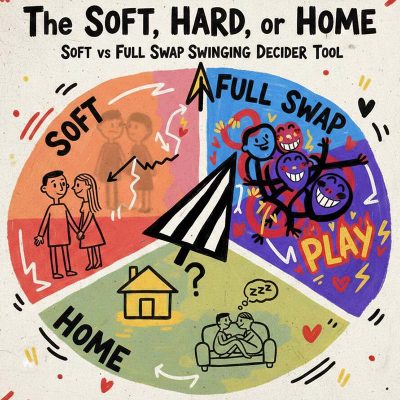
Don't let a "Soft Swap" night turn into a "Hard Feelings" morning.
Walking into the club with different expectations is a grenade waiting to explode. He thinks it’s a free-for-all; she thinks it’s just drinks and dancing. That silence in the car ride home? That’s the sound of a preventable disaster.
Stop guessing. Use this tool to sync your "sexual GPS" before you leave the driveway. Determine exactly how wild you’re getting tonight, so the only surprise is how much fun you have.

The fantasy of swinging is electric, but that cold sweat you feel when thinking about your partner with someone else? That’s your survival instinct warning you that your foundation is at stake. Most couples don’t fail because they lacked desire; they fail because they lacked a safety net. Ambiguity is where jealousy festers, and "winging it" is the fastest way to turn a dream into a nightmare of resentment and "what have we done?"
The Essential Guide to Swinging is your anxiety-proof roadmap through the chaos. Don't gamble your marriage on hope. Build a fortress of trust, master the repair chats, and ensure your exploration is defined by care, not a catastrophe

Full swap is the deep end. The rush is intense, but so is the risk of emotional wreckage. That tightening in your chest isn’t just nerves; it’s the fear that a "fun night" could become a permanent scar on your marriage. You can’t un-ring this bell, so never strike it without a plan.
The Essential Guide to Full Swap Swinging replaces reckless gambling with calculated discipline. From ironclad vetting to "emergency brake" scripts, we provide the safety architecture required to swap bodies without losing your minds. Don't just hope it goes well, engineer it

Gemini said
The fantasy is electric. The reality? It can be a grenade that blows up your marriage and your social circle. That tightening in your chest isn't just nerves. It is a warning that you are risking everything on a vibe. "Winging it" is the fastest way to turn a fun group chat into a toxic war zone.
The Essential Guide replaces the chaos with ironclad protocols. We provide the vetting tools, jealousy airlocks, and privacy scripts needed to swap bodies without losing your mind. Secure your safety first.
The fantasy of swinging is electric, but that cold sweat you feel when thinking about your partner with someone else? That’s your survival instinct warning you that your foundation is at stake. Most couples don’t fail because they lacked desire; they fail because they lacked a safety net. Ambiguity is where jealousy festers, and "winging it" is the fastest way to turn a dream into a nightmare of resentment and "what have we done?"
The Essential Guide to Swinging is your anxiety-proof roadmap through the chaos. Don't gamble your marriage on hope. Build a fortress of trust, master the repair chats, and ensure your exploration is defined by care, not a catastrophe
Full swap is the deep end. The rush is intense, but so is the risk of emotional wreckage. That tightening in your chest isn’t just nerves; it’s the fear that a "fun night" could become a permanent scar on your marriage. You can’t un-ring this bell, so never strike it without a plan.
The Essential Guide to Full Swap Swinging replaces reckless gambling with calculated discipline. From ironclad vetting to "emergency brake" scripts, we provide the safety architecture required to swap bodies without losing your minds. Don't just hope it goes well, engineer it
The core ideas behind playroom etiquette and space awareness
Etiquette is more than manners. In a playroom it is a system for ensuring that everyone can relax and enjoy themselves. Space awareness is about recognizing that different people need different physical and emotional space. Some people want a lot of interaction while others may want a more limited experience. The aim is to create a setting where every participant can communicate honestly and feel safe to decline or change their mind at any moment.
Two guiding principles run through all etiquette decisions. First, consent is ongoing. People can change their minds at any time and that choice must be respected immediately. Second, communication is proactive not reactive. A small check in early in the session can prevent a lot of tension later. If you are hosting or attending a play session, you are responsible for keeping communication lines open and for stepping in when you notice a partner looks uncomfortable or overwhelmed.
Boundaries and agreements that set the stage
Boundaries are personal. They require clear articulation and sometimes negotiation. An agreement is a mutual decision about what will happen. When you come to a play session think in terms of three sets of boundaries and agreements: personal boundaries about what you want or do not want, interaction boundaries for how you engage with others, and logistical boundaries that cover time, space and safety. The moment you step into a room with other adults you are responsible for honoring those boundaries.
Personal boundaries
These are about what you want and do not want as an individual. They cover sexual activities, types of touch, and emotional closeness. They are perfectly valid and can evolve over time. A common personal boundary is a hard limit on a particular activity such as no kissing of a partner outside a certain group, or not engaging in specific types of play. Another example might be a boundary around discussing personal life in detail outside the playroom. The point is to know where you stand and communicate that clearly to your partners.
Interaction boundaries
These govern how you interact with others in the space. They can include rules like whether you prefer to be introduced before joining a scene, whether you want to be asked before you are touched or joined, and how you want to handle spectators or bystanders. Clear interaction boundaries save a lot of awkward moments. They also help people stay emotionally safe and focused on what they want from the experience.
Logistical boundaries
These cover practical elements such as time spent in the playroom, privacy expectations, where activities take place within a venue, and what safety measures are required. It is perfectly normal to outline a plan for how long you will stay in the play area, how you will signal if you want to leave a scene, and what you will do if someone violates a boundary. Putting these rules on the table before getting started reduces stress and helps everyone stay aligned.
How to communicate clearly and respectfully
Clear communication is the backbone of good playroom etiquette. It helps create a climate where people can say yes with confidence or say no without fear of pressure. A few simple practices go a long way.
- Use explicit consent Instead of assuming yes ask questions such as Is this okay with you right now Would you like to join or watch Are you comfortable with this pace and activity
- Check in often Do quick check ins after a new person joins or when the scene shifts. A simple How are you feeling right now is enough to surface concerns early
- Respect soft and hard limits If someone says I am not sure or I am not comfortable that is a boundary you must honor. Do not pressure or tease someone into changing their mind
- Keep the language non confrontational Focus on your own feelings and needs rather than accusing others. Use I statements such as I feel nervous when this happens instead of you never
- Be specific in requests Instead of general phrases like Have fun together say I would like to join this moment but I am not sure how would you like me to participate
- Use a pause strategy If a moment feels intense use a pause to assess feelings and to recalibrate. Pauses are empowering and show you value consent
Space awareness in practice
Space awareness means recognizing that people occupy space in different ways and that comfort with closeness varies. It also means recognizing that your own sense of space can shift from moment to moment. A few practical ideas can make a big difference in real life.
- Create a soft layout Setup seating that allows people to talk and watch without feeling crowded. Provide options for people to sit apart or move closer as they choose.
- Offer visible signals Place a small flag or a colored wristband on people who are open to conversation and those who would like to be left alone for a while. Signals help reduce misreads and pressure
- Respect proximity cues If someone takes a small step back or shifts gaze away it is a clear sign that they need more space. Honor that instantly
- Watch for nonverbal cues Facial tension and stiff posture can reveal discomfort even when words are not spoken. If you notice those cues check in quickly
- Group dynamics need careful attention In a multi couple setting it is common for people to split up into subgroups at times. Move with intention and communicate about who you are with before and after
First timer friendly guidelines
Being new to a playroom can feel exciting and nerve wracking. The goal is to reduce anxiety and increase consent. Here are guidelines that help beginners walk in with confidence.
- Agree on a welcome plan Before you enter the space agree on how you want to be approached and how you want to approach others. A simple hello and introduction can set a positive tone
- Introduce yourselves When meeting new play partners offer a simple introduction to your relationship status and what you are hoping to explore. It keeps expectations clear
- Use safe words or signals If things start to feel uncomfortable have a pre agreed signal such as a hand signal or a word that means pause now. Respect that signal immediately
- Start small Choose a comfortable activity and build from there. It is perfectly acceptable to opt for a light interaction such as kissing or holding hands if that feels right
- Seek consent from all involved Before moving into any more intimate space check in with every person who would be part of the moment. Do not assume
Don't let a "Soft Swap" night turn into a "Hard Feelings" morning.
Walking into the club with different expectations is a grenade waiting to explode. He thinks it’s a free-for-all; she thinks it’s just drinks and dancing. That silence in the car ride home? That’s the sound of a preventable disaster.
Stop guessing. Use this tool to sync your "sexual GPS" before you leave the driveway. Determine exactly how wild you’re getting tonight, so the only surprise is how much fun you have.
The fantasy of swinging is electric, but that cold sweat you feel when thinking about your partner with someone else? That’s your survival instinct warning you that your foundation is at stake. Most couples don’t fail because they lacked desire; they fail because they lacked a safety net. Ambiguity is where jealousy festers, and "winging it" is the fastest way to turn a dream into a nightmare of resentment and "what have we done?"
The Essential Guide to Swinging is your anxiety-proof roadmap through the chaos. Don't gamble your marriage on hope. Build a fortress of trust, master the repair chats, and ensure your exploration is defined by care, not a catastrophe
Full swap is the deep end. The rush is intense, but so is the risk of emotional wreckage. That tightening in your chest isn’t just nerves; it’s the fear that a "fun night" could become a permanent scar on your marriage. You can’t un-ring this bell, so never strike it without a plan.
The Essential Guide to Full Swap Swinging replaces reckless gambling with calculated discipline. From ironclad vetting to "emergency brake" scripts, we provide the safety architecture required to swap bodies without losing your minds. Don't just hope it goes well, engineer it
Gemini said
The fantasy is electric. The reality? It can be a grenade that blows up your marriage and your social circle. That tightening in your chest isn't just nerves. It is a warning that you are risking everything on a vibe. "Winging it" is the fastest way to turn a fun group chat into a toxic war zone.
The Essential Guide replaces the chaos with ironclad protocols. We provide the vetting tools, jealousy airlocks, and privacy scripts needed to swap bodies without losing your mind. Secure your safety first.
The fantasy of swinging is electric, but that cold sweat you feel when thinking about your partner with someone else? That’s your survival instinct warning you that your foundation is at stake. Most couples don’t fail because they lacked desire; they fail because they lacked a safety net. Ambiguity is where jealousy festers, and "winging it" is the fastest way to turn a dream into a nightmare of resentment and "what have we done?"
The Essential Guide to Swinging is your anxiety-proof roadmap through the chaos. Don't gamble your marriage on hope. Build a fortress of trust, master the repair chats, and ensure your exploration is defined by care, not a catastrophe
Full swap is the deep end. The rush is intense, but so is the risk of emotional wreckage. That tightening in your chest isn’t just nerves; it’s the fear that a "fun night" could become a permanent scar on your marriage. You can’t un-ring this bell, so never strike it without a plan.
The Essential Guide to Full Swap Swinging replaces reckless gambling with calculated discipline. From ironclad vetting to "emergency brake" scripts, we provide the safety architecture required to swap bodies without losing your minds. Don't just hope it goes well, engineer it
Hosting versus attending a play session
As a host you hold extra responsibility because you set the stage for safety and comfort. As a guest you contribute to the atmosphere through your actions and your respect for others boundaries. Here are practical tips for both roles.
Hosting tips
- Clarify the rules in writing Post the key guidelines in a visible area. Include consent expectations, space rules and the process for checking in
- Arrange space for privacy Provide a quiet corner or a private room where people can talk or pause if they need some downtime
- Establish a check in rhythm Plan regular quick check ins. This might be every 15 minutes or after a new person joins
- Provide basic supplies Have tissues, water and a small first aid kit accessible. Clean towels and hand sanitizer can be helpful too
- Respect privacy Do not share partner or encounter details outside the space without explicit consent
Attending tips
- Read the room Take a moment to observe the vibe before stepping into conversations or scenes
- Introduce yourself clearly A simple hello and your relationship status helps others know who you are and what you are looking for
- Ask before you join Always ask to participate and respect the response even if it is a no
- Be mindful of touch Let others set the tempo for physical interaction and avoid grabbing or grabbing at private spaces without explicit consent
- Offer aftercare After a scene or a strong moment check in with partners and offer support if needed
Real world scenarios you can relate to
Let us look at a few common situations and talk through how space awareness and etiquette work in each one. These are practical, not theoretical and they reflect everyday dynamics in the swing and ENM world.
Scenario one we call the first party entry
A couple attends a private social event where a few other couples are present. The room is a mix of quiet corners and a more lively center area. The couple decides to start with introductions and a few light conversations. They ask a potential partner if they would like to explore a kiss or a cuddle only after both partners in the couple feel comfortable with the idea. They use a simple signal to pause and check in again if the other person seems hesitant. They avoid discussing more intimate topics early and keep the pace comfortable for everyone.
Scenario two a playful triad balance test
Two partners from a couple meet another partner who is also exploring. They discuss boundaries together before engaging with the newcomer. They agree on a time limit for the initial interaction and decide to freeze and talk again if anyone feels a shift in comfort level. They share a plan for aftercare and decide to split a little time so each person feels included. The group uses a calm tone and avoids any competitive edge which helps everyone stay relaxed and connected.
Scenario three a dynamics shift during a session
Mid session a partner decides they would like to pause and regroup with their primary. The other participants acknowledge this decision and create space for the partner to step back. The group uses a brief check in to ensure the primary is still comfortable with re joining later. The moment is handled with respect and care, and no one is pressured to stay in a scenario that no longer feels right.
Scenario four a club setting with multiple rooms
In a club with several play rooms there might be a main area for conversation and a more intimate room for scenes. Attendees approach with intention and clear communication. People introduce themselves and propose activities while asking for consent. If a person is busy in a moment they can signal for a time out and the group respects that pause. The staff and hosts ensure the area remains clean and well lit so everyone can feel safe and relaxed.
Safety and health 101 for the playroom
Safety is about more than not injuring someone physically. It is about emotional safety, consent and health. Here are practical safety guidelines that you can implement in any play space.
- STI testing Regular testing and honest disclosure about health status is a shared responsibility. Discuss testing cadence with partners and ensure everyone is comfortable with the level of risk you are willing to accept
- Condoms and barriers Use condoms if that is part of the agreed safety plan. Have a supply available and make sure people know where to find it
- Lubricants Use water based lubricants as a standard option. Some silicone lubes can degrade certain materials so check compatibility
- Hygiene Clean hands and clean surfaces reduce risk of infections and help everyone feel comfortable
- Allergy and scent awareness Be mindful of strong scents from perfumes and lotions which can be overpowering for some people. Offer fragrance free options when possible
- Boundaries around devices If cameras or recording devices are allowed they must be clearly disclosed and have explicit consent from all parties involved
Jealousy and emotional management in ENM play spaces
Jealousy can show up even when everyone is kind and the rules are clear. The good news is that jealousy is a signal. It tells you something you care about is being touched. The moment you notice jealousy you can address it with a calm and direct conversation. Here are strategies that help.
- Name the feeling A simple statement like I am feeling a little jealousy right now helps you own the emotion and makes it easier for others to respond with care
- Check in with the root cause Do you feel left out Do you fear losing attention or is there something else going on such as fatigue or stress
- Re negotiate boundaries If your feelings point to a boundary that is not working you can discuss adjustments. Focus on what would feel safer and more comfortable
- Use aftercare to restore trust A dedicated moment after the scene can help contain emotions and reinforce connection
Aftercare and ongoing consent
Aftercare is time set aside after a scene to reconnect and to ensure everyone leaves the space feeling respected. This may be a quiet talk a cuddle a glass of water or simply space to reflect. If you are hosting you can offer a short structured aftercare routine and invite partners to share how they felt about the session. If you are visiting you can ask for a closing moment to share what you appreciated and what you want to adjust next time. The goal is to leave everyone feeling cared for and valued.
Practical tips and quick checklists
Here are compact, actionable checklists you can print and keep handy. They are designed to keep play sessions smooth and enjoyable for everyone involved.
Before you go to the play space
- Clarify your own boundaries List what you want to explore and what you want to avoid. Revisit these before heading out
- Agree on consent protocols Decide how you will ask for consent how you will back out and how you will signal a pause
- Share plans with your partner Confirm who will be joining you if any and how time will be split
- Pack essentials Bring condoms lubricant a towel a small first aid kit and a means to communicate with your partner
- Carry a small boundary card A short note summarizing your hard limits soft limits and any non negotiables can be handy
During the session
- Check in regularly A quick I am ok with this approach continues to build safety
- Respect space signs If someone uses a signal or steps back give them space without question
- Be mindful of who you are interacting with Do not corner or pressure anyone for attention you would not want to receive
- Keep voices at a respectful level Loud talking can disrupt others who are in a different mood or state
- Be ready to adapt Plans can shift in a moment. Being flexible and communicating changes is a mark of maturity
After the session
- Debrief as a group or with your partner Share what you enjoyed what was less comfortable and what you would change next time
- Follow up on any concerns If something happened that is not sitting well talk about it with care and schedule a time to revisit the boundary plan
- Document insights for next time A quick note can help you remember what to emphasize and what to avoid
Common issues and how to handle them
Even in well run spaces things can come up. Here are common situations and practical approaches for handling them with grace.
- Boundary misreads If a boundary is interpreted differently by two people address it openly and re define the plan with clear language
- Discomfort mid scene If someone looks uncomfortable pause and check in. It is always acceptable to pause and reassess rather than push ahead
- Time management If the group moves quickly and someone feels rushed take a moment to slow down and confirm that pace works for everyone
- Privacy concerns Respect privacy when it comes to what happens in the play space. Do not share details without explicit consent
Safety first and health aware play
Choosing to engage in shared experiences responsibly means balancing fun with care. You can have exciting experiences without compromising safety. Take these health oriented steps seriously.
- Health status Share general wellbeing honestly and avoid risky activities if you are unwell
- Cleanliness Use clean surfaces and fresh towels for each encounter to reduce risk
- Medication and allergy awareness Be aware of any allergies to lotions or substances used in play and have alternatives ready
- Safe space for minors Only adults are involved in these spaces and under no circumstances should anyone under the age of 18 be present
Glossary of terms and acronyms you might hear in ENM circles
- ENM Ethical non monogamy a framework for consensual relationships with multiple people
- Swinging Couples or individuals explore sexual experiences with others with consent
- Playroom The space where activities happen in a consent driven setting
- Boundary Personal lines about what is acceptable in terms of behavior and actions
- Consent Ongoing enthusiastic agreement that can be withdrawn at any time
- Check in Short conversations during a session to assess comfort
- Aftercare Time after a scene when participants reconnect and process emotions
- STI Sexually transmitted infection a health concern that requires responsible testing and disclosure
- Unicorn A person who joins a couple for a dating or sexual dynamic often negotiating terms with both partners
- NSA No strings attached casual encounter without ongoing emotional involvement
Frequently asked questions
What exactly is playroom etiquette in a swinging ENM context
Playroom etiquette refers to the shared expectations about how people interact in a space where multiple adults engage in relationships or sexual activity with consent. It includes how you approach others how you handle introductions how you ask to join a moment how you check in how you respect boundaries and how you participate in aftercare. Etiquette is about making space feel safe and welcoming for everyone involved while keeping the energy positive and enthusiastic for all.
How do I start a conversation about boundaries with a new partner
Start with a simple open ended question that invites discussion such as What are your hard limits and soft limits What makes you feel safe What would you like to explore tonight If there is a desire to protect a primary relationship you can say I want to keep our primary relationship as the main focus and would like to explore with others within those boundaries
What should I do if I notice someone seems uncomfortable
Pause and check in with a gentle approach. You can say I notice this moment feels intense for you would you like to pause or take a step back If they want to continue you can adjust the pace and options accordingly If you are hosting you can offer a quiet space for a break or a slower pace without pressuring anyone
Are there common mistakes beginners make when it comes to space awareness
Common missteps include mis reading signals assuming consent without asking failing to check in after a new person joins and pressing for more intensity than others want. The best remedy is consistent check ins and a culture where people feel safe to say no or not yet without fear of judgment
Do we need to disclose health status
Honesty about health is essential in shared spaces. People should discuss recent testing results if that is part of the agreed safety plan and guests should be upfront about any health concerns that could affect others. The aim is to protect everyone in the space while respecting privacy
What about privacy and sharing details outside the play space
Privacy is a core value in ENM spaces. Do not share details about others outside the play room without explicit consent. If you want to discuss something publicly seek permission first or keep it anonymous to protect the identities of everyone involved
How do I handle jealousy in a healthy way
Jealousy is a signal to pause and reflect not a reason to end an experience. Use it as a trigger to check in with yourself and your partner talk openly about what you need to feel safe and connected. Seek solutions together and consider adjusting boundaries or pacing to restore balance
Is it okay to attend a play session with a partner who is not fully on board
Only if both partners are clear and honest about what is possible. If one person feels uncertain it is wise to hold off until there is strong alignment. Pushing for a joint experience when one person is hesitant is a quick path to discomfort
How should I respond if someone breaks a boundary
Address it calmly and immediately. A simple request to pause or remove yourself from a moment can be the fastest way to restore safety. If a boundary is repeatedly violated discuss it with a trusted group member or host and consider a revised plan for future sessions
What should I do after a session ends
Engage in aftercare and reflect on the experience with your partner. If you want to learn for next time write down what went well and what could be improved. If others were involved you can follow up respectfully to share appreciation or to discuss any concerns that may have arisen
Final notes on creating respectful and enjoyable play spaces
Playroom etiquette and space awareness are not about rigid rules. They are about creating a framework where adults can explore with confidence and care. The most important ingredients are ongoing consent honest communication and a genuine respect for the needs and boundaries of every person in the room. By focusing on space awareness you help ensure that everyone can feel comfortable comfortable enough to speak up and fully enjoy the experience. If you adopt these practices you will find that your play sessions are more satisfying more inclusive and easier to manage emotionally.
Remember that every space you enter is a living dynamic. The goal is to keep it kind and clear so everyone can show up as their best self. We hope this guide gives you practical tools to improve your own play spaces and to make encounters that feel exciting and safe for all involved.
Thanks for reading this deep dive into playroom etiquette and space awareness. If you want more guidance tailored to your exact dynamic feel free to reach out. We are here to help you think through scenarios from a practical perspective with a bit of humor and a lot of care.
Don't let a "Soft Swap" night turn into a "Hard Feelings" morning.
Walking into the club with different expectations is a grenade waiting to explode. He thinks it’s a free-for-all; she thinks it’s just drinks and dancing. That silence in the car ride home? That’s the sound of a preventable disaster.
Stop guessing. Use this tool to sync your "sexual GPS" before you leave the driveway. Determine exactly how wild you’re getting tonight, so the only surprise is how much fun you have.
The fantasy of swinging is electric, but that cold sweat you feel when thinking about your partner with someone else? That’s your survival instinct warning you that your foundation is at stake. Most couples don’t fail because they lacked desire; they fail because they lacked a safety net. Ambiguity is where jealousy festers, and "winging it" is the fastest way to turn a dream into a nightmare of resentment and "what have we done?"
The Essential Guide to Swinging is your anxiety-proof roadmap through the chaos. Don't gamble your marriage on hope. Build a fortress of trust, master the repair chats, and ensure your exploration is defined by care, not a catastrophe
Full swap is the deep end. The rush is intense, but so is the risk of emotional wreckage. That tightening in your chest isn’t just nerves; it’s the fear that a "fun night" could become a permanent scar on your marriage. You can’t un-ring this bell, so never strike it without a plan.
The Essential Guide to Full Swap Swinging replaces reckless gambling with calculated discipline. From ironclad vetting to "emergency brake" scripts, we provide the safety architecture required to swap bodies without losing your minds. Don't just hope it goes well, engineer it
Gemini said
The fantasy is electric. The reality? It can be a grenade that blows up your marriage and your social circle. That tightening in your chest isn't just nerves. It is a warning that you are risking everything on a vibe. "Winging it" is the fastest way to turn a fun group chat into a toxic war zone.
The Essential Guide replaces the chaos with ironclad protocols. We provide the vetting tools, jealousy airlocks, and privacy scripts needed to swap bodies without losing your mind. Secure your safety first.
The fantasy of swinging is electric, but that cold sweat you feel when thinking about your partner with someone else? That’s your survival instinct warning you that your foundation is at stake. Most couples don’t fail because they lacked desire; they fail because they lacked a safety net. Ambiguity is where jealousy festers, and "winging it" is the fastest way to turn a dream into a nightmare of resentment and "what have we done?"
The Essential Guide to Swinging is your anxiety-proof roadmap through the chaos. Don't gamble your marriage on hope. Build a fortress of trust, master the repair chats, and ensure your exploration is defined by care, not a catastrophe
Full swap is the deep end. The rush is intense, but so is the risk of emotional wreckage. That tightening in your chest isn’t just nerves; it’s the fear that a "fun night" could become a permanent scar on your marriage. You can’t un-ring this bell, so never strike it without a plan.
The Essential Guide to Full Swap Swinging replaces reckless gambling with calculated discipline. From ironclad vetting to "emergency brake" scripts, we provide the safety architecture required to swap bodies without losing your minds. Don't just hope it goes well, engineer it
