
Starting With Fantasy Conversations


Welcome to a down to earth, no fluff guide to kicking off fantasy conversations in a swinging ethical non monogamy dynamic. If you are new to this world or you are looking to level up the way you talk about fantasies with your partner or partners then you are in the right place. We do not scare you with jargon we explain terms and walk you through practical steps you can actually use in real life. Think of this as a friendly chat with a trusted friend who tells it straight and keeps it real.
Quick Links to Useful Sections
- What this guide covers
- Key terms you will hear and what they mean
- Why start with fantasy conversations
- Who should start these conversations
- How to prepare for a fantasy conversation
- How to start the actual conversation
- Opening script ideas
- Developing a shared fantasy map
- Key elements of a fantasy map
- Conversation formats you can use
- In person conversations
- Text or written prompts
- Voice notes and recorded intros
- Prompts you can use right away
- Sample dialogue you can borrow and tailor
- Realistic scenarios and learning through practice
- Scenario one
- Scenario two
- Scenario three
- Safety first in fantasy conversations
- Jealousy and how to handle it in ENM fantasy work
- Common mistakes to avoid
- Grown up with terms and acronyms explained
- Practical tips for ongoing fantasy conversations
- Checklist before you step up to talk about fantasies
- Putting it into practice
- Real life stories and learning from others
- Building a long lasting culture of healthy exploration
- Glossary of useful terms and acronyms
- Frequently asked questions
What this guide covers
This article helps you understand what fantasy conversations are and why they matter in Swinging ENM dynamics. We break down common terms and acronyms so you know what people mean when they say things like ethical non monogamy or compersion. You will get step by step methods to start conversations safely and respectfully and you will find ready to use prompts and scripts. We also look at how to navigate jealousy and how to test fantasies in small controlled ways so your relationship stays strong while you explore new territory.
Key terms you will hear and what they mean
We keep explanations concise and practical so you can reference them during a conversation. If a term pops up that you do not know you can come back here and read a short definition.
- Ethical Non Monogamy ENM stands for ethical non monogamy. This is a relationship style where people choose to have intimate or sexual connections with more than one person with the knowledge and consent of everyone involved. The ethical part means honesty, consent and communication are at the center of all decisions.
- Swinging A dynamic where committed couples explore sexual experiences with others as a couple or with other couples. The focus is often social, fun and consensual sharing rather than long term attachment with third parties.
- Open relationship A broader term that includes swinging but can also cover other arrangements where partners may have ongoing relationships with others outside the primary couple.
- Polyamory A form of non monogamy where people maintain multiple loving relationships with the knowledge and consent of everyone involved. This may include emotional connections beyond sexual activity.
- Compersion The feeling of joy or happiness when a partner experiences pleasure with someone else. Think of it as not feeling jealous but feeling glad for your partner’s happiness.
- Jealousy management The skills and practices used to recognize and cope with jealously in a healthy way rather than letting it derail a relationship.
- Boundaries Clear limits set by partners about what is acceptable and what is not. Boundaries can be soft or hard and they can evolve over time.
- Consent An enthusiastic yes given freely by all involved adults before any activity. Consent is ongoing and can be withdrawn at any time.
- Fantasy conversation A structured talk focused on desires, boundaries and possibilities that might be explored in a swinging ENM dynamic. It is not a guarantee of action but a plan for exploration.
- Aftercare The time and care you give after a sexual or intimate experience to ensure emotional safety and connection. Aftercare can include talking, cuddling, checking in on feelings and boundaries.
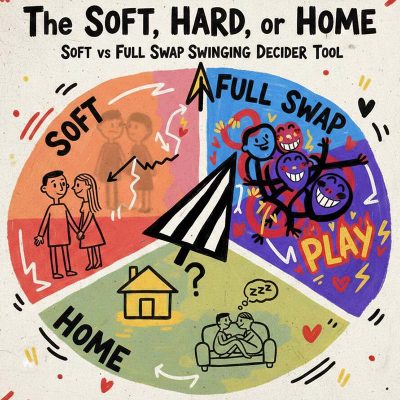
Don't let a "Soft Swap" night turn into a "Hard Feelings" morning.
Walking into the club with different expectations is a grenade waiting to explode. He thinks it’s a free-for-all; she thinks it’s just drinks and dancing. That silence in the car ride home? That’s the sound of a preventable disaster.
Stop guessing. Use this tool to sync your "sexual GPS" before you leave the driveway. Determine exactly how wild you’re getting tonight, so the only surprise is how much fun you have.
The fantasy of swinging is electric, but that cold sweat you feel when thinking about your partner with someone else? That’s your survival instinct warning you that your foundation is at stake. Most couples don’t fail because they lacked desire; they fail because they lacked a safety net. Ambiguity is where jealousy festers, and "winging it" is the fastest way to turn a dream into a nightmare of resentment and "what have we done?"
The Essential Guide to Swinging is your anxiety-proof roadmap through the chaos. Don't gamble your marriage on hope. Build a fortress of trust, master the repair chats, and ensure your exploration is defined by care, not a catastrophe
Full swap is the deep end. The rush is intense, but so is the risk of emotional wreckage. That tightening in your chest isn’t just nerves; it’s the fear that a "fun night" could become a permanent scar on your marriage. You can’t un-ring this bell, so never strike it without a plan.
The Essential Guide to Full Swap Swinging replaces reckless gambling with calculated discipline. From ironclad vetting to "emergency brake" scripts, we provide the safety architecture required to swap bodies without losing your minds. Don't just hope it goes well, engineer it
Gemini said
The fantasy is electric. The reality? It can be a grenade that blows up your marriage and your social circle. That tightening in your chest isn't just nerves. It is a warning that you are risking everything on a vibe. "Winging it" is the fastest way to turn a fun group chat into a toxic war zone.
The Essential Guide replaces the chaos with ironclad protocols. We provide the vetting tools, jealousy airlocks, and privacy scripts needed to swap bodies without losing your mind. Secure your safety first.
The fantasy of swinging is electric, but that cold sweat you feel when thinking about your partner with someone else? That’s your survival instinct warning you that your foundation is at stake. Most couples don’t fail because they lacked desire; they fail because they lacked a safety net. Ambiguity is where jealousy festers, and "winging it" is the fastest way to turn a dream into a nightmare of resentment and "what have we done?"
The Essential Guide to Swinging is your anxiety-proof roadmap through the chaos. Don't gamble your marriage on hope. Build a fortress of trust, master the repair chats, and ensure your exploration is defined by care, not a catastrophe
Full swap is the deep end. The rush is intense, but so is the risk of emotional wreckage. That tightening in your chest isn’t just nerves; it’s the fear that a "fun night" could become a permanent scar on your marriage. You can’t un-ring this bell, so never strike it without a plan.
The Essential Guide to Full Swap Swinging replaces reckless gambling with calculated discipline. From ironclad vetting to "emergency brake" scripts, we provide the safety architecture required to swap bodies without losing your minds. Don't just hope it goes well, engineer it
Why start with fantasy conversations
Who should start these conversations
In most cases one or both partners should take the lead depending on the situation. If you initiate you can set the tone as respectful and curious rather than pushy. It is important to invite feedback and to listen actively. The goal is to create a safe space where both people feel seen and heard. If you are the partner who tends to be more cautious you might want to invite your partner to share their thoughts while you confirm your own boundaries in a calm, non reactive way. Remember this is a team sport and you are building a shared playbook not a solo script.
How to prepare for a fantasy conversation
Preparation is the secret sauce. You want to come into the talk with clarity and a sense of safety for everyone involved. Here is a simple preparation plan you can use.
- Self reflection Spend time identifying your own desires and your boundaries. Write down a few core fantasies and a few hard limits you do not want to cross. Be honest with yourself about what truly matters to you.
- Identify non negotiables Decide what you cannot compromise on and what you might consider bending under certain conditions. This helps you communicate with confidence instead of reacting in the moment.
- Choose the right moment Find a time when you both feel calm and unhurried. A quiet evening at home or a weekend away can work well. Avoid moments of stress or conflict as the talk will be harder and less productive.
- Set a tone Begin with curiosity and care. Make it clear you want to explore together and you value your partner’s feelings as much as your own.
- Choose a format Decide whether to talk in person first, use a written note, or a combination of both. Some couples benefit from starting with a written prompt to reduce nerves.
How to start the actual conversation
The opening matters. You want to invite a conversation rather than demand a decision. Use I statements to keep the focus on your feelings and experiences rather than making statements about your partner. This helps keep defenses down and opens space for honest listening.
Opening script ideas
Here are some gentle, non pressuring openings you can tailor to your voice and situation.
- I have been thinking about our relationship and I would love to explore a few ideas with you when you feel ready. Could we talk about fantasies and boundaries together?
- I trust you and I want to understand what excites you. I also want to share a few thoughts about fantasies and how we might approach them safely.
- If you are curious about this, I would love to hear your thoughts first. I will share mine after we listen to each other for a while.
Developing a shared fantasy map
A fantasy map is a simple tool to organize thoughts and keep the conversation productive. It helps you both see what could be possible, what should be tested gradually and what should be avoided entirely. A map is not a commitment it is a living document you can revisit whenever you need to reassess feelings or boundaries.
Key elements of a fantasy map
- Core fantasies A list of fantasies you both find exciting. You can include things like watching a partner with another person or sharing a single experience with a couple in a safe setting.
- Boundaries Clear lines that you both agree on. Include soft boundaries which could be flexible and hard boundaries which are non negotiable.
- Triggers Topics or scenarios that cause stress or discomfort. Identifying these helps you pause before moving forward.
- Check in plan Decide how you will check in during and after a potential experience. This might include agreed times for a post experience talk and a plan for aftercare.
- Test steps Outline small steps you can take to test the fantasy in controlled ways. This reduces risk and helps you learn together.
Don't let a "Soft Swap" night turn into a "Hard Feelings" morning.
Walking into the club with different expectations is a grenade waiting to explode. He thinks it’s a free-for-all; she thinks it’s just drinks and dancing. That silence in the car ride home? That’s the sound of a preventable disaster.
Stop guessing. Use this tool to sync your "sexual GPS" before you leave the driveway. Determine exactly how wild you’re getting tonight, so the only surprise is how much fun you have.
The fantasy of swinging is electric, but that cold sweat you feel when thinking about your partner with someone else? That’s your survival instinct warning you that your foundation is at stake. Most couples don’t fail because they lacked desire; they fail because they lacked a safety net. Ambiguity is where jealousy festers, and "winging it" is the fastest way to turn a dream into a nightmare of resentment and "what have we done?"
The Essential Guide to Swinging is your anxiety-proof roadmap through the chaos. Don't gamble your marriage on hope. Build a fortress of trust, master the repair chats, and ensure your exploration is defined by care, not a catastrophe
Full swap is the deep end. The rush is intense, but so is the risk of emotional wreckage. That tightening in your chest isn’t just nerves; it’s the fear that a "fun night" could become a permanent scar on your marriage. You can’t un-ring this bell, so never strike it without a plan.
The Essential Guide to Full Swap Swinging replaces reckless gambling with calculated discipline. From ironclad vetting to "emergency brake" scripts, we provide the safety architecture required to swap bodies without losing your minds. Don't just hope it goes well, engineer it
Gemini said
The fantasy is electric. The reality? It can be a grenade that blows up your marriage and your social circle. That tightening in your chest isn't just nerves. It is a warning that you are risking everything on a vibe. "Winging it" is the fastest way to turn a fun group chat into a toxic war zone.
The Essential Guide replaces the chaos with ironclad protocols. We provide the vetting tools, jealousy airlocks, and privacy scripts needed to swap bodies without losing your mind. Secure your safety first.
The fantasy of swinging is electric, but that cold sweat you feel when thinking about your partner with someone else? That’s your survival instinct warning you that your foundation is at stake. Most couples don’t fail because they lacked desire; they fail because they lacked a safety net. Ambiguity is where jealousy festers, and "winging it" is the fastest way to turn a dream into a nightmare of resentment and "what have we done?"
The Essential Guide to Swinging is your anxiety-proof roadmap through the chaos. Don't gamble your marriage on hope. Build a fortress of trust, master the repair chats, and ensure your exploration is defined by care, not a catastrophe
Full swap is the deep end. The rush is intense, but so is the risk of emotional wreckage. That tightening in your chest isn’t just nerves; it’s the fear that a "fun night" could become a permanent scar on your marriage. You can’t un-ring this bell, so never strike it without a plan.
The Essential Guide to Full Swap Swinging replaces reckless gambling with calculated discipline. From ironclad vetting to "emergency brake" scripts, we provide the safety architecture required to swap bodies without losing your minds. Don't just hope it goes well, engineer it
Conversation formats you can use
Different formats work for different couples. You can mix formats as your comfort grows. The key is to keep communication open and ongoing.
In person conversations
In person conversations are ideal for nuance and reading body language. Create a calm environment and set expectations about staying respectful and patient. Use pauses to let feelings settle and avoid rushing to conclusions. You can capture important points by taking notes together so you both remember what you agreed on.
Text or written prompts
Some people find it easier to start with written prompts. A text message or a shared notepad can help you articulate complex feelings without pressure. After you exchange initial thoughts you can move to a live conversation with a clearer map in front of you.
Voice notes and recorded intros
Voice notes can be a useful bridge between text and in person talk. They give you an opportunity to hear tone and emotion without the pressure of speaking face to face right away. You can also record short clips to revisit later when you are ready to discuss further.
Prompts you can use right away
Below are ready to use prompts you can adapt. They are designed to be non assertive and to invite dialogue rather than compel action.
- What if we imagined a scenario where we meet another couple for a casual hangout first and then explore what feels exciting from there
- Would you be open to a conversation about watching one of us with someone else and how that could feel in a safe environment
- Are there any roles or dynamics that you find intriguing but not comfortable with yet
- What boundaries would make you feel safest in a scenario like this
- What would be a red line we should never cross and how can we recognize it early
- Would you like to create a date night plan to test a fantasy in small steps
Sample dialogue you can borrow and tailor
Here are neutral, non explicit dialogue snippets you can adapt to your voice. Remember to use I statements and invite feedback.
- Hey I have been thinking about our relationship and I would like to explore a fantasy with you. I want to know what excites you and what makes you nervous. Can we talk for a bit about boundaries and possibilities
- I love how much trust we have built. I would feel safer if we frame this as a map rather than a plan. Let us outline what would be on the table and what would stay off the table for now
- If we tried something together what would be a good first step for you that would feel comfortable and not scary
- Would you be willing to test this in a low risk way such as a movie night with a couple of close friends or in a social setting with clear boundaries before any private time
Realistic scenarios and learning through practice
Let us look at some everyday setups that illustrate how fantasy conversations can flow. These are not prescriptions but templates you can adapt. Each scenario includes potential boundaries and a reflection question to guide your next step.
Scenario one
You and your partner are curious about the idea of watching one another with another person during a casual setting. The conversation explores comfort with the idea of a shared moment with another adult. You discuss location, boundaries around what is allowed to happen physically and emotionally, and a post event debrief. After the talk you decide to try a supervised session with a trusted friend couple in a public space before attempting a private moment. Reflection question: How did the talk feel for you when you heard your partner share their imagination
Scenario two
You create a list of soft fantasies that you both find exciting. These include small acts such as kissing or light touch in a controlled environment. You agree to test one small element at a time during a monitored date night. You discuss aftercare and how you will check in after each step. Reflection question: What part of this felt most exciting and what caused hesitation
Scenario three
A couple wants to explore the possibility of meeting another couple at a private venue with clear safety arrangements. They agree on a pre event check in and a code word to pause if either partner feels uncomfortable. They decide to keep the first encounter very light and focus on conversation and connection more than any sexual activity. Reflection question: Does this plan reduce risk while still allowing exploration
Safety first in fantasy conversations
Safety is not a single moment it is an ongoing practice. In Swinging ENM safety includes physical health emotional safety and social safety. The following practices help keep everyone feeling secure and respected.
- Consent first Always get enthusiastic consent before moving forward. Consent is ongoing and can be paused or withdrawn at any time.
- Do not pressure If one person feels unsure the conversation should pause. You can return to it later or decide to table the idea altogether.
- Set boundaries Document clear boundaries that you both agree on. Revisit them regularly as feelings and circumstances change.
- Practice safer sex Discuss sexual health openly including STI status and testing. Agree on protective measures and how to handle health concerns if they arise.
- Aftercare matters Plan time after any emotional or physical exploration to reconnect. This can be a simple conversation a cuddle or a short debrief session about feelings and next steps.
Jealousy and how to handle it in ENM fantasy work
Jealousy is a natural emotion and it does not mean your relationship is failing. The goal is to handle jealousy in a way that strengthens trust rather than erodes it. When you notice jealousy rising try these steps.
- Acknowledge the feeling without judgment
- Pause and take a breath before responding
- Ask for clarification about what would help you feel safer
- Offer reassurance and identify actionable steps you can take together
- Revisit boundaries and adjust as needed
Common mistakes to avoid
Avoid rushing into decisions. Avoid assuming your partner will read your mind. Do not use fantasy conversations to manipulate or shame your partner. The aim is to build understanding and trust not to win a negotiation. Keep realistic expectations and allow time for feelings to settle.
Grown up with terms and acronyms explained
We want you to feel confident when you hear these terms in conversations or online. Add these to your glossary as you learn more.
Practical tips for ongoing fantasy conversations
Fantasy conversations are not a one time event. They are the start of an ongoing dialogue. Here are practical tips to keep this conversation alive and productive over time.
- Regular check ins help you stay aligned. Schedule a monthly or quarterly revisit to re evaluate boundaries and fantasies.
- Keep a shared journal or document where you both can add thoughts between talks. This helps you gather ideas and reflect on them later without pressure.
- Be explicit about what you want to try and what you want to avoid. Clarity reduces tension and confusion.
- Respect privacy and discretion. Not every fantasy is meant to be shared publicly and you do not owe anyone access to your intimate details.
- Celebrate small wins. Even a small step forward can bolster trust and deepen your connection.
Checklist before you step up to talk about fantasies
- Confirm both partners have time and are in a calm space for the talk
- Prepare a simple map with core fantasies and boundaries
- Decide on a format and a time frame for the conversation
- Agree on a signal to pause if the talk becomes too intense
- Agree on aftercare steps and a follow up plan
Putting it into practice
Now that you have the framework here is a short playbook you can use to bring fantasy conversations into your relationship with ease.
- Step one pick a calm moment and invite your partner to talk with you about fantasies and boundaries
- Step two explain why you want to explore these topics and how you hope it will improve trust and connection
- Step three share your core fantasies using I statements and invite feedback
- Step four listen actively and reflect back what you heard to confirm understanding
- Step five collaborate to create a simple map with a few test steps and a clear aftercare plan
Real life stories and learning from others
Hearing how others navigate fantasy conversations can help you feel less alone. Here are a few anonymized snippets and the lessons they taught us. Remember every couple is different and your path may look different but the principles remain the same trust openness and care.
- A couple found that starting with a written prompt allowed them to talk about fantasies without the stakes of a live conversation. After several exchanges they moved to an in person talk and gradually built a plan for a light test night that went well and strengthened their bond.
- Another couple used a shared journal to collect ideas and concerns. This helped them approach the conversation in small steps and prevented a single loud moment from derailing the discussion.
- A different pair discovered that their first fantasy involved intimacy boundaries that were not aligned. By pausing and recalibrating they uncovered a more comfortable shared fantasy that honored both of them.
Building a long lasting culture of healthy exploration
Ultimately the goal is to create a relationship culture that supports healthy exploration. This means ongoing consent honest communication and consistent care for each other. It means recognizing when a fantasy is not right for now and choosing to revisit later. It means building a partnership where both people thrive and feel seen and valued. When that happens you create a foundation that can weather the inevitable changes that come with life and love.
Glossary of useful terms and acronyms
Frequently asked questions
How do I start a fantasy conversation with my partner
Begin with a calm invitation and use I statements. For example say I have been thinking about our relationship and I would like to discuss some fantasies and boundaries when you have space for a calm conversation. Invite feedback and make it a mutual exploration rather than a demand.
What should I do if my partner reacts with fear or resistance
Give them time and space to process. Validate their feelings and ask what would make them feel safer. Propose starting with small steps or a written prompt to ease into the conversation. If fear continues consider pausing the topic and revisiting at a later time.
Is it possible to keep fantasies private while still being part of an ENM dynamic
Yes some fantasies may be explored privately or with a trusted partner while maintaining the boundaries and agreements that keep the primary relationship strong. Always discuss privacy expectations and ensure consent is clear for any sharing outside the couple.
How do I handle jealousy when fantasies involve others
Acknowledge jealousy as a natural signal. Use check ins and honest conversations to understand the source of the jealousy. Seek reassurance or adjust boundaries if needed. Practice compersion by focusing on your partner s happiness while maintaining your own boundaries.
Should we use scripts or prompts to guide fantasy conversations
Scripts and prompts can be a helpful starting point but they should not replace authentic dialogue. Use them to reduce anxiety and then adapt the conversation to fit your unique relationship voice and tone.
What if I want to try something but my partner is not ready
Respect the pace of your partner. You can still discuss your interest and revisit later. Perhaps agree to a non sexual exploration such as creating a shared fantasy map or attending a social event with others in a low risk way before any intimate activity occurs.
How often should we revisit our fantasies and boundaries
Make it a regular habit. Revisit every few months or after a major life event. Boundaries and comfort levels can shift over time and regular check ins keep you aligned.
What is a post talk aftercare routine look like
Aftercare can be a simple debrief where you both share what you felt during and after the conversation or experience. You can cuddle share a beverage and reflect on what worked and what did not. The goal is to reinforce care and trust in your relationship.
Don't let a "Soft Swap" night turn into a "Hard Feelings" morning.
Walking into the club with different expectations is a grenade waiting to explode. He thinks it’s a free-for-all; she thinks it’s just drinks and dancing. That silence in the car ride home? That’s the sound of a preventable disaster.
Stop guessing. Use this tool to sync your "sexual GPS" before you leave the driveway. Determine exactly how wild you’re getting tonight, so the only surprise is how much fun you have.
The fantasy of swinging is electric, but that cold sweat you feel when thinking about your partner with someone else? That’s your survival instinct warning you that your foundation is at stake. Most couples don’t fail because they lacked desire; they fail because they lacked a safety net. Ambiguity is where jealousy festers, and "winging it" is the fastest way to turn a dream into a nightmare of resentment and "what have we done?"
The Essential Guide to Swinging is your anxiety-proof roadmap through the chaos. Don't gamble your marriage on hope. Build a fortress of trust, master the repair chats, and ensure your exploration is defined by care, not a catastrophe
Full swap is the deep end. The rush is intense, but so is the risk of emotional wreckage. That tightening in your chest isn’t just nerves; it’s the fear that a "fun night" could become a permanent scar on your marriage. You can’t un-ring this bell, so never strike it without a plan.
The Essential Guide to Full Swap Swinging replaces reckless gambling with calculated discipline. From ironclad vetting to "emergency brake" scripts, we provide the safety architecture required to swap bodies without losing your minds. Don't just hope it goes well, engineer it
Gemini said
The fantasy is electric. The reality? It can be a grenade that blows up your marriage and your social circle. That tightening in your chest isn't just nerves. It is a warning that you are risking everything on a vibe. "Winging it" is the fastest way to turn a fun group chat into a toxic war zone.
The Essential Guide replaces the chaos with ironclad protocols. We provide the vetting tools, jealousy airlocks, and privacy scripts needed to swap bodies without losing your mind. Secure your safety first.
The fantasy of swinging is electric, but that cold sweat you feel when thinking about your partner with someone else? That’s your survival instinct warning you that your foundation is at stake. Most couples don’t fail because they lacked desire; they fail because they lacked a safety net. Ambiguity is where jealousy festers, and "winging it" is the fastest way to turn a dream into a nightmare of resentment and "what have we done?"
The Essential Guide to Swinging is your anxiety-proof roadmap through the chaos. Don't gamble your marriage on hope. Build a fortress of trust, master the repair chats, and ensure your exploration is defined by care, not a catastrophe
Full swap is the deep end. The rush is intense, but so is the risk of emotional wreckage. That tightening in your chest isn’t just nerves; it’s the fear that a "fun night" could become a permanent scar on your marriage. You can’t un-ring this bell, so never strike it without a plan.
The Essential Guide to Full Swap Swinging replaces reckless gambling with calculated discipline. From ironclad vetting to "emergency brake" scripts, we provide the safety architecture required to swap bodies without losing your minds. Don't just hope it goes well, engineer it
