
Trans and Nonbinary Inclusion in Lifestyle Spaces

Welcome to a guide that keeps it real while expanding the circle. The world of ethical non monogamy ENM and swinging is built on consent open communication and mutual respect. When we talk about inclusion we mean every person who wants to participate feels seen heard and safe. In this guide we focus on trans and nonbinary inclusion inside lifestyle spaces. We will unpack terminology provide practical steps and share realistic scenarios you can use in your own circles. If you are hosting an event a venue a club night or a private gathering or you are a couple exploring a new dynamic this guide is for you. Think of it as a friendly field manual from your experimental crew at The Monogamy Experiment. We aim to be funny honest and helpful while never losing sight of real life experience and human dignity.
Quick Links to Useful Sections
- Pronouns nicknames and the basics you should know
- A quick glossary you can carry in your pocket
- Why trans and nonbinary inclusion matters in ENM and swinging spaces
- Ethical considerations for organizers hosts and participants
- From profiles to play rooms how to make spaces welcoming
- Profiles and matchmaking
- Events and venues
- Group play and negotiation
- Language that respects and invites
- Real world scenarios and how to handle them with care
- Scenario one a new guest arrives with different pronouns
- Scenario two a long standing couple explores inviting a nonbinary friend into a scene
- Scenario three a partner uses a gendered label for the nonbinary guest
- Scenario four a misgendering incident occurs in a crowded space
- Scenario five someone feels excluded because of a body type or transition journey
- When boundaries cross the line and what to do about it
- Health safety and accessibility considerations for trans and nonbinary participants
- Linguistic and cultural sensitivity how to create inclusive norms that last
- Realistic expectations how inclusion influences the energy of a dynamic
- What you can do this week to start building inclusive practice
- Practical tips for individuals couples and organizers
- Practical resources and ongoing learning
- Checklist for inclusive practice in lifestyle spaces
- Glossary of useful terms and acronyms
- Frequently asked questions
Pronouns nicknames and the basics you should know
Before we dive into the practical stuff here is a quick primer. Trans describes someone whose gender identity differs from the sex they were assigned at birth. Nonbinary refers to someone who does not identify exclusively as male or female. Pronouns are the words a person uses to refer to themselves most often he him his she her hers they them theirs or other forms accepted by the individual. Pronouns are not about biology they are about respect. If you are unsure ask politely what pronouns someone uses and then use them consistently. You can extend this practice to name tags profiles and any written materials you share in a space. The key idea is to create spaces where pronouns and names are as normal as wearing a name badge at a big conference.
A quick glossary you can carry in your pocket
- ENM Ethical Non Monogamy a relationship framework that allows more than one consensual romantic or sexual relationship at a time with consent transparency and agreed boundaries.
- Swinging A subset of ENM focusing on sexual activities between couples or individuals with others in a non exclusive way within agreed rules.
- Trans Short for transgender a person whose gender identity differs from the sex they were assigned at birth.
- Nonbinary A gender identity that does not fit within the traditional binary of male or female.
- Pronouns The words used to refer to a person in third person or in conversation such as he him his she her hers they them theirs or other forms a person might choose.
- Pronoun prompt A friendly quick question or display asking people for their pronouns and preferred names.
- Safe space A setting where participants are committed to respect inclusivity and non harassment.
- Consent An ongoing and enthusiastic agreement to participate in any activity whether sexual emotional or relational.
- Affirming language Language that validates a person identity and experience without making assumptions.
- Misgendering Referring to a person with the wrong pronouns or gender identity.
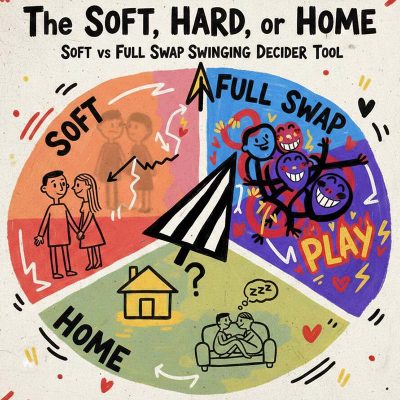
Don't let a "Soft Swap" night turn into a "Hard Feelings" morning.
Walking into the club with different expectations is a grenade waiting to explode. He thinks it’s a free-for-all; she thinks it’s just drinks and dancing. That silence in the car ride home? That’s the sound of a preventable disaster.
Stop guessing. Use this tool to sync your "sexual GPS" before you leave the driveway. Determine exactly how wild you’re getting tonight, so the only surprise is how much fun you have.
The fantasy of swinging is electric, but that cold sweat you feel when thinking about your partner with someone else? That’s your survival instinct warning you that your foundation is at stake. Most couples don’t fail because they lacked desire; they fail because they lacked a safety net. Ambiguity is where jealousy festers, and "winging it" is the fastest way to turn a dream into a nightmare of resentment and "what have we done?"
The Essential Guide to Swinging is your anxiety-proof roadmap through the chaos. Don't gamble your marriage on hope. Build a fortress of trust, master the repair chats, and ensure your exploration is defined by care, not a catastrophe
Full swap is the deep end. The rush is intense, but so is the risk of emotional wreckage. That tightening in your chest isn’t just nerves; it’s the fear that a "fun night" could become a permanent scar on your marriage. You can’t un-ring this bell, so never strike it without a plan.
The Essential Guide to Full Swap Swinging replaces reckless gambling with calculated discipline. From ironclad vetting to "emergency brake" scripts, we provide the safety architecture required to swap bodies without losing your minds. Don't just hope it goes well, engineer it
Gemini said
The fantasy is electric. The reality? It can be a grenade that blows up your marriage and your social circle. That tightening in your chest isn't just nerves. It is a warning that you are risking everything on a vibe. "Winging it" is the fastest way to turn a fun group chat into a toxic war zone.
The Essential Guide replaces the chaos with ironclad protocols. We provide the vetting tools, jealousy airlocks, and privacy scripts needed to swap bodies without losing your mind. Secure your safety first.
The fantasy of swinging is electric, but that cold sweat you feel when thinking about your partner with someone else? That’s your survival instinct warning you that your foundation is at stake. Most couples don’t fail because they lacked desire; they fail because they lacked a safety net. Ambiguity is where jealousy festers, and "winging it" is the fastest way to turn a dream into a nightmare of resentment and "what have we done?"
The Essential Guide to Swinging is your anxiety-proof roadmap through the chaos. Don't gamble your marriage on hope. Build a fortress of trust, master the repair chats, and ensure your exploration is defined by care, not a catastrophe
Full swap is the deep end. The rush is intense, but so is the risk of emotional wreckage. That tightening in your chest isn’t just nerves; it’s the fear that a "fun night" could become a permanent scar on your marriage. You can’t un-ring this bell, so never strike it without a plan.
The Essential Guide to Full Swap Swinging replaces reckless gambling with calculated discipline. From ironclad vetting to "emergency brake" scripts, we provide the safety architecture required to swap bodies without losing your minds. Don't just hope it goes well, engineer it
Why trans and nonbinary inclusion matters in ENM and swinging spaces
Inclusion is more than polite words it is about practice. Lifestyle spaces thrive when people feel welcomed acknowledged and safe to set boundaries speak up and participate. Trans and nonbinary folks bring new perspectives energy and curiosity to intimate conversations and play dynamics. When spaces are inclusive participants are more likely to engage openly with consent clear boundaries and honest communication. That reduces awkward moments misunderstandings and misfires that can cause harm. Inclusion also helps challenge harmful stereotypes and normalizes a wide range of bodies identities and experiences. That is not just a nice to have it changes the quality of connections and the ethics of the space.
There are two practical pillars you can build around right away. The first is language. The second is systems. Language is the daily substrate that makes people feel seen. Systems are the structures you build into events apps and group norms to keep that feeling consistent over time. Both together create a culture where safety trust and curiosity can grow.
Ethical considerations for organizers hosts and participants
Hosting or participating in ENM spaces means taking responsibility for the climate of the room. You are not just arranging a party you are curating a social experience. Here are core considerations to guide every event from a casual house party to a formal play night.
- Consent loops check in with people before inviting them into intimate spaces and keep doors open for soft no or pause anytime. Consent is ongoing and can be withdrawn at any moment without judgment.
- Pronoun respect invite use verify and consistently apply preferred pronouns. If you make a mistake apologize briefly and move on using the correct pronouns going forward.
- Names matter use the names people choose even if you previously knew them by a different name. A person name is part of their identity and respect matters.
- Explicit safe play boundaries publish clear boundaries and expectations before an event especially for any group activities or partnered experiences. People should have a simple way to say no or stop at any moment.
- Privacy discuss what is allowed to be shared outside of the space. A lot of people care about whether their identities or bodies are public or private in photos stories and social media.
- Accessibility and comfort consider different comfort levels including sensory needs accessibility physical safety and emotional workload. For some people a loud crowded space is exhilarating for others it is draining or triggering.
- Nonfetishizing approach treat every participant as a full person with preferences and boundaries not as a fantasy element or a curiosity. This helps prevent objectification and respects personal agency.
From profiles to play rooms how to make spaces welcoming
Practical steps can move your vibe from friendly to genuinely inclusive without turning every event into a lab experiment. Here are actionable movements for different layers of your lifestyle environment.
Profiles and matchmaking
Trans and nonbinary people frequently navigate dating spaces that rely on gendered filters or limited pronoun options. When you set up profiles for groups or apps or when you run a matchmaking process for a party consider the following:
- Provide a clearly visible pronoun field and name field that cannot be edited by other users without consent.
- Include a short note inviting people to share how they identify and what they are looking for in a respectful way.
- Avoid implying that certain identities are expected for participation or that a dynamic must fit a binary model in order to join.
In practice it means when someone starts a conversation or a date you can say I see you use they them pronouns would you share your preferred name and boundaries for this interaction. This small script opens a respectful path forward.
Events and venues
When you curate a space such as a swing event or a club night these questions matter:
- Is the venue accessible and comfortable for people with diverse gender expressions and bodies?
- Are there private spaces and quiet corners for conversations where someone can step away if needed?
- Are there staff volunteers or safety monitors trained to recognize and respond to misgendering harassment or boundary crossing?
- Do you offer clear signage about pronouns name displays and consent expectations?
Signage is part of the fabric of safety. A simple clear policy on pronouns visible at the entrance and in the loop of event communications can set a tone that inclusion is a core value not an after thought.
Group play and negotiation
Play nights are about chemistry and consent. A few practical moves help include trans and nonbinary participants without slowing down the momentum:
- Start with a general consent overview before activities begin and remind people that boundaries can be adjusted at any time.
- Encourage participants to state pronouns and names at the start of each new interaction within the group.
- Offer a neutral facilitator who can help interpret and mediate if a miscommunication arises in the moment.
- Make it easy to pause a scene and redress if someone feels uncomfortable or if someone misgenders another participant.
Language that respects and invites
Words shape reality in life drawing as well as relationship building. Practice these language shifts today:
- Use inclusive terms that do not assume gender expressions identity or sexual orientation as the default.
- Avoid making assumptions about what someone wants based on their appearance or the way they move.
- When referring to someone created roles such as partner or play partner ask for consent before inserting labels that may not fit every person.
- When in doubt ask and respect the answer you receive even if it changes the plan.
Real world scenarios and how to handle them with care
Let us walk through some everyday moments you might encounter in a swinging ENM setting and how to handle them with fairness and respect. These vignettes are not instructions for performing or fetishizing but templates for responsible interaction.
Scenario one a new guest arrives with different pronouns
Scenario details and approach. A guest arrives and introduces themselves with pronouns they use. You may hear someone else use the wrong pronouns in conversation. Address it calmly and publicly if needed and privately with the person who misgendered them. The response should reinforce the correct pronouns for the guest and explain that pronoun use is a sign of respect for everyone involved. The guest should feel welcomed and safe without feeling singled out or shamed.
Scenario two a long standing couple explores inviting a nonbinary friend into a scene
How to handle this with sensitivity. The couple should first check in with the nonbinary friend about boundaries safety and comfort in this specific scene. They should then communicate clearly to the group what they are inviting and how it will work. The nonbinary guest should be given space to express any limitations or preferences regarding costume roles or styling for example. The focus remains on clear consent and mutual enjoyment not on labels or stereotypes.
Scenario three a partner uses a gendered label for the nonbinary guest
What to do in the moment. If a participant uses a gendered label like sir or madam for someone nonbinary gently correct and model the appropriate language for the situation pronouns and preferred name included. A quick honest correction is enough to realign the dynamic with respect while keeping the energy in the room positive and comfortable.
Scenario four a misgendering incident occurs in a crowded space
In this case the priority is safety and de escalation. A staff member or trusted host can approach the person who misgendered with a concise respectful reminder that pronouns were not used correctly and that correcting it helps everyone feel safe. The person who was misgendered should have the option to step away or to continue with the event as they prefer. After the incident follow up with the affected person privately to apologize and reinforce the correct language moving forward.
Scenario five someone feels excluded because of a body type or transition journey
Inclusion means making space for difference. A good response is to acknowledge the feeling validate their experience and offer optional activities that connect with their interests. If a person feels uneasy with certain activities you can propose alternatives or schedule a different time for those experiences. The goal is to keep people in the group feeling seen and welcomed while honoring their boundaries.
When boundaries cross the line and what to do about it
Every space has a potential for boundary crossing. The key is to have a plan that prioritizes safety fairness and accountability. Here is a practical boundary script you can adapt:
- State the boundary in clear terms before participating in any activity
- Invite feedback and acknowledge any concerns
- Pause if someone requests a boundary check or if a line has been crossed
- Redirect to a comfortable activity or community member if issues cannot be resolved quickly
In all cases the goal is to keep participants feeling safe heard and connected. You do not gain anything by powering through if someone is uncomfortable or if a line has been crossed. A pause and a respectful reset are signs of leadership not weakness.
Don't let a "Soft Swap" night turn into a "Hard Feelings" morning.
Walking into the club with different expectations is a grenade waiting to explode. He thinks it’s a free-for-all; she thinks it’s just drinks and dancing. That silence in the car ride home? That’s the sound of a preventable disaster.
Stop guessing. Use this tool to sync your "sexual GPS" before you leave the driveway. Determine exactly how wild you’re getting tonight, so the only surprise is how much fun you have.
The fantasy of swinging is electric, but that cold sweat you feel when thinking about your partner with someone else? That’s your survival instinct warning you that your foundation is at stake. Most couples don’t fail because they lacked desire; they fail because they lacked a safety net. Ambiguity is where jealousy festers, and "winging it" is the fastest way to turn a dream into a nightmare of resentment and "what have we done?"
The Essential Guide to Swinging is your anxiety-proof roadmap through the chaos. Don't gamble your marriage on hope. Build a fortress of trust, master the repair chats, and ensure your exploration is defined by care, not a catastrophe
Full swap is the deep end. The rush is intense, but so is the risk of emotional wreckage. That tightening in your chest isn’t just nerves; it’s the fear that a "fun night" could become a permanent scar on your marriage. You can’t un-ring this bell, so never strike it without a plan.
The Essential Guide to Full Swap Swinging replaces reckless gambling with calculated discipline. From ironclad vetting to "emergency brake" scripts, we provide the safety architecture required to swap bodies without losing your minds. Don't just hope it goes well, engineer it
Gemini said
The fantasy is electric. The reality? It can be a grenade that blows up your marriage and your social circle. That tightening in your chest isn't just nerves. It is a warning that you are risking everything on a vibe. "Winging it" is the fastest way to turn a fun group chat into a toxic war zone.
The Essential Guide replaces the chaos with ironclad protocols. We provide the vetting tools, jealousy airlocks, and privacy scripts needed to swap bodies without losing your mind. Secure your safety first.
The fantasy of swinging is electric, but that cold sweat you feel when thinking about your partner with someone else? That’s your survival instinct warning you that your foundation is at stake. Most couples don’t fail because they lacked desire; they fail because they lacked a safety net. Ambiguity is where jealousy festers, and "winging it" is the fastest way to turn a dream into a nightmare of resentment and "what have we done?"
The Essential Guide to Swinging is your anxiety-proof roadmap through the chaos. Don't gamble your marriage on hope. Build a fortress of trust, master the repair chats, and ensure your exploration is defined by care, not a catastrophe
Full swap is the deep end. The rush is intense, but so is the risk of emotional wreckage. That tightening in your chest isn’t just nerves; it’s the fear that a "fun night" could become a permanent scar on your marriage. You can’t un-ring this bell, so never strike it without a plan.
The Essential Guide to Full Swap Swinging replaces reckless gambling with calculated discipline. From ironclad vetting to "emergency brake" scripts, we provide the safety architecture required to swap bodies without losing your minds. Don't just hope it goes well, engineer it
Health safety and accessibility considerations for trans and nonbinary participants
Health and safety are universal concerns in any play environment. Trans and nonbinary participants may have unique needs tied to anatomy growth or gender affirming care. Here is how you can be thoughtful without being overbearing:
- Provide information about safer sex practices inclusive of different bodies and medical considerations. Do not assume one size fits all.
- Offer discreet changing areas and privacy options for participants who may want privacy during transitions or adjustments.
- Ensure that bathrooms are not gendered in a way that forces anyone into uncomfortable situations. If possible provide neutral options and clear signage.
- Train staff and volunteers to respond with care to incidents that could escalate into harassment or discrimination.
Sexual health conversations can feel awkward and should be handled with respect and clarity. The aim is to normalize practical safety information while preserving the dignity and autonomy of every participant.
Linguistic and cultural sensitivity how to create inclusive norms that last
Inclusion is not a one time checklist it is an ongoing process. Here is how you can build durable inclusive norms into your organization and your social routines.
- Make pronoun and name fields a standard part of every profile and every check in at events. Update them as needed and treat changes with respect.
- Regularly invite feedback from participants about what is working and what could be improved. Use surveys or open dialogue sessions with a trusted facilitator.
- Publish a concise inclusive policy that explains expectations around language consent and interaction. Place it where attendees can read it before participating.
- Lead by example. The hosts and organizers should model inclusive language and demonstrate how boundaries are treated with care and seriousness.
Realistic expectations how inclusion influences the energy of a dynamic
In a dynamic that welcomes diverse gender identities including trans and nonbinary people you will notice more nuanced conversations more creativity and often stronger mutual care. People bring their own experiences which can enrich the energy of a night lead to deeper connections and safer more meaningful play. You may also need more time to calibrate energy or to adjust plans as you learn together. Patience consistency and a willingness to adapt are your best tools here. The payoff is a vibrant community where people feel truly seen and valued.
What you can do this week to start building inclusive practice
- Ask attendees to share their pronouns and preferred names in a simple form or on name tags
- Review your event guides and staff training materials to ensure your language and policies are explicitly inclusive
- Invite feedback from recent participants about inclusivity and safety and commit to one concrete improvement
- Offer a dedicated safety contact for disclosures privacy concerns or boundary issues
Practical tips for individuals couples and organizers
- Always ask about pronouns instead of assuming based on appearance or style
- Respect every person as an autonomous participant with their own boundaries and desires
- Use inclusive language that avoids gendered stereotypes about bodies or behavior
- Provide options for privacy and boundaries that feel safe for everyone
- Keep communication channels open before during and after events
Practical resources and ongoing learning
Learning is ongoing and the landscape evolves. Here are some friendly starting points you can explore to deepen your understanding and improve your practice:
- Podcasts focused on ENM life and gender diversity
- Books and articles on consent communication and inclusive language
- Workshops or facilitated discussions on transgender nonbinary inclusion in group spaces
- Supportive online communities where you can ask questions and share experiences
Checklist for inclusive practice in lifestyle spaces
- Pronouns and preferred names are clearly visible on profiles name tags and event materials
- Consent is explicit ongoing and revisited in every new interaction
- Harassment or misgendering is addressed immediately with clear corrective action
- Privacy privacy privacy a person should be able to disclose what they want to about their identity and boundaries
- Accessibility and comfort are central to every plan from venue choice to session scheduling
Glossary of useful terms and acronyms
- ENM Ethical Non Monogamy a framework that supports multiple romantic or sexual connections with consent and clear boundaries
- Swinging A form of ENM typically involving couples and sometimes single participants who engage in sexual activities together within agreed rules
- Trans A person whose gender identity differs from the sex assigned at birth
- Nonbinary A person whose gender identity is not exclusively male or female
- Pronouns Words used to refer to a person such as he him his she her hers they them theirs and other forms that a person may choose
- Misgender To refer to someone with the wrong gender identity or pronouns
- Inclusive language Language that affirms a person identity and avoids making assumptions
Frequently asked questions
How can I ensure I am using correct pronouns and names
Start by asking the person what pronouns and name they prefer. Write them down and use them consistently. If you make a mistake acknowledge it briefly apologize and move on using the correct form. Do not draw attention to the error or make a big scene.
What should I do if I misgender someone
Apologize briefly acknowledge the mistake and correct yourself. Then continue with the conversation using the correct pronouns. If the person wants to discuss it later offer a private moment or follow up later in a respectful way.
How do I handle a situation where someone feels unsafe or harassed
Act quickly. Separate the persons involved offer support to the affected person and remove any potential trigger from the environment if possible. Document the incident follow up with the affected person and review safety policies to prevent future occurrences.
Can a nonbinary person participate in a traditionally gendered activity
Yes if all participants consent and the activity is adjusted to respect the nonbinary person. The important thing is to discuss expectations ahead of time and to adapt the experience to include the person comfortably.
What does consent look like in a mixed gender space
Consent is clear enthusiastic and ongoing. Before any activity check in with everyone involved and invite explicit yes from all parties. If anyone hesitates or withdraws consent the activity should stop and alternatives explored.
How can event organizers make spaces more inclusive
Provide pronoun name displays offer staff training and set clear inclusive policies. Create a feedback loop so participants can share concerns without fear. Ensure there are private spaces for individuals who need a break or who prefer less crowded environments.
Is it okay to discuss gender and pronouns in public spaces
Yes as long as the conversation is respectful and inclusive. Encourage questions when they are asked with kindness and a genuine interest in learning. Avoid making anyone feel singled out or uncomfortable.
What if someone asks about a participant gender identity
Respect privacy. Do not disclose someone identity without their explicit consent. If identity information is relevant to a safety or consent context share only what is necessary and only with those who need to know.
Don't let a "Soft Swap" night turn into a "Hard Feelings" morning.
Walking into the club with different expectations is a grenade waiting to explode. He thinks it’s a free-for-all; she thinks it’s just drinks and dancing. That silence in the car ride home? That’s the sound of a preventable disaster.
Stop guessing. Use this tool to sync your "sexual GPS" before you leave the driveway. Determine exactly how wild you’re getting tonight, so the only surprise is how much fun you have.
The fantasy of swinging is electric, but that cold sweat you feel when thinking about your partner with someone else? That’s your survival instinct warning you that your foundation is at stake. Most couples don’t fail because they lacked desire; they fail because they lacked a safety net. Ambiguity is where jealousy festers, and "winging it" is the fastest way to turn a dream into a nightmare of resentment and "what have we done?"
The Essential Guide to Swinging is your anxiety-proof roadmap through the chaos. Don't gamble your marriage on hope. Build a fortress of trust, master the repair chats, and ensure your exploration is defined by care, not a catastrophe
Full swap is the deep end. The rush is intense, but so is the risk of emotional wreckage. That tightening in your chest isn’t just nerves; it’s the fear that a "fun night" could become a permanent scar on your marriage. You can’t un-ring this bell, so never strike it without a plan.
The Essential Guide to Full Swap Swinging replaces reckless gambling with calculated discipline. From ironclad vetting to "emergency brake" scripts, we provide the safety architecture required to swap bodies without losing your minds. Don't just hope it goes well, engineer it
Gemini said
The fantasy is electric. The reality? It can be a grenade that blows up your marriage and your social circle. That tightening in your chest isn't just nerves. It is a warning that you are risking everything on a vibe. "Winging it" is the fastest way to turn a fun group chat into a toxic war zone.
The Essential Guide replaces the chaos with ironclad protocols. We provide the vetting tools, jealousy airlocks, and privacy scripts needed to swap bodies without losing your mind. Secure your safety first.
The fantasy of swinging is electric, but that cold sweat you feel when thinking about your partner with someone else? That’s your survival instinct warning you that your foundation is at stake. Most couples don’t fail because they lacked desire; they fail because they lacked a safety net. Ambiguity is where jealousy festers, and "winging it" is the fastest way to turn a dream into a nightmare of resentment and "what have we done?"
The Essential Guide to Swinging is your anxiety-proof roadmap through the chaos. Don't gamble your marriage on hope. Build a fortress of trust, master the repair chats, and ensure your exploration is defined by care, not a catastrophe
Full swap is the deep end. The rush is intense, but so is the risk of emotional wreckage. That tightening in your chest isn’t just nerves; it’s the fear that a "fun night" could become a permanent scar on your marriage. You can’t un-ring this bell, so never strike it without a plan.
The Essential Guide to Full Swap Swinging replaces reckless gambling with calculated discipline. From ironclad vetting to "emergency brake" scripts, we provide the safety architecture required to swap bodies without losing your minds. Don't just hope it goes well, engineer it
